'Everything' in Cuba needs to change, Cubans say in rare nationwide poll
Published in News & Features
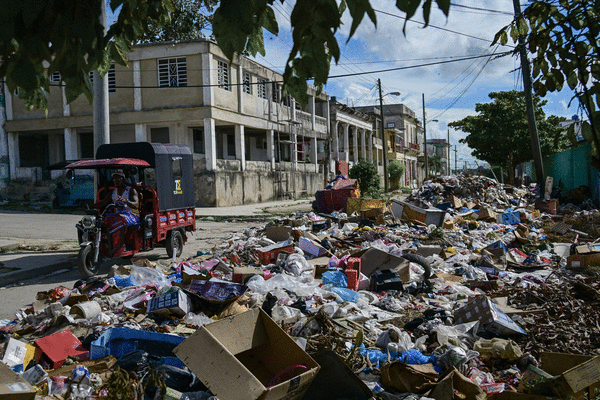
An overwhelming majority of Cubans say their country is heading in the wrong direction and 78% say it needs “serious and urgent change,” according to a rare nationally representative survey carried out through face-to-face interviews inside the island and released Wednesday.
The poll, conducted for the Washington-based International Republican Institute by NORC at the University of Chicago, a research organization formerly known as the National Opinion Research Center, paints a picture of a government that has lost the backing of its people.
Unlike previous surveys that relied on online volunteers, this new nationally representative poll used in-person interviews across Cuba’s urban and rural regions, reaching people who are not connected to the internet. Its findings echo two other surveys published this year — Americas Barometer survey and a poll led by Cuban media outlet el Toque —which found overwhelming dissatisfaction with the government, widespread economic hardship and strong support for political change. Despite their different methodologies and limitations, all three polls point to the same conclusion: Cubans want change, and they want it now.
Eighty-five percent of respondents strongly disagree that the current government represents them, and the same share strongly disagree that the current system is the most suitable one for Cuba. Eighty-two percent say the country is governed in the interest of some groups, against 12% who say it is governed for the majority. Just 8% think Cuba is on the right track.
The verdict on the government’s record is just as stark. Asked to name its most important accomplishment, 69% answered “nothing.” Asked to name its biggest failure, the most common answer, at 30%, was “everything.” Eighty-two percent strongly disagree that the government is doing enough to address the needs of people like them.
The appetite for change is broad. When asked, without prompting, what most needs to change in Cuba, the most common specific answer was “the government” (18%), while another 21% said “everything.” Only 10% prefer gradual change that preserves the existing system, and 7% say Cuba has to be protected from those who want to change the current order.
The poll lands as Cuba endures a deepening humanitarian crisis and escalating tensions with the Trump administration. Still, Cuba’s leaders have dug in their heels: Díaz-Canel said in an interview he would not step down, and his government insists Cuba’s communist system is not up for negotiation.
Unlike other recent attempts to gauge Cuban opinion, which relied on online questionnaires, this survey was done in person. Between July 22 and Sept. 7, 2026, interviewers visited 1,199 Cubans aged 18 and older in their homes and recorded their answers electronically. The margin of error is up to plus or minus 4.2 percentage points.
Young Cubans are the most critical
Discontent runs deepest among the young, the survey shows. Ninety percent of Cubans aged 18 to 35 say the country is going in the wrong direction, compared with 80% of those 56 and older. Eighty-five percent of the youngest group call for serious, urgent change, compared with 72% of the oldest. And 89% of young adults strongly disagree that the government is doing enough for people like them, compared with 77% of those 56 and older.
The survey does identify a smaller core that is more sympathetic to the system and warier of change. Nineteen percent of all Cubans, roughly one in five, say nothing needs to change in the country. That view is concentrated among older Cubans: 26% of those 56 and older say nothing needs to change, compared with 17% of those 36 to 55 and 12% of those 18 to 35.
Older respondents are also the most likely to say Cuba must be protected from those who want to change the current order (10%, against 6% of the youngest group), that the country is governed in the interest of the majority (18%), and that it is heading in the right direction (12%).
Yet even among older Cubans, assessments of the government’s performance are overwhelmingly negative. Seventy-seven percent of those 56 and older strongly disagree that the government is doing enough to address their needs, 80% say the country is heading in the wrong direction, and 72% say it needs serious and urgent change. Fifty-seven percent of them describe their household’s economic situation as very bad, and 48% say they have trouble feeding themselves and their families.
Díaz-Canel at the bottom, below Raúl Castro
As in other recent polls, Cuba’s handpicked president Miguel Díaz-Canel remains a deeply unpopular figure. Seventy-six percent of Cubans hold a highly unfavorable opinion of him and just 1% hold a highly favorable one. That puts him below Prime Minister Manuel Marrero (74% highly unfavorable) and below former president Raúl Castro, still considered the leader of the revolution, whom 69% view very unfavorably.
The survey also measured opinions about two younger members of the Castro family who have gained prominence this year. Raúl Guillermo Rodríguez Castro, Raúl Castro’s grandson and former head of his personal security, known in Cuba as “El Cangrejo,” has led backchannel conversations with Washington. Seventy percent of Cubans view him highly unfavorably and 7% somewhat unfavorably. Eight percent said they had never heard of him.
Deputy Prime Minister Oscar Pérez-Oliva Fraga, a grandnephew of Fidel and Raúl Castro who also serves as minister of foreign trade and investment, is the least known of the five: 19% said they had not heard of him.
Asked which politician or public figure they trust most, 73% of Cubans named no one. Fidel Castro, who died in 2016, was the top choice of 3%. Díaz-Canel was named first by 2%.
Little faith in institutions
GAESA, the military-controlled conglomerate that manages many of Cuba’s key economic sectors, draws a highly unfavorable rating from 64% of Cubans. But the conglomerate, a frequent target of U.S. sanctions, remains an unknown to a significant share of the population: 14% said they had never heard of it and another 15% did not know or declined to give an opinion. The conglomerate was led until his death in 2022 by Luis Alberto Rodríguez López-Calleja, Rodríguez Castro’s father.
The poll points to a broader collapse of trust in Cuban institutions. Seventy-eight percent of Cubans hold a highly unfavorable view of the Communist Party, the same share as for the National Revolutionary Police and the Committees for the Defense of the Revolution, the neighborhood-level groups through which the state has long organized and monitored daily life. The National Assembly of People’s Power fares slightly worse, at 79% highly unfavorable, and the state-run stores that sell goods in hard currency are rated highly unfavorably by 76%.
The one exception is religious institutions, which 29% of Cubans view highly favorably and 31% somewhat favorably.
The question about trusted public figures also suggests how far the erosion reaches. Beyond the 73% who trust no public person, the few names Cubans did volunteer were often not politicians at all: the family doctor was the top choice of 3%, and a neighbor and “my mother” were each named first by 1%.
Cubans also describe a system in which they have no voice. Eighty-seven percent strongly disagree that ordinary people can influence decisions made in Cuba, 85% strongly disagree that they can protest in public if they disagree with the government, and 87% strongly disagree that the media are free to report without being told what to publish. Sixty-eight percent call corruption a very serious problem.
The political rejection comes against the backdrop of a deep economic crisis. Fifty-three percent of Cubans describe their household’s economic situation as very bad, and 44% say they have trouble feeding themselves and their families and buying even the most essential things. Forty-five percent say their household’s situation worsened a lot in the past six months. Food is the heaviest burden on the household budget for 65% of respondents.
Electricity was the most frequently cited problem facing the country, mentioned by 40% as the first or second most important. Ninety-one percent say the government is doing a very bad job providing electricity and fuel, and the same share say so about providing food through the libreta, the ration card.
_____
©2026 Miami Herald. Visit miamiherald.com. Distributed by Tribune Content Agency, LLC.




Comments