As king tides hit Southern California on Thanksgiving, some residents grateful it wasn't worse
Published in News & Features
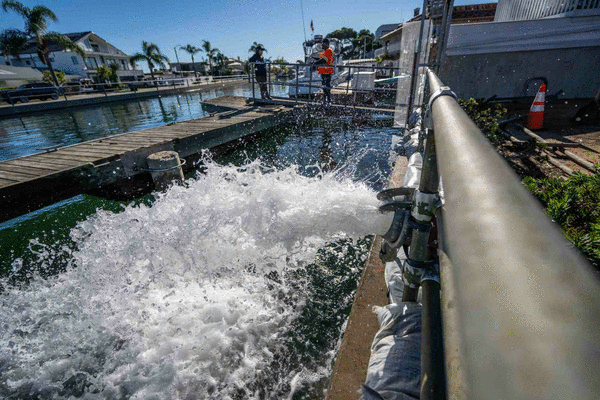
With a third day of king tides battering the Southern California coast on Thanksgiving Day, the forecast of heavier surf added to the unease of residents already on the lookout for flooding.
A high tide of about 8 feet arrived between 9 and 10 a.m., while large breaking waves were anticipated throughout the day in Los Angeles County, ranging from 6 to 11 feet and accompanied by dangerous rip currents, forecasters said.
The Manhattan Beach and Hermosa Beach piers were temporarily closed because of the high surf and hazardous conditions, those cities reported on Thursday morning.
In Orange County, a coastal flood warning is in effect through 1 p.m. Friday. King tides were expected to approach a near-record 8 feet on Thursday morning, the National Weather Service said, along with breaking waves of 4-6 feet and local sets of 7-8 feet on west-facing beaches.
But cities and residents have spent weeks preparing for this week’s king tides with sandbags and tarps, and deploying pumps and other devices to divert water.
And on Thursday, some were indeed thankful.
Suzanne Burke said she canceled plans to visit family in Tennessee over the Thanksgiving holiday to guard her Bayview Drive house in Sunset Beach, where she’s lived in for 47 years.
“I couldn’t not be here to defend my home,” she said.
After the October floods filled her garage with 8 inches of water, Burke enlisted the help of a neighbor to build a moat of 2,000 sandbags around the property. The record high tide Wednesday – 8.3 feet in Huntington Beach – flooded her driveway, but no water intruded into the house.
She’s now decided to spend Christmas in Tennessee, nervous that the moat may not hold down what’s expected to be even higher tides next month.
For some, the stress of the damage caused by a series of recent high tides has made Thanksgiving an afterthought.
Along 66th Place, at one of the red-tagged homes along the Long Beach Peninsula, homeowner Abe Green and his wife were getting some items from their residence Wednesday before heading back to Los Angeles to spend Thanksgiving with family and friends.
“This is our house, so we’re not real happy,” Green said as he stood outside of his damaged home. “I don’t have any gushing feelings about how sad it is to not have Thanksgiving here, but still dealing with the economic impact of what has to be done. We met with contractors and engineers today, and they’ve given us figures that we didn’t allot for in our lives.
“We’re hoping that next Thanksgiving will be a better one,” Green said. “We’re going to figure out what we have to do and somehow bounce back.”
City public works employee Ray Lara was out with other crew members since 4 a.m. on Naples Island in Long Beach on Thursday, monitoring the situation along the Naples Canal and pumping water as needed.
Around 8:45 a.m., he said the situation appeared under control, with about two or three pumps operating in various spots on the island and another three pumps on standby. Crew members would be out each day through Sunday, he said.
A number of people were out for morning strolls, some with young children or dogs as kayakers and paddle boarders navigated along the canal. No major flooding was seen.
John Satariano grew up on Naples Island and has lived there on and off for 50 years.
The state replaced parts of the seawall along the canal about 10 years ago, he said, adding that in hindsight, the wall perhaps should have been built higher. Shortly after 9 a.m., the water level had risen to about a foot below the top of the wall.
One man said the water level was about 5 inches to the top of the wall the day before. Another couple said the water is usually 4 to 5 feet below the top of the seawall.
Water levels notwithstanding, Satariano said residents on Naples aren’t “freaking out” over the tides.
“When you live near the water, you have to expect it’s not going to be the same every day,” he said.
King tides, driven by gravitational pull, are typically the highest tides of the year and are being driven even higher this week because of warm water conditions from the developing El Niño and other factors.
But this year brought a different, earlier deluge. It began in September, when the region was battered by waves from a string of storms that left several beachfront homes in Long Beach and Dana Point red-tagged. Then unusually warm water conditions caused higher-than-expected tides in October, and many low-lying coastal neighborhoods were swamped. More than 100 homes and businesses in Huntington Beach were flooded.
Looking ahead
Timu Gallien, an associate professor of civil and environmental engineering at UCLA who directs its Coastal Flood Lab, said the bigger waves expected in some areas on Thursday could cause more erosion along the Malibu coast, particularly at already vulnerable spots such as Westward Beach. The county has been carrying out emergency erosion repairs at that beach, and crews were placing big boulders as protection Wednesday, according to county officials.
“The tide level will be similar. The difference will be we’re expecting a fair amount of wave energy, and particularly on Thursday morning,” Gallien said. “And it’s those waves that often cause erosion.”
Gallien said rock barriers can be effective at protecting roads and other infrastructure, but they come with a tradeoff: They can also leave less sandy beaches for people to enjoy.
“If you dump a bunch of rocks on your beach to protect the Pacific Coast Highway… then all you have is rocks. That’s not the same beach,” she said.
Gallien described king tides as a glimpse of what coastal communities could face as sea levels rise, and said they offer an opportunity to consider longer-term resolutions, such as living shorelines – a method that uses plants, sand, stone, and other materials to stabilize coasts and preserve habitats – rather than relying on emergency fixes. She noted that California has already begun exploring longer-term approaches.
And maintaining emergency protections will become harder as sea levels rise, she added.
Another round of unusually high tides is expected around Dec. 24, followed by another around Jan. 20, Gallien said. Whether those events cause significant damage will depend in large part on whether powerful waves coincide with the highest tides. She pointed to the 1982-83 El Niño winter, when large waves and high tides arrived together and caused widespread damage.
As he manned pumps in River Avenue and 42nd Street in Newport Beach Wednesday after the tides had receded, Adam Sanabria, who works for a contractor, raised concerns about lasting damage from all the recent flooding. He said despite the pumps, some water came up at cracks and weak spots in the nearby sidewalk and roadway.
“I think a big challenge for the city will be underground roadwork. They need to make sure there are no gaps between sidewalks and the ground below them,” he said. “That’s how sinkholes are created.”
High tides and surf have begun undermining asphalt near an overlook along the lower access road to White Point and Royal Palms beaches in San Pedro, according to the Los Angeles County Department of Beaches and Harbors.
Department spokesperson Nicole Mooradian said Wednesday the asphalt near a bench at the overlook was beginning to collapse, prompting crews to cordon off the area. County staff were monitoring the area because the road provides access to a lower parking lot, restrooms and Royal Palms Beach.
In Redondo Beach, sand has washed away along the shoreline, particularly between Topaz Street and the pier, Mooradian said Wednesday.
But Drew Blaisdell, a Los Angeles County Fire Department lifeguard, said on Wednesday that Zuma, Point Dume and Malibu Surfrider beaches were looking better after west swells over the past two weeks brought sand back to areas previously eroded by south swells.
Although tides remain high, he said, there appears to be enough sand to protect vulnerable areas for now.
_____
Teresa Liu, Christina Merino and Erika I. Ritchie contributed to this report.
_____
©2026 MediaNews Group, Inc. Visit ocregister.com. Distributed by Tribune Content Agency, LLC.






Comments