Q&A: Suzanne Vega cites her inspirations: Bob Dylan, Marc Chagall and NYC rats
Published in Entertainment News
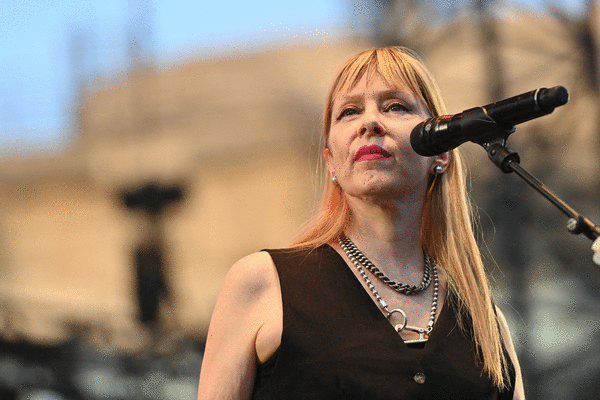
ANAHEIM, Calif. — For singer-songwriter Suzanne Vega, inspiration for a song can arrive from anywhere at any time.
On her new album, “Flying With Angels,” the song “Last Train From Mariupol” arrived with news from the war in Ukraine. “Speakers’ Corner” stemmed both from a pandemic crisis and the still-looming threats to American’s freedom of speech.
“Rats” is a punky, fun narrative about the vermin that plague her hometown of New York City.
And then there’s “Chambermaid,” inspired by Bob Dylan’s classic song “I Want You,” and “Lucinda,” a tribute to the singer-songwriter Lucinda Williams with some lyrics taken directly from Williams’ memoir.
“Bob Dylan’s been an influence since I was 9 years old,” Vega says on a recent phone call. “I remember hearing ‘Blowin’ in the Wind’ when my third-grade teacher played it for our class. I thought it was beautiful and interesting, and the images stayed with me,” she adds.
“But mostly, it was just one morning I woke up, and I was thinking about the chambermaid in the song ‘I Want You,’” Vega says. “And I woke up with the idea that I am the chambermaid today,” she laughs. “And I’m going to write about the chambermaid’s response to being Bob Dylan’s chambermaid.”
The song flew out of her, Vega says.
“I think I did the whole thing in about an hour and 15 minutes,” she says. “I couldn’t believe it because it’s a pretty dense song, you know, and it’s not an easy narrative there. But I guess I felt like it was something that had been waiting a while that wanted to come out. So that was wonderful.”
“Don’t Tell Anybody the Secrets I Told You,” Lucinda Williams’ memoir, arrived in 2023. At some point, Vega also came across Williams’ address and phone number, written in her own hand, in one of her old notebooks from the ’80s.
“We must have been hanging out at Folk City and just decided to keep in touch, which we then didn’t do,” Vega says. “I’ve performed on the same bill as her more than once, and, of course, I’ve seen her perform many times.”
Where Vega had to get permission from Dylan and the publishing company that owns the song she interpolated, she hasn’t yet talked with Williams about the song “Lucinda.”
“I got a Facebook note from one of the guys who works for her, and he played it for her,” she says. “He mentioned there were a couple of nights where, after the load-out, they were all sitting around drinking and listening to the song, including Lucinda.
“I thought that was super cool,” Vega says. “I was like, how great.”
In an interview edited for length and clarity, Vega talked about her creative process as a songwriter, the common threads that run through her four decades of making records, her love for the works of writer Carson McCullers, and more:
Q: “Flying With Angels” is your first album of new original material in about a decade. Take me through creating these songs.
A: It starts with a writing period. And in this case, we [Vega and longtime collaborator Gerry Leonard] started work on this album shortly after the pandemic began. So we weren’t really allowed to get together until maybe 2021.
I write songs in all different kinds of ways. Sometimes it’s a melody. If the melody comes to me and I go, “Ooh, I like this,” I’ll make a voice memo. I’m always keeping notes in my journals. I’m always writing on my phone.
“Sometimes I’ll play the guitar, and if I have an idea on the guitar, I’ll make a voice memo demo and send that to Gerry. He makes a spreadsheet out of everything I give him, and then we get together like once a week and play around. Figure out how the song is going. Do we need lyrics, do we need melody work, do we need a bridge or an intro?
And sometimes we just listen to music, which is really fun. It can be anyone from Trent Reznor to the Grateful Dead or David Bowie. Just anybody.
Q: Let me ask you about some of the themes here. The title track references flying, as does “Alleys,” which references the artist Marc Chagall’s flying characters, though I couldn’t figure out which painting that is.
A: Yes, they’re all flying because they’re in love. That was a hard song to finish, the song “Alley.” I kept getting the image in my mind of the Marc Chagall lovers, and then I just decided, well, just put him in the song.
The way I see [the imagery of flight] is in this album, you’ve got the ground. The ground is covered in “[Last Train From] Mariupol” and in “Rats.” The images of war and invasion. And also, rats are all over. They’re underground and they’re in tunnels.
Then you’ve got everything in between, like Heaven and Earth and Hell. I sort of see it as I’m down here on Earth. There are times that I’d love to escape the pressures that I feel, and so I sometimes long for a kind of transcending. Kind of getting out of the struggles I feel myself to be in.
And that’s where I would go. So it’s all of a piece. It’s the sky and the ground and then everything in between.
Q: A feeling of struggle also seems to thread through the album. What do you hope a song about tough times can provide a listener?
A: Well, I hope they feel some relief when they listen to the songs. A song like “Speakers Corner,” anybody who’s thought about the role of free speech lately. I wrote the song at this point three years ago. I didn’t know we were going to have Trump as president again. I was thinking maybe by the time the album came out the song would be passé.
My husband had a very bad case of COVID, which ended in his not being able to speak. He had two strokes that affected his speech center. Which was ironic because he was a lawyer, and his specialty was the First Amendment. He was a spoken-word poet. So “Speakers’ Corner” is about conversations that we used to have.
He was concerned about all the places that used to be speakers’ corners through the centuries were being paved over and becoming malls. In a sense, this song is my attempt to thread together all these themes of speaking: learning to speak again, who’s able to speak, who’s being silenced. This also comes through in “Witch,” that idea, “you mute the man because you can.”
Q: Let me ask you about the sense of reality in some songs. “Galway” felt like there was really a guy in a bar who invited you to Galway.
A: Yes, there was. [Laughs.]
Q: And there’s a line in “Rats” about them eating through the backseat of a Prius, and that’s such a specific detail it feels like it happened to someone you know.
A: It did. In fact, all of those anecdotes [in “Rats”] were real. They’re told to me by someone else or overheard at a party or read about in the newspaper or on the Nextdoor app. “They’re swarming in Barzini’s” – that I read all about online. I’ve had so many anecdotes told to me that I could probably do verse after verse after verse.
Q: The 12-minute version of “Rats.”
A: Yeah. And yes, there is a guy who invited me to Galway once. A long, long time ago in the ’90s, and it’s just like the song. I was like, “No, no, I can’t do that.” But all these years later, I was thinking about him and remembering him and thinking, God, you know what? That could have been really very nice.
Q: Did you ever get to Galway?
A: No, I played a show once, 15 minutes outside of Galway in some field somewhere in the pouring rain. It wasn’t very romantic at all. I’m hoping we’re going to go back to Ireland. I’d love to go see this beautiful landscape that he described to me.
Q: You’ve got to play “Galway” in Galway.
A: I know.
Q: That song in particular, and the lines about fate, destiny, and history, really moved me. I find myself increasingly wistful or nostalgic for crossroads moments in my past.
A: Well, I’m so glad. Yeah, I do a fair amount of that these days, too. Like, gee, what if I had done this instead of that? Or something that seemed so insignificant at the time, now I look and it seems meaningful looking back on it.
Q: All the time for me, too. I was looking at some of your sets from the fall, and you were playing five or six new songs and then the rest across four decades of albums. Are there threads and themes that all your records have in common?
A: Well, first of all, my life. I used to have this discussion with my stepfather about time and whether time was circular or linear. I have always felt that time was circular. I saw it as kind of a clock that would go around, and you get a chance at things again. It’s not the same, but things come around again.
That seemed to really bother him, and he seemed to think that was a really neurotic point of view. [Laughs]. He thought it was cleaner and better to have things linear because then you can leave things behind. Of course, he was a fiction writer, so he was more interested in the narrative.
I have found in my life that there are things that repeat. Things that interested me as a child, as a teenager and as a young adult still interest me. The whole idea of solitude versus society, like how do you interact with other people and still maintain your own integrity? That’s something that is constantly coming back.
Q: What about musically?
A: My first album was based on the acoustic guitar, but it was very important to me to mix it with the technology of the time. So the very first thing you hear on the song “Cracking” is Lenny Kaye’s distorted electric guitar. Then there’s the synthesizers going “dink-dink-dink.” [Kaye, a longtime member of Patti Smith’s band, produced Vega’s debut album.]
So with every album, it has been my intention to mix an acoustic sound with whatever is the technology of the moment. I think these are the things that make everything cohesive.
Q: Your previous album was “Lover, Beloved: Songs from an Evening with Carson McCullers,” which was based on your 2011 play about her. Tell me about your attraction to her and her work.
A: I was taking an acting class in college, and I had the assignment to come in dressed as a person in the arts who’s no longer alive and be ready to field questions as though you’re on TV. So I had seen the then-current biography of Carson McCullers.
She’s this woman with blunt-cut hair, wearing a jacket and smoking cigarettes. I went and got that biography out of the library and just devoured the whole thing. She’s this tall, gangly girl. Really awkward. She loved to drink gin – a chain-smoking bisexual who became wildly famous at 23 because of this unbelievable book that she wrote [“The Heart is a Lonely Hunter”].
So I found it really easy to slip into her character, and I just developed this fascination with her, which has pretty much continued.
©2026 MediaNews Group, Inc. Visit ocregister.com. Distributed by Tribune Content Agency, LLC.









Comments