Bad Bunny's Super Bowl halftime show puts Latino pride center stage
Published in Entertainment News
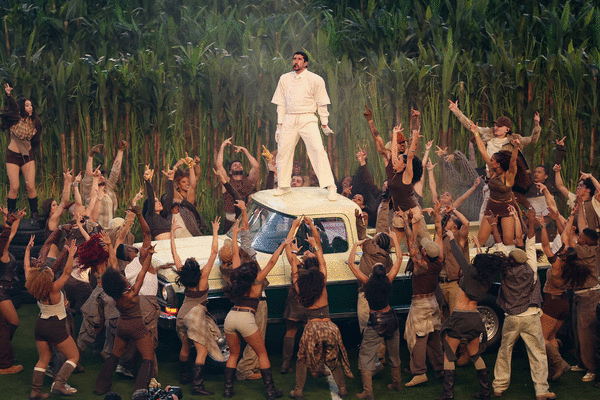
For 13 minutes on Super Bowl Sunday, Bad Bunny transported 68,000 people from Levi’s Stadium to the streets of Puerto Rico.
On a set modeled after an island marketplace square, complete with acrobats on power lines, a legal wedding ceremony on a roof and performers dressed as tall grass (more on that later), 31-year-old Benito Antonio Martínez Ocasio made history as the first Super Bowl halftime show headliner to perform all-Spanish music.
Bad Bunny’s meteoric rise as one of the most-streamed artists in the world culminated in a showcase of his genre-bending discography, with songs that expertly blended elements of salsa, reggaeton and Puerto Rican plena with trap beats and Latin pop.
On the field, Bad Bunny asked one simple request of America: To get up and dance. At a time when more stars are taking their stances on politics to the national stage, Bad Bunny did so through unadulterated pride in his Latino culture.
Dressed in a custom white jersey with his last name embroidered on the back, Bad Bunny traveled up to the mainstage and opened with “Tití me Preguntó,” a Latin trap anthem from his 2022 album “Un Verano Sin Ti” (“A Summer Without You”). He was joined by dozens of dancers and live musicians playing maracas and brass instruments as the word “perre” — Spanish for “for my family” — flashed across Levi’s Stadium’s massive jumbotron.
Bad Bunny's set list also featured old favorites for longtime fans, including 2020’s “Yo Perreo Sola” and “Safaera” and 2023’s “MONACO.”
Of course, Bad Bunny pulled from his most recent album, 2025’s “DeBÍ TiRAR MáS FOToS” for “BAILE INoLVIDABLE” (“Unforgettable dance”), and as the stadium lit up in flashing lights (each fan was given a lanyard to wear, synced with the halftime performance).
The stage spanned nearly the entire length of the 100-yard football field. Bad Bunny traveled through a maze-like set of artificial grass. Performers dressed in stringy green bodysuits — perhaps a creative take on getting such props on and off the field in a timely manner. Bad Bunny showed off athleticism too — jumping on a pickup truck and climbing on power pole props, recalling the blackouts that plagued Puerto Rico after Hurricane Maria.
For all the energy and hype his performance exuded, there were tender moments too. At one point, a prerecorded video played on the jumbotron, showing Bad Bunny handing a Grammy to a young boy — presumably his younger self.
When it came to surprise guests, Bad Bunny proved he was the ultimate poker face. While fans widely speculated he would bring collaborator Cardi B on stage (Cardi B arrived in the Bay Area to support her partner, Patriots receiver Stefon Diggs), he played us all by featuring Lady Gaga, who performed a salsa rendition of her hit song “Die With A Smile.” Draped in a light blue dress and wearing a Flora de Maga, Puerto Rico’s national flower, Lady Gaga met up with Bad Bunny on stage for a playful dance segment.
And she wasn’t the only one to share the stage with Bad Bunny: The “King of Latin Pop” Ricky Martin appeared as well, serenading the audience with his smooth tenor. His choice of guests made a statement: Puerto Rican singer Martin publicly came out as gay in 2010, and Lady Gaga has long documented her support for LGBTQ+ rights through her music and activism.
Bad Bunny’s role as a political lightning rod leading up to his performance couldn’t be more underscored. Soon after he was announced as the headliner in October, he hosted “Saturday Night Live” where he told critics in his opening monologue they had “four months to learn” the language he’ll speak in the show. And just last week, he made headlines for criticizing Immigration and Customs Enforcement amid President Donald Trump’s immigrant crackdown, saying “ICE out” in his Grammy acceptance speech for Album of the Year. “Before I thank God, I just want to say, ICE out,” Bad Bunny said in his speech.
But none of that seemed to weigh on Bad Bunny’s mind, or those of his fans Sunday night — who were caught up in “Benito fever,” as many called it. Bad Bunny ended his set with the title song from “DeBÍ TiRAR MáS FOToS” (“I should have taken more photos.”) In it, he sang a love letter not only to his homeland, but to Latinos and Latino Americans across the world. He chanted the names of several Latin countries, from Mexico to Colombia as their respective flags were paraded around the field. High above him, a message broadcast on the screen: “The only thing more powerful than hate is love.”
©2026 The Seattle Times. Visit seattletimes.com. Distributed by Tribune Content Agency, LLC.










Comments