Q&A: Band of Horses toast 'Everything All the Time' 20th anniversary in Seattle
Published in Entertainment News
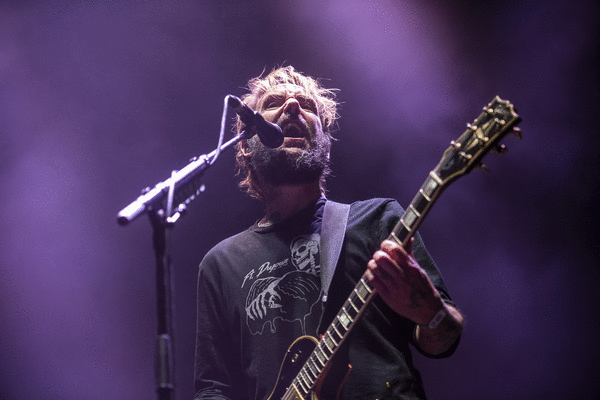
SEATTLE — Twenty years ago, Seattle (like the world at large) was a much different place. The grunge era’s sunset gave way to the dawn of an indie rock renaissance in the late '90s and early 2000s, spearheaded locally by bands like Modest Mouse and Death Cab for Cutie.
In 2006, Sub Pop released the debut album from Band of Horses, a Southern-charmed indie rock group widely believed to be Seattle’s next big thing at the time. Those prognostications from trucker-hatted rock fans in the know proved correct. With an emotionally potent brew dashed with the right amounts of jangle and twang, “Everything All the Time” became one of the city’s era-defining albums, the inescapable lead single “The Funeral” immortalized as part of the soundtrack to the new millennium’s indie rock explosion.
Frontman Ben Bridwell is still trying to make sense of it all. A former member of cult-favorite Seattle band Carissa’s Wierd, the South Carolina-raised singer/guitarist might find some clarity once he’s back in town this week to commemorate the 20th anniversary of the album’s release with a string of events and sold-out shows, starting with an art show curated by longtime drummer Creighton Barrett (March 18, Hometeam Gallery) and an intimate warm-up gig at The Vera Project (March 19). Notably, the band will donate $1 for every ticket sold on its upcoming tour, which starts a few weeks later on the East Coast, to the nonprofit all-ages venue that helps prep Seattle-area youth to become active members of the music scene.
After a short acoustic performance at Easy Street Records (March 20), coinciding with the release of a 20th anniversary reissue with a bunch of bonus tracks, the Horses slide over to the fabled Showbox for two nights (March 21-22), with Sunday’s show livestreaming at volume.com.
Ahead of the homecoming, we caught up with Bridwell to talk 20 years of “Everything All the Time” and all things Seattle — a place that still holds a special place in his heart all these years later. This conversation has been edited for length and clarity.
Q: Why was it important for you to kick things off back in Seattle?
A: Well, I guess it's been a series of blown expectations and a staggering, whirlwind of a trip we've been on for 20 years. Might be nice to go conjure up some memories and follow the breadcrumbs back to see how the hell this all started.
Q: What is it like for you coming back to Seattle these days?
A: I love coming back to Seattle. For a couple of years there, after we had left and moved back to South Carolina — we moved away because rents got so expensive and we were traveling so much, it was like, Man, if we're going to be touring all this much, maybe when we come home we should get in some place where we can have a yard or be around family."
We could see our adult lives forming before us, and so maybe a couple of years coming back, we still had so many friends that were in the scene, and maybe there's still a little bit of saltiness to it, or the nostalgia was so thick that it had more difficult feelings colliding.
But in the past, I'd say 10 years, it's nothing but a fun trip to see how things have changed and to soak up all the good stuff. It doesn't have any lingering feelings of unfinished business or anything.
Q: When you played Bumbershoot in 2023, which was a pivotal year for the festival, you really embraced being back, and it was one of the defining sets of the weekend.
A: That's amazing that you say that. It was deliberate on our part, too. We had our Sonics flag, we were kind of blazing and, God, it felt more like a homecoming than (past shows). We've played so many shows in Seattle since we left. For some reason, it didn't have a homecoming vibe to it. And maybe that’s because, at least personally, going to Bumbershoot for so many years — not just playing it over the years, but just being in attendance — it has big memories for me. I guess it was just the right fit then.
Q: Does the city still feel familiar, or does it seem like it's changed drastically since you were living here?
A: It depends which block you're walking on sometimes, doesn't it? I was out there for a bit doing some rehearsals for the last tour that the Horses did up there. I was posted up for a week in Fremont, where I used to work, and walking those big hills, sometimes I am like, "God, walking these hills (used to) seem a lot easier."
But it's kind of surprising, there's so many individual properties. Every little quarter of an acre is optimized for some sort of maximum output of retail or otherwise, much less building higher for more residents. And the disparity of wealth, that hasn't gotten better. It's on a different scale now. That's just the world, I guess.
Q: Can you tell me about your relationship with the Vera Project?
A: One of the first shows the Horses played was at Vera Project, and even the band I was previously in, Carissa’s Wierd, we played the Vera. We've had some great shows there. In some ideal world, there's a Vera in every town, where kids and people that otherwise wouldn't have the means to get really good training and teaching in the audio, video (and) the concert realms — it seems like such a dream. It's like Willy Wonka for peoplewhoare perverts for sound, like me. If I had one here in Awendaw, South Carolina — population 2,000 — my kids would definitely be going there.
Q: When you look back on “Everything All the Time,” how do you view the record 20 years later?
A: It was so surprising that band happened at all, much less got signed to the greatest label in Sub Pop. And then it took off the way it did. It was so jarring and always has been in a way. We'd be playing somewhere or just walking around town and (our) song would come on in a bar. It scared the crap out of me, and I ran away from it for forever.
Recently, I've had to listen to it to see if I can make heads or tails of what happened, and it's crazy. I don't know if it's because it is such an amateuristic, shot-in-the-dark kind of thing, having never really been a musician or a songwriter, really. I think there's a little bit of deer-in-the-headlights action on my part where I've just been like, "Don't look at the weird, scary thing that's happening." But I'm still just shocked and humbled and grateful for all of it.
It's given me a purpose and an outlet to create my own world creatively and settle internal strife and conversations in my mind — a place to exorcise a lot of demons. All I know is I'm grateful, and I'm not sure why it's happening. I'm still confused.
Q: Carissa’s Wierd had just ended. Where were you at mentally and creatively when you started writing these songs?
A: Those first couple records, I was always trying to turn six songs into 10. Like,"There's a few good ones here, now I gotta somehow fill it out with some other songs."So, constantly trying to punch above my weight as a songwriter and trying to be comfortable under that kind of pressure, I remember it being pretty daunting.
Especially once we got into the studio environment, where I, for the first time, realized that just because you can write that song doesn't mean you can perform it well enough to have it recorded, good for all to hear. So, all of a sudden that new batch of challenges came with a whole new sense of pressure, which was,"Oh crap, now you might be wasting money because you're not proficient enough as a player or you've never sang in a studio before."I just remember being, pardon the expression, scared (expletive).
Q: In the press notes with the reissue, you wrote: “This album made all of my dreams come true. Forever grateful for the desperation that fueled its inspiration.” What created that desperation?
A: I dropped out of school when I was in my 10th grade year, I think. I came to Seattle with no skills and very little prospects of even being able to live inside. I slept outside for a little bit before I was able to get a job, thanks to the Crocodile.
Along the way, I was just working jobs to be able to pay rent, working in restaurants, and just living out a young man's dramas, definitely going nowhere fast, and really no purpose in life. I was swinging wild, and there were a lot of low times of being stuck on the bus, going to another job that sucked, staring out the window, and dreaming of something better for myself, but not knowing where (or) what my purpose was.
Q: Is it true that you once slept on the roof of the Showbox?
A: It was right down from the Showbox, it wasn't on their roof. The better story would be sleeping on top of the Showbox. But there was some wild stuff.
There used to be a Ryder truck outlet at the bottom of Denny Hill. I was sleeping on a Ryder truck one time at night, because they don't lock them, you rent the lock as well. The one truck that took off from the lot had me in it. It pulled out onto Denny (Way) in morning traffic, and me in my sleeping bag, holding all my tapes and my tape player, spilled out the back once the door flew open. Four lanes of traffic all stopped for me to pick up my belongings, and I was just cracking up, man. Like, "That's how this day is starting? OK, wow, it can only go up.
Q: You worked at the Crocodile for a while?
A: I did. They hired me, and I had my sleeping bag on my back. I still didn't have a place to stash my bedding. I was lucky that we knew Isaac (Brock) from Modest Mouse, and Modest Mouse was really starting to pop off around this time. He knew some people at the Crocodile, and he got me an interview with them. Even though I was underage, I had a fake ID, and they didn't find out for like a damn year. They were so mad at me.
Coming from South Carolina, where we'd have to travel like 300 miles to go see a decent indie rock show, to be at the Crocodile every day, I was in heaven, man. Even though I was in the dish pit, soaking wet.
Q: What’s life like for you in South Carolina these days when you’re not touring?
A: If I'm not working, I'm hanging out with my kids, or I'm doing something for the house. We are finishing a new record that I'll soon not have to hear anymore, and it's been really fun and exciting. But man, am I looking forward to getting to Seattle. It's been 20 years of touring our butts off, and there's a purpose there also for me, which is connecting those songs to the people that care about them. A piece of me is in that world, and I really need it as well.
© 2026 The Seattle Times. Visit www.seattletimes.com. Distributed by Tribune Content Agency, LLC.








Comments