8 reasons the bells tolled for the Basilica Block Party
Published in Entertainment News
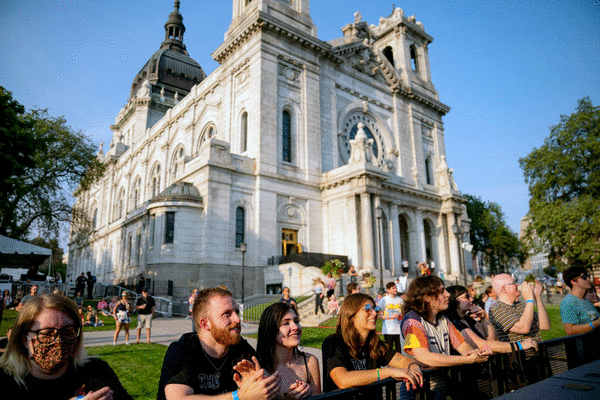
MINNEAPOLIS — After being lost at sea since the COVID-19 pandemic and moving to an island in 2024, the Basilica Block Party was finally put out to pasture in 2026.
Representatives at the Basilica of St. Mary in Minneapolis confirmed this week that their two-day music festival — a staple summer event for Twin Cities music fans since 1995 — had officially ended. They tried to revive it from a two-year hiatus in 2024 in a new riverfront location, Boom Island Park. They took another hiatus in 2025. And that was it.
“The final Block Party was held in 2024, concluding an incredible run and leaving a lasting legacy in our community,” reads a statement on the event’s website.
Few were surprised by the news, especially music-biz insiders and avid concertgoers who had seen the event lose its once-divine mojo in recent years. Here’s a recap of the myriad circumstances that led to the BBP’s demise.
1. COVID cursed it
The pandemic was cruel to the entire music industry, but it was especially rough on the Basilica party. Its 2020 lineup had to be canceled. It came back arguably too soon in 2021 and lost money after bumping to a later September run (from the usual July dates) and implementing a proof-of-vaccine policy to ease lingering worries about the virus. Ticket sales slumped in ’21 even with a solid lineup featuring Spoon, AJR and the Avett Brothers — the latter of whom wound up canceling last-minute. Yep, COVID.
2. Changes in promoters
The driving force behind the block party in its first two decades was Sue McLean, a pioneering Twin Cities concert promoter who poured her heart into the event until she died of cancer in 2013. Live Nation took over the bookings just before the pandemic in 2019. The concert industry behemoth lined up some hip and hot younger names such as Kacey Musgraves, Spoon and Zach Bryan, but it never seemed as invested or hands-on as McLean.
In its final installment in 2024, the event was taken over by Twin Cities Summer Jam co-organizer Jerry Braam, whose short stint was a bust.
3. Change of location
One big problem with the 2024 block party was it didn’t actually take place outside the namesake basilica. Construction in and around the giant, Xcel Energy-owned parking lot that housed the festival’s main stage forced it to move to a new site. It wound up at Boom Island Park on the Mississippi River near downtown Minneapolis — not a bad location for a concert (the Rock the Garden festival was a hit there in 2016), but it just was not the same.
4. Overreach in its final year
Instead of building on the millennial- and Gen Z-age audiences that Live Nation had started to attract with its bookings, the final year brought the lineup back into the FM-radio-tuned 1990s with Counting Crows and the Goo Goo Dolls for headliners. However, BBP’s old FM sponsor, Cities 97, had mostly changed formats, lost listeners and was not involved anymore. Organizers overpaid for those veteran, casino-moneyed artists and other costly efforts to relaunch the fest, adding to the financial shortfall from underwhelming ticket sales.
5. Catholic Church protests
Block party organizers stressed year after year that money raised from the event went to restoration costs of the historic basilica (opened in 1914). That’s why the event was first thrown in 1995. It went on to raise more than $7 million over the next three decades, some of which also went to the church’s St. Vincent de Paul ministry for needy residents.
However, some concertgoers said they refused to attend the event because of the broader Catholic Church’s sex abuse scandals and its stance against same-sex marriage. There were formal boycotts and physical protests organized in the early 2010s, when the Archdiocese of St. Paul and Minneapolis opposed the ultimately successful efforts to legalize marriage equality in Minnesota.
6. Rising costs
It got a lot more expensive to put on events like the BBP over the past decade, when music festivals popped up all over the country like juice bars. Artists and their handlers began charging more for performance fees during the bustling summer months. The cost of event insurance and various production needs went up, too.
These were big reasons that the Walker Art Center sidelined its Rock the Garden festival in 2022. Same with the Soundset hip-hop festival, which was consistently the biggest festival in town until its organizers threw their hands up in the air in 2019.
7. Rising competition
Unluckily for them, the final year that BBP organizers attempted to resurrect their event also happened to be the first year that Lollapalooza’s promoter, C3 Presents, put on the Minnesota Yacht Club festival in St. Paul — just 12 miles away and two weeks before the block party was held on Boom Island. The Yacht Club festival was (and continues to be) the biggest draw among area music festivals, and its lineup this year looks especially BBP-like.
Greatly adding to the competition in 2026, former block party booker Live Nation is about to open its sprawling new Mystic Lake Amphitheater near Canterbury Park in Shakopee, where it has booked a lot of former Basilica headliners, including Train and the Goo Goo Dolls.
8. It simply got old
As did its core audience. The music biz is a finnicky one that depends heavily on a younger clientele looking for the next cool, new thing. A festival in a church parking lot known for booking Train and the Goo Goo Dolls was never going to be a next, cool thing again. It actually says a lot about the Basilica Block Party’s original conception and heyday-era popularity that the event was able to last as long as it did.
©2026 The Minnesota Star Tribune. Visit startribune.com. Distributed by Tribune Content Agency, LLC








Comments