Rick Kogan: Remembering Tim O'Malley, a big comedic talent with an even bigger heart
Published in Entertainment News
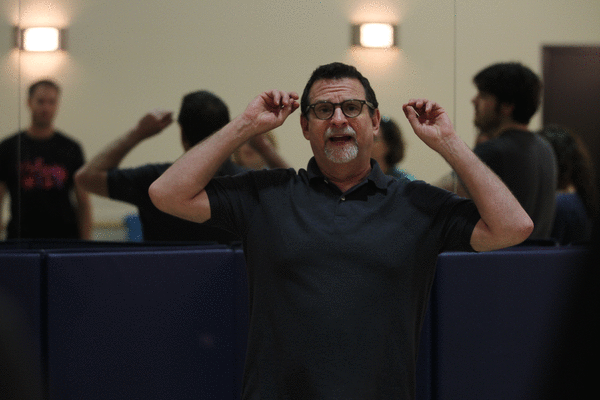
CHICAGO — One reacts to death in a variety of ways, and hearing that Tim O’Malley had died on May 11 at 68 from natural causes brought shock and tears across the city. But soon enough, there came smiles, for not only was O’Malley one of the most naturally funny people this city has ever known, memorable as a performer and teacher at The Second City, he was also a man who used some of his own experiences to help and inspire others.
“We met in 2005, and that was that,” said Pamela Staker, a talented visual artist and O’Malley’s companion. “We decided we didn’t need a piece of paper to build a fully committed life together. We embraced the term ‘life partners’ and deliberately built the life we wanted together.”
To see them together was to understand the playful nature of their relationship and the depth of their affections. “Tim would protect the one he loved from further indignities and help us make our own way forward with the full force of that Tim O’Malley energy. He was fiercely protective, loyal, and loving. And this was the template for how we would love each other through all the hurts.”
“Yes, he could be wildly funny. Everyone always talks about his irreverence and gruff South Siderness, and don’t get me wrong, we played together in that way all the time. But for me, it was his tenderness and vulnerability that touched my heart and brought out the same in me.”
O’Malley was a child of the Beverly neighborhood, the 10th of the 11 kids of Thomas Aloysius and Mary Frances O’Malley. All of their children attended college and it was at Southern Illinois University that Tim O’Malley discovered acting. In a short time, he was a member of the touring company of The Second City in 1986, and a few years later, he was elevated to the resident company, sharing the Mainstage with Bonnie Hunt, Tim Meadows, Bob Odenkirk, Chris Farley and others, all sharing dreams of stardom.
But for him, those dreams were shattered when he started on the road of addiction.
“I had certain preconceived notions of where my career should be going,” he told me more than a decade ago. “I watched as others moved on, to ‘Saturday Night Live’ and elsewhere, and I wondered when it would be my turn. I had always been a drinker and, like a lot of people my age, experimented with drugs. I had always considered my use to be recreational. But my career disappointments fueled my drug and alcohol use.”
In 1993, he quit Second City and moved in with his father after the death of his mother. He worked as a bartender and supplemented the booze available in that job with increasing drug use.
“I just gave up,” he says, giving an example of how far he fell. “There was one night I was driving around in my underwear looking to buy some crack.”
His father and a younger sister finally persuaded him to seek help. He underwent a 90-day Gateway Foundation program and was clean and sober and steady enough by 1996 to join the faculty of The Second City Training Center, where he would begin a teaching career that touched a couple of generations.
He also wrote and performed “Godshow,” an autobiographical play that played for many years at the start of this century at Second City, iO Theater, and the Beverly Arts Center. It was a big hit, pleasing audiences and changing lives and still possible to see on YouTube.
In 2012, he created and led an innovative program for Gateway that used improv techniques as a means of treatment in its West Side facility. It was called “Immediacy in Effective Communication” and was conducted for men in their 30s and 40s, men who had led rough lives on the streets, some of whom had done prison time. But he shared his own stories and led them in improv games.
“In improv, you learn that the group is greater than the sum of its parts,” he told me. And more recently said, “I still hear from some of the guys who I worked with me. Just to be part of their lives and part of their ongoing recovery … that’s a tremendous feeling. A great reward.”
He always tried to help. Shortly after he had gotten sober he tried mightily to help his former Second City cast mate, Chris Farley, who had become a movie star while O’Malley was getting clean. In the last 10 days of his life, Farley called O’Malley every day. On the morning of Dec. 17, 1997, the two men talked and O’Malley said, “I’m coming downtown for a (recovery group) meeting tonight. Call me if you want to go.”
Farley never called. The next morning he was found dead in his Hancock building apartment. Cocaine and morphine overdose was the cause. He was 33 years, the same age as his idol John Belushi when Belushi died in California.
“I loved Chris dearly,” O’Malley said. “His death just wrecked me.”
O’Malley would later say, “Too much emphasis is placed on the celebrities who die early. That’s understandable. But look, addiction — booze or drugs — is not relegated to any one occupation. It’s people in all professions. Guys in the trades who are surrounded by drinkers, they think it’s part of life.
“High-profile people get all of the attention. But what about the everyday drunks or addicts we never hear about? The sons and daughters, mothers and fathers? There is a terrible tragedy there.”
———
(Rick Kogan is a columnist for the Chicago Tribune.)
———
©2026 Chicago Tribune. Visit chicagotribune.com. Distributed by Tribune Content Agency, LLC.







Comments