Why these rare early Marilyn Monroe photos stayed hidden for decades
Published in Entertainment News
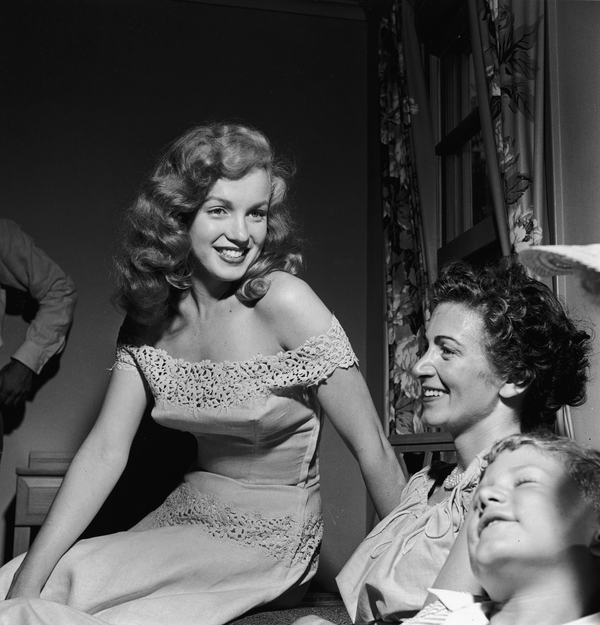
LOS ANGELES — It was the summer of 1949 when a 22-year-old, newly hired Milwaukee photojournalist was assigned to take portraits of an unknown 23-year-old actor passing through town on a publicity tour. John Ahlhauser spent 30 minutes capturing seven photos of the up-and-coming starlet. One was published in the Milwaukee Journal Sentinel and Ahlhauser took the other six home.
That unknown actor was Marilyn Monroe (although her legal name was still Norma Jeane Mortenson).
To celebrate Monroe's 100th birthday on June 1, five photos from the shoot are being auctioned off through proxy bidding until Tuesday morning, when the live auction will occur. The photos were shot as part of a promotion for Monroe's brief role in the Marx brothers' final feature together, "Love Happy." According to Ahlhauser's daughter, Mame O'Meara, these pictures represent an unguarded and unedited version of the celebrity.
"When we took it to 'Antiques Roadshow' — which it did not get on at that moment — they said these are before she got her nose job, before she went platinum, and that she had developed a look in her eye in January of 1950 that really kept you out of her personal space," O'Meara said. "They describe these seven little pictures as windows into her soul."
The Milwaukee Journal Sentinel ran one photo in 1949 and a second image was used in Gloria Steinem's 1988 book, "Marilyn: Norma Jeane." In 2011, all of Ahlhauser's work was placed in a trust, including his photos of Monroe.
Monroe's estate was controlled by Anna Strasberg, the second wife of Monroe's acting coach and close friend, Lee Strasberg, since his death in 1982. O'Meara explained that the family waited to release Ahlahauser's photos of Monroe because of the "contention" over Anna Strasberg's ownership of Monroe's image. Strasberg died in 2024.
"Strasberg was fighting in court for all of the images of Marilyn, and we put these in a trust and actually worked to keep them quiet at that time," O'Meara explained.
When Ahlhauser died in March 2016, O'Meara and her five siblings inherited hundreds of their father's yellow Kodak photo boxes. Inside the boxes were his photos of Monroe, organized with the "sleeve dated and with the assignment on the outside."
"I wanted to touch absolutely everything in the boxes," O'Meara said. "[My siblings] were both gracious, and none of them wanted to, and so I have had the privilege the last six years of going through every print he ever made, and I'm just working on the negatives now."
However, O'Meara and her siblings aren't entirely ready to let go of Monroe yet. While they'll be auctioning off five of the photos, they're planning to keep two.
"We're selling these five, and people can take the copyright and put them on coffee mugs, or make an AI movie, or whatever they want to do with them," O'Meara said, laughing. "We'll just keep the two really nice ones that he was so proud of. We'll keep those in his collection, and we can sell prints if we feel like it."
While Ahlhauser's photo of Monroe may become his most iconic image, the session didn't feel like a particularly notable event in his career. It wasn't as impactful as when he photographed the 1968 Democratic National Convention in Chicago or civil rights marches in 1960s Mississippi. But for O'Meara, that's where the beauty of these photos lies.
"They are both really nobodies; they're both people doing a job," O'Meara said. "And yet, when I look at those pictures, I think they both had to really allow themselves to let the camera find the vulnerability, and that to me is the art in it."
©2026 Los Angeles Times. Visit latimes.com. Distributed by Tribune Content Agency, LLC.









Comments