10 years after Pulse, new play explores grief, trauma and moving on
Published in Entertainment News
ORLANDO, Fla. -- It started with a friend. A friend who had been at Pulse that night. Everyone in Central Florida knows what “that night” means: That Saturday night that led to unthinkable violence in the early hours of Sunday morning, June 12, 2016, when a gunman killed 49 people in the nightclub on Orange Avenue just south of downtown.
Years after that horrific night, that friend of Chip Byers reached out to say he still wasn’t OK.
“It took me by surprise,” Byers said. “It made sense, but it took me by surprise. Back then, we all said to survivors, ‘We’re there for you, we support you.’ But at some point, I moved on with my life. I assumed everybody did.”
The plight of his friend moved Byers. And inspired him.
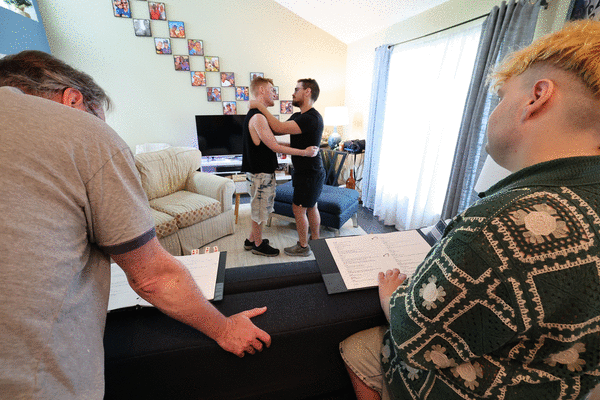
The inspiration resulted in “The Earth May Be Flat,” a play by Byers that will debut at the Dr. Phillips Center for the Performing Arts on June 14. The two-character drama does not re-enact the tragedy or reference any real victims or survivors by design.
Instead, it is set in the present day — a decade later — when survivor Noah is forced to examine his complicated feelings about that night and how it’s affecting his relationship with his younger boyfriend, Jagger.
“Noah’s been largely trapped since it happened. He can’t move on, but he also doesn’t want to on some level, as he doesn’t want the world to forget,” Byers said. Jagger, meanwhile, wasn’t affected by Pulse in the same way and doesn’t understand Noah’s emotions.
The two debate throughout the play how to effectively honor the past while building a future as playwright Byers examines generational differences, opposing political viewpoints, the tricky balance between memories and moving on, and the different ways we cope with life’s obstacles.
“I think the relationship between our characters is beautiful,” said Weston Kemp, the New York City-based actor who plays Jagger. “There is a willingness to meet somewhere in the middle and try to figure out ‘how do we move on together?'”
And while the relationship travails of Jagger and Noah, played by local actor Celestino di Cicco, make the play personal, their opposing outlooks mirror the divisions that still rankle in Central Florida today, especially when it comes to the long-delayed memorial at the Pulse site.
“That is a major point in the play: How do we memorialize this?” Byers said. “And in doing that, how do we not hurt ourselves further?”
Kemp had worked in Orlando before; in 2023, he starred in the Encore Performing Arts production of “Sordid Lives” at the Dr. Phillips Center for the Performing Arts. But living out of state, he knew nothing of the OnePulse fiasco in which the nonprofit foundation raised nearly $20 million in public and private funds over seven years but never built a planned memorial or museum.
“I was not aware what a fight this has been for Orlando,” he said, although he understands the inherent conflict between a memorial for survivors and victims’ families and one created for the nation at large.
“What’s appropriate? And who has the right to make that decision?” Kemp asks rhetorically. “It’s heartbreaking.”
He remembers exactly where he was the night of the Pulse shooting: At the famed New York City gay bar Stonewall, where riots took place in 1969 and started the modern gay-rights movement.
“The news was breaking, and I was absolutely terrified,” he recalled. “I didn’t go out to clubs for a very long time after that. It scared me so much.”
In that regard, he differs from his character, Jagger, who was not affected by what happened at Pulse. Kemp likes the way Byers uses his play to show the gay community is not a monolith.
“Just because we’re gay doesn’t mean that we all feel the same and we’re all going through the same things,” he said.
In talking to his friend who survived the Pulse shooting, Byers realized there are gay Central Floridians still experiencing feelings he couldn’t imagine.
“I’m expected to be grateful I got through this,” his friend told him. “I’m supposed to show the world that gay people can be strong. I need to be allowed to be human.”
High-profile legislation targeting the gay community, transgender individuals and drag artists also spurred his desire to write “The Earth May Be Flat,” said Byers, who has playwright experience but is currently doing graduate work in cultural heritage management through Johns Hopkins University.
Some of those political headwinds hit the production itself, as an institution Byers declines to name backed out of the project so as not to jeopardize government funding. With veteran local actor-director Roy Hamlin and others, the group pushed ahead with the privately funded play, even in the face of a barrage of hateful social media comments.
“I won’t let that stop me,” Byers said.
He has peppered the roughly 80-minute play’s script with local references — theme-park annual passes, I-4, OBT, the erasure of Pulse’s rainbow crosswalk — that give it a sense of place. But the story’s heart is in the back-and-forth between Jagger and Noah.
“What I hope people take away from this show is that all of these conversations are more nuanced than we treat them,” Kemp said. “If we could have an actual conversation instead of shouting that you are wrong or I am right, we could be able to get to a deeper truth.”
It’s a truth, Byers believes, that is as necessary now as it was a decade ago — maybe even more so.
“Pulse isn’t just something that happened 10 years ago,” Byers said. “It’s something we still live with today.”
____
‘The World May Be Flat’
• When: 8 p.m. June 14
• Where: Pugh Theater at the Dr. Phillips Center for the Performing Arts, 445 S. Magnolia Ave. in Orlando
• Cost: $45.55
• Info: drphillipscenter.org
©2026 Orlando Sentinel. Visit at orlandosentinel.com. Distributed by Tribune Content Agency, LLC.






Comments