Chiseling out the Goodman's 'Iceboy!,' piece by piece, bit by bit
Published in Entertainment News
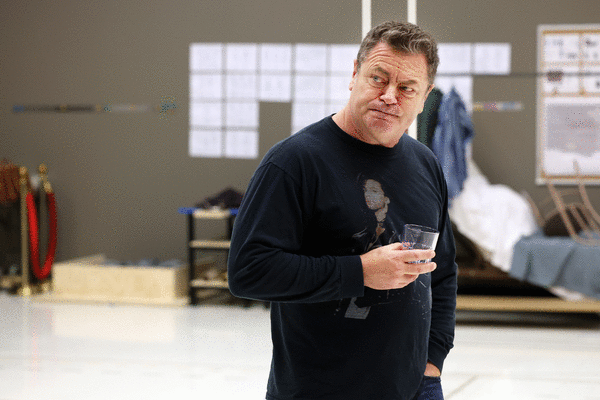
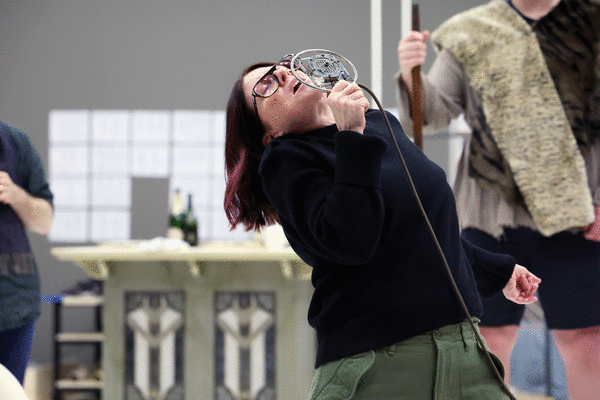
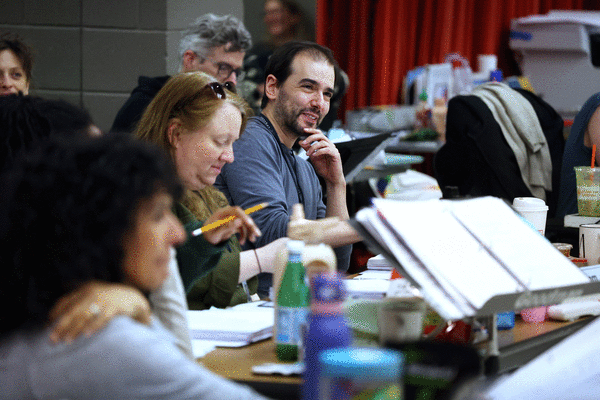
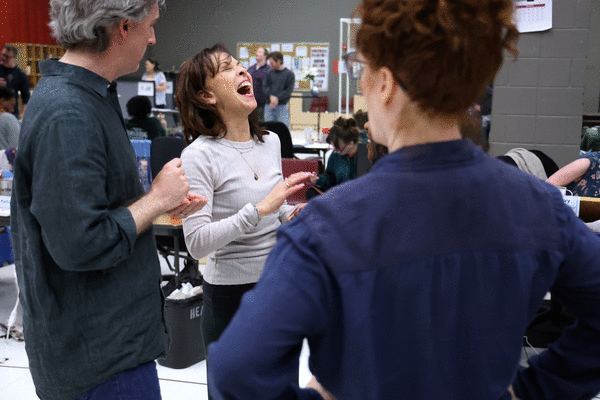
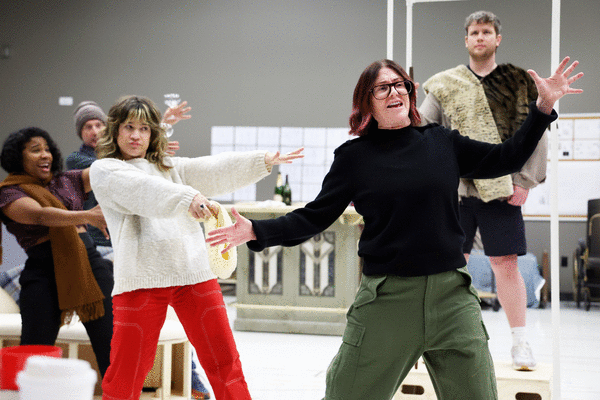





CHICAGO — The Lindbergh Baby joke wasn’t working.
Not because it was tasteless — you don’t have a Lindbergh Baby joke unless you know it’s tasteless to begin with — but because the joke didn’t land, it wasn’t funny, it didn’t work, nobody laughed. Actually, a couple of people in the rehearsal room chuckled but it sounded more supportive of the actors than a real laugh. It was a week into rehearsals for “Iceboy!,” the Goodman Theatre’s big summer show, the finale to its centennial season, with six weeks before opening, and like every original musical, it was being put together bit by bit, piece by piece, every little detail, using trial and error.
It’s easy to take this process for granted until you’re in the room, watching this process.
An actor sings, off-handedly, that he hopes the Lindbergh Baby is OK, this being 1930s Manhattan, and another actor, playing the wet-blanket, steps in to say, sir, um, he’s not.
And the first actor replies, “You really know how to clear a room!”
Crickets. Silence.
They run the scene again. This time, at the Lindbergh Baby, the actor, Donterrio, a Goodman ensemble member, quips: “Someone take the newspaper from this guy!”
Still crickets.
Donterrio turns to the table at the front of the room. Behind it sit the writers, Erin Quinn Purcell and Jay Reiss and Mark Hollmann, and the musical’s director, Marc Bruni. “Iceboy!” — which is fully titled “The Completely Untrue Story of How Eugene O’Neill Came to Write ‘The Iceman Cometh,'” and stars Megan Mullally and Nick Offerman — tells the story of a frozen caveman who gets adopted by a Broadway ingenue; it will have its world premiere on Monday night in Chicago.
Donterrio, having spun through a lot of different takes on the line, says, “Tell me when I make you laugh, I’m trying here.” Someone says they’re laughing every time. “Every time?” Donterrio asks. Yes, someone adds, yes, four out of four times, there is a laugh.
Except there really isn’t, and a week later, the scene still doesn’t work.
A month later, it’s gone, thrown out.
As are chunks of the opening song; a line here, and a line there; an entirely new closing number has replaced the first stabs at a closing number; and every awkward silence is excised.
That’s a brief list of the tweaks. Somewhere between the play’s initial incarnation off-off-Broadway at the Adobe Theatre Company in New York — when it was “Hooray for Iceboy,” written by Purcell and Reiss — and its hop-skip through workshops and thwarted pandemic-era ambitions and eventual debut at the Goodman, it gained an entirely new genre (it wasn’t always a musical), a major composer (Hollmann, who won a Tony for “Urinetown”) a big-ticket celebrity couple (Mullally and Offerman, who have been married 23 years), a cameo by Eugene O’Neill (that bloomed into a narrative device), a character named Frankenstein, a gorilla, and a new song about menopause. It has since lost, for starters, a Riverdance interlude (by Offerman), the Pope and a Chinese butler.
“Actually Frankenstein was a Chinese butler at one point,” Mullally said. “He would sing a song in Chinese, my character would try to guess what he was saying and then, at a certain point, I’d start singing with him in Chinese. I was reluctant about him becoming Frankenstein, but then after we did workshops with Frankenstein, I became converted.”
Before rehearsal one morning, Bruni described the demands of any creative job: “You sculpt, you whittle, you move on before paint has dried, and you realize you may love all your children, but eventually, sometimes, you will need to Medea the kids.”
Again, as obvious as it sounds, until you watch the sausage being made, it’s just yummy sausage. You forget that to assemble even a knowingly insane two-and-a-half-hour show about a Broadway diva who decides to buy a frozen caveman, the people up there spend years sorting through and adjusting lines, music, sets, dances, characters. You forget, at the Goodman at least, that they rehearse six days a week for two months, around eight hours a day.
Take the opening number.
There’s a lyric where reporters are wondering why Mullally’s Vera Vim, a fading actress, bought a caveman. Reiss wasn’t happy with a rhyme: “Your reasoning is hazy / Perhaps you’re crazy / Or mentally lazy.” Except the line did too much work to be pulled. So they were at the Goodman until 10 p.m., trying alternatives. As of this writing, the new lyric: “Did you do it for attention? / Or reinvention? / Or was it pretension?” The problem, Reiss said, was that Vera hadn’t given a reason yet. “No one accuses musicals of realism,” Hollmann agreed, “but be logical toward your own logic.”
Later in the show, Iceboy (Grey Henson, who played Damian in Broadway’s “Mean Girls”), discussing his stone-age past, says he was “the slowest person in my clan.” Hollmann changed it to “slowest ONE in my clan.” Reiss said that wasn’t funny. “And yet rhythmically it scanned better,” he admitted. “But it’s not funny anymore.”
Funny, in this case, won.
“Lights!” Bruni said, basically meaning “Action!”
Offerman stepped forward from the back of the rehearsal room and the cast and crew clapped to simulate the inevitable entrance applause from the audience. Offerman explained he was Eugene O’Neill, “four-time Pulitzer winner, and three-time divorcee.” Within minutes, the plot leapt from O’Neill to an Arctic expedition, to a caveman, to an auction.
“Wait, wait,” Mullally said, stomping the brakes.
An assistant was standing in front of the mirror and Mullally couldn’t see herself dancing.
The assistant shuffled to one side and the scene reset. Then again, and again, stopping each time to adjust for a beat, a movement, the flow of actors in the room, a twist of a hand, an arm thrown that way, not this way. On four Fridays in a row, I watched this scene rehearse, and each Friday looked barely different than the Friday before. Because this is the first 10 minutes of the show, Bruni told me, “and with a musical, the first 10 minutes are critical, you’re setting the rules of this world.” He needed it faster. Two songs became one. A scene with (real world) gossip columnist Louella Parsons — gone. A scene that explained the expedition — gone. “We decided we didn’t want to give the audience time to clap, so trimming, cutting, you go O’Neill, the discovery, the auction, the penthouse, Vera’s an orphan, everyone pities Vera, Vera turns that into publicity. All in the opening — just boom, boom, boom, boom.”
Or as choreographer JoAnn M. Hunter, a kind of female Martin Short, radiating endless energy, would put it, clapping her hands, leading dancers around the rehearsal space:
“FOUR, FIVE, SIX — SHA! SHA! SHACKA! SHACKA! DA! DADA! DA! SHACKA! DA!”
Or:
“BEED-A-DEED! DOOBA! DOOBA! GABBA! DA! GABBA CHA KA! GORGEOUS!”
Either way, you watch, and you wonder how they could actually be ready for a show in eight weeks. Momentum appears nonexistent. Hunter stands with ensemble actors Melanie Brezill and Andrea San Miguel, going slowly over lyrics, letting each beat land on each word. Brezill, singing: “‘Cause polio is rampant / And we don’t have a drug!”
“AND polio,” Hunter says.
“AND polio is rampant …”
“Andrea, Melanie, I love what you’re doing,” Hunter says, quickly, “it’s wonderful, which means I like it, but on the downbeat, here, do this — BOOM, ba ba BOOM BADA BABA!”
They do this.
“OK,” Hunter says, illustrating each line again, punching words, working hands: “Have. You. Seen. These. Terrible. Reviews. They’re. Bad. For. Business. And besides… Nazi GERMANY is rounding up the gays and Jews.” Brezill and San Miguel sing to her in response: “We’ve read all that. You’re such a downer. Don’t be so annoying — UGH!”
“Wait,” Hunter says, “‘we’ve READ…’”
“We’ve READ…”
“Also,” Hunter says, miming a downward slope, “‘DON’T, Be, so, annoying — ugh …”
“‘DON’T, Be, so, annoying — ugh …’”
“YES!”
“This song will be in my head all night,” Brezill mutters.
Hunter and Bruni have worked together on Broadway and at the Kennedy Center in Washington, D.C. You watch them work and wonder where one’s instructions end and the other’s begin. With an original musical, there’s no precedent, Hunter said, there’s no earlier iteration of the book or lyrics to turn to, so every beat, every move, is theirs alone — they’re making it up. “In this case, there’s a real percussiveness, I don’t need a drummer! I am the percussion! The stomps, the beats. I can’t read music myself but I hear the orchestrations in my head, cowbell, triangle. I want a light bulb to turn on in my head. No, a triangle! You know what I mean.”
After weeks of learning it, by the time they’re get to dress rehearsal, most of it — the Nazis et al. — will be gone. They’re paring, whittling. During one run through the opening number, Mullally notices a taxidermic bear draped over a sofa, a part of the set. She stops. “I can’t,” she says. She approaches Bruni, she has an aversion to fur. The bear is removed. Anything that slows the pace is removed. Bruni always wants it faster. He fears the audience jumping ahead of the jokes.
“And some would like it even faster,” Reiss says.
Piecing together a show this way truly has a logic and language onto itself. Offerman, whose role provides a framework for the plot, spends chunks of rehearsal watching. He says: “Look, I studied theater at U of I in Champaign, I took ballet, I love sword fighting — I wanted to be a swashbuckler, more than anything. I can do dramatic roles and I can do comedic roles. I’m classically trained! I know the terminology. People do not expect me to be graceful! But I was a break dancer when I was a kid in Minooka.
“I’m confident in my ability to get myself across in any genre, but musical theater has a presentational quality I’ve never really worked in, the kind when you’re in the middle of a song, you’re giving some to the audience, some to your partner. You’re stepping so outside the bounds of realism. I said to Marc about this one song we’re doing, “Marc, am I having this reaction to Megan? Should I be telling the audience I’m having this reaction?’ Please help me with your musical theater vocabulary — I am not sure.”
: : :
If much of this sounds random and cobbled, to some extent it is by design. Purcell, who grew up in Rock Island, recalled the origin of “Iceboy!” as almost being an exercise.
“At Adobe, in early 2001, we had a stage but we didn’t have a play, plus the company had no money. So Jay and I were like, why don’t we just ask whoever’s in the company what they want do and if they will be in the show and we’ll kind of make up the rest based on that, whole cloth, just pulling things out of the air. So, OK, how about a caveman? How about like a take on ‘All About Eve’ except Eve is a caveman? One actor wanted a genderless role. Another liked using Frankenstein. A lot of people wanted to tap dance. We started trying to figure out how we would connect all of this.”
Eugene O’Neill didn’t arrive for another decade.
Hollmann — who himself grew up in southern Illinois and studied music at the University of Chicago and knew a thing or two about improvised storefront mashups as a founding member of the Chicago comedy troupe Cardiff Giant— got involved in 2012, after Purcell and Reiss decided it needed to be a musical. He began cowriting lyrics with Reiss, who by then was also co-creator of the 2005 Tony-nominated Broadway hit “25th Annual Putnam County Spelling Bee.” Soon they picked up Mullally, who had left Northwestern University after two years, then spent a decade in Chicago theater before television’s “Will & Grace.”
Offerman, despite what he says, has worked in musicals before. He was Jud Fry in a Minooka Community High School production of “Oklahoma!” and played sax in the band for “Bye Bye Birdie.” After the University of Illinois Urbana-Champaign, he co-founded the once-adored Defiant Theatre in Chicago (which folded in 2004); he also worked on shows at Steppenwolf and Goodman, choreographing fights for Chicago Shakespeare.
The point is, everyone here expects a show to emerge, then change, constantly.
Henson, as Iceboy, and Sarah Stiles (of Broadway’s “Avenue Q” and TV’s “Billions”), who plays Vera’s assistant, stood in a rehearsal room before Bruni, assistant director Lo Williams and music director Vadim Feichtner, fine-tuning a ballad called “Marry Me,” which only sounds sweet. Stiles, laughing at the end of one take, said to herself: “I mean, it’s so sweet, and yet it’s so filthy. But it’s also their courtship, right?”
“That’s right,” said Bruni, “and we shouldn’t know exactly how the other side will react.”
“Is the distance between us good?” asked Henson. “We’re timid at this point.”
“Maybe … more distance,” Bruni said.
“But there is something to an audience seeing both our heads at once, not having to swivel their heads,” said Stiles. “They see you give it and me take it at the same time.”
The room tittered.
“Sickos,” she said.
They run through the song again. Then again, and again. Stiles keeps singing “climb a tree,” not “find a tree.” And they go again. The actors offer suggestions each time, on movement, dialogue. Both said later, you learn to read the room; you offer your ideas, but not a million ideas. “With a show like this, an original,” Stiles said, “the dream, the urge, is putting your stamp on it, feeling ownership over the role.” Yet, Henson said, “it can also get scary, because — and I talk to my therapist about this — being an actor is something we started doing as kids, a time when you knew your place, when you didn’t overstep, and a little part of me still feels like … you want to speak, but stay in your lane.”
“Thoughts? Ideas?” Bruni asks.
Stiles steps forward. She has a song about menopause. “As someone herself in menopause, I feel passionate about portraying that in a way so women feel championed, they are not crying for no reason. I cried this morning because I missed my brother, which makes no sense. I just talked to him. It’s an out-of-nowhere-ness.”
“That’s the goal,” Bruni says. “Grey?”
“My song,” Henson says. “It’s so different from the rest. I wonder if we’re trying not to make it heavy, or maybe we’ve earned that heavy … maybe the stakes are high enough.”
They return to “Marry Me”, a duet between a woman who longs for a traditional marriage and a caveman who plans to drink blood from an oxen to celebrate that romance. They make it through without a glitch. The room claps. “It’s great already,” someone says. Bruni says, “Couple things. What I love is that these two don’t know where this is going, they’re at the getting-to-know-you phase. Grey, after you sing ‘Drinking urine in a sacred space,’ that’ll get a laugh, let it happen. Tiny thing, Sarah, when he says, ‘Where I come from, we don’t get married, instead …’ Let the news land on you.”
“I could highlight INSTEAD …” Henson says.
“We don’t need that,” Bruni says.
“Do I even understand how intense I sound?”
“No, you’re a caveman, it’s just factual to you.”
: : :
And on and on, additions, subtractions.
A week later, roughly a month before opening night, Henson is getting better at cave-speak. But his growling and grunting alternates with full-formed Broadway musical belting, at times within a space of seconds — he’s been worrying if his voice can take that. While most of his cave dialogue in the script reads essentially as “Hoo-owa,” he’s playing with variations, saying “OO-GA!” and “PAWMA-MA-GOWA!” and when the script calls for him to croon “POO-poo!” he begins singing “POO-pee!” then catching himself.
“The softer one, the ‘Poo-poo,’” he says to Bruni, “is funnier.”
“They’ll tell us,” Bruni replies, meaning the audience.
Mullally and Henson reset themselves, returning to a song where Vera asks Iceboy to call her “Ma-ma.” She wears stylishly baggy clothing, he wears what appears to be stitched together animal skins. She starts singing, then halts abruptly — wrong lyrics. (“I’ve done so many workshops of this for so long,” she said later, “for 12 years it had one set of lyrics, all of a sudden, a new set of lyrics, not that different from the last set.”)
“MMMA,” Grey says. “MMA-MMM. MGA-GA! Mmm-GA-MMAMAMMM — MAMA!”
He bursts forward, Al Jolson-like, arms wide. The room erupts in applause.
“That’s the idea, right?” Henson says. “Instead of just stepping forward.”
“A lot of fun,” Bruni says. “What I don’t love is that there’s so much wind-up to get there. It should feel like one thing. I don’t want that step to telegraph what’s happening.”
“So just all in one move — like “MMMA-Mmm-MMM… MAMA!”
“That’s it. Why don’t we take a break?”
“I’d rather do it now, again,” Mullally says. “I feel if we break, it’ll all be gone.”
“Got it — once again.”
Then again.
: : :
By the time the production moves out of rehearsal rooms at the Goodman into a theater, about a week and a half before the first previews, countless tweaks have been made and the whole thing is mostly in place and despite Mark Twain’s warning of the danger of explaining humor — it’s like dissecting a frog, “you learn a lot in the process but in the end, you kill it” — every joke and mug and quip and non sequitur has been justified and reasoned. The tone, in fact, is rowdy and funny, and not the funny Reiss worries about — “a Broadway funny, a more gentle funny.” It’s also burst past several of the “established theater rules” Hollmann seems eager to trample on — namely, exhausting the audience with too much, too quickly, too fast. It’s approaching the entropy Bruni sought.
He sits in the dark Albert Theatre at the Goodman, surrounded by scripts flayed open across music stands and a forest of glowing laptops and he watches and takes notes.
Wait, he says, those doors need to be slightly closer together.
That message table in the spa scene — lose it.
He raises a hand in the air, making a circle with a finger — faster, faster.
But the truth is, once there is an audience, this’ll change again, then again.
Offerman put it this way: “We spend all of rehearsal trying to parse the best way to play this particular symphony. ‘Would this be better with an oboe? Get that oboe out here!’ This continues, for me at least, until closing night, even if the show is baked and finished and we’re in a fancy equity situation like the Goodman. It’s all on paper; the understudies have to be able to copy you — it’s a very professional way to do things. I came out of Defiant Theatre, which was wonderfully sloppy and scrappy and storefront and much more low-budget and improvised. Though either way, on opening night, if they were to say ‘Here’s the script and we’re not changing a thing from here on, not one word,’ I’d spend two months of performances trying to figure out the best way to deliver everything I do. That’s true of most performing artists. You are never ever really done.
“And that’s the point. When I watch myself on TV or in a film, I never think, ‘(expletive)-A, buddy. You did it. Jordan never dunked so beautifully.’ Even when people are thrilled, I basically say, ‘Glad that worked for you.’ But I think I could have picked up the pace a bit more in that second scene. I’m that baseball player watching the tape, who got some hits, maybe even won the game. Now, please excuse me, but I’d like to try it once more.”
———
If you go
“Iceboy!” runs through Aug. 9 at the Goodman Theatre, 170 N. Dearborn St.; tickets and more information at 312-443-3800 and www.goodmantheatre.org
———
©2026 Chicago Tribune. Visit at chicagotribune.com. Distributed by Tribune Content Agency, LLC.









Comments