Movie review: 'Teenage Sex and Death at Camp Miasma' a loving send-up of repressed millenials
Published in Entertainment News
Jane Schoenbrun’s three narrative features comprise a fascinating trilogy about the mediated world and the identities we locate therein. “We’re All Going to the World’s Fair” (2021) sees a young girl losing herself in an occult online game. “I Saw the TV Glow” (2024) is a dreamy, metaphysical exploration of 1990s children’s television, nostalgia, fandom and trans identity.
Their latest film — and arguably their masterpiece, at least so far — is “Teenage Sex and Death at Camp Miasma,” a sharp, playful, sexy and surprisingly warm Hollywood satire about repressed millennials who have outsourced their sexual desire to the movies. The film is a loving send-up of film nerds who’d rather intellectualize and compartmentalize than truly feel in any sort of sensual or embodied way. Packaged in a delightfully erotic and utterly phantasmagoric love letter to 1980s slasher movies, laced with themes of Lacanian psychoanalysis, and soundtracked to millennial dog whistles, it’s Schoenbrun’s battle cry to return to the “flesh and fluids” that made us in the first place.
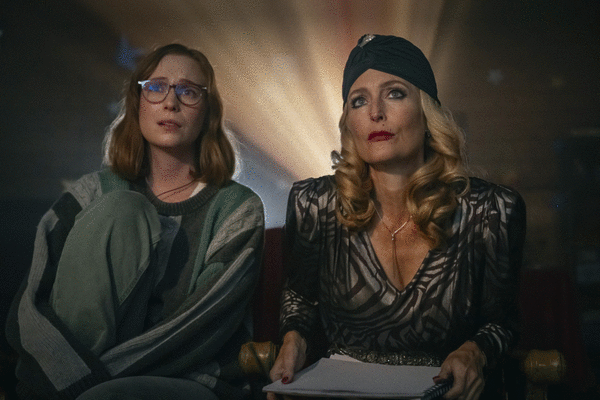
Schoenbrun weaves the tapestry of "Camp Miasma" with familiar threads pulled from classic horror, noir and slasher movies. Hannah Einbinder plays filmmaker Kris, a “Sundance wunderkind” tasked with reviving the long-dead “Camp Miasma” horror franchise. As Billy Presley, the aging star of the “Friday the 13th”-style slasher series, Gillian Anderson is the Norma Desmond to Kris’ Joe Gillis, and their “Sunset Boulevard” is the abandoned summer camp where the film was once shot. Billy now lives there, swanning about, smoking joints, painting, serving up platters of fried chicken and watching her film on a personal print. Kris finds her there during a snowy winter storm fit for “The Shining.”
Kris speaks the language of the movies, and often only that. She references Norma Desmond outright, and rattles off facts about the stars of “Sleepaway Camp.” Her Sundance movie imagined the violence of “Psycho” from the point of view of the shower curtain. Kris seems to derive dopamine from two primary sources: movie trivia and gummy candy. She’s smart, neurotic and entirely unsatisfied in her trendy, sexually fluid polycule, which unfortunately includes a bisexual man named Thor (Aren Buchholz).
But Kris is about to have a second sexual awakening with Billy, nested within the memory of her very first, which occurred while watching Billy onscreen in “Camp Miasma.” Simultaneously, the “Camp Miasma” killer, Little Death (Jack Haven), who has a ceiling vent for a head, is emerging from the depths of the lake, summoned by the creative coital energy that Billy and Kris are generating. Imagine the surprise and dismay of all the Hollywood executives when Kris tries to explain via Zoom that Little Death is the ultimate creator here — and he has final cut.
Making a movie about making a movie means that Schoenbrun actually gets to make the cheesy ‘80s slasher movie that changed Kris’ life, with bimbos and himbos and fake blood galore. Schoenbrun respects the genre and its meta-textual ephemera: the VHS tapes, fan conventions, and even the think pieces that live on obscure blogs.
But what’s fun about Schoenbrun’s movies is that while they are deeply cerebral about the medium-specific and self-reflective ideas on display, there’s very little actual irony or rug-pulling. There’s a deep-rooted earnestness that pulls it all together. Kris’ Hollywood world is heightened, yet authentic, and so is Billy’s reality, even if the exteriors of the remote, snowy camp are made of beautiful matte paintings and miniature sets. So are the geysers of blood Little Death summons with a giant spear, though they are hilariously excessive and digitally pixelated. It’s all fake but it’s all real too, Schoenbrun seems to be saying. The film is a multilayered confection of “realness,” a mille-feuille of artifice, knowingness and films within films. The characters are simultaneously voyeurs and exhibitionists, subjects and objects, watchers and the watched.
One of the keys to this complex tone lies in the pair of performances at the center. Anderson delivers a breathy, honey-accented turn as a former screen siren, playing Billie like a Tennessee Williams heroine. But the revelation is Einbinder, who has been terrific in “Hacks” but pulls out something much deeper, and more carnal, here. She sells both the humor of her nebbish character but also the blooming emotion as she comes into herself, fully realized. Kris is funny, earnest, relatable, heartbreaking and ultimately empowered, and the film wouldn’t work without the full range of Einbinder’s performance (and one astonishing close-up).
Though Schoenbrun is playfully critical about the characters and setting, there’s also a joy and reverence throughout “Teenage Death and Sex at Camp Miasma,” which is so much more than genre exercise or knowing pastiche. The message here is to get out of our heads and into our bodies, and it’s OK if we need movies to do that. Our movies, ourselves, after all.
———
'TEENAGE SEX AND DEATH AT CAMP MIASMA'
4 stars (out of 4)
MPA rating: R (for bloody violence, gore, sexual content, graphic nudity, drug use and some language)
Running time: 1:52
How to watch: In theaters Aug. 7
———
©2026 Tribune Content Agency, LLC








Comments