His specialty was adultery, murder and erotic thrills. When will Adrian Lyne get his respect?
Published in Entertainment News
LOS ANGELES — Emerging from the same wave of stylish, advertising-trained British directors that included Ridley Scott and Alan Parker, Adrian Lyne used steam, smoke, dramatic lighting, great clothes and incredible hair on beautiful people to explore the eternal and ongoing divide between women and men and their often conflicting psychosexual agendas. To run down the names of Lyne's greatest hits — "Flashdance," "9½ Weeks," "Fatal Attraction," "Indecent Proposal," "Unfaithful" — is to appreciate something essential, unencumbered and willfully kind of trashy about '80s and '90s moviegoing.
This week, with a trio of screening events in Los Angeles, Lyne (pronounced like "mine") may finally get the full respect he has long been due. Lyne is scheduled to appear at the Academy Museum on Thursday with a 4K showing of 1987's "Fatal Attraction," for which he was Oscar-nominated for directing, and do a Q&A moderated by UCLA's Maya Montañez Smukler. Then on Friday, Lyne will attend a 35 mm screening of 2002's "Unfaithful" with a Q&A moderated by podcaster and film historian Karina Longworth. Finally on Saturday at an event presented by Hollywood Entertainment, Lyne will be at Brain Dead Studios for 2022's "Deep Water."
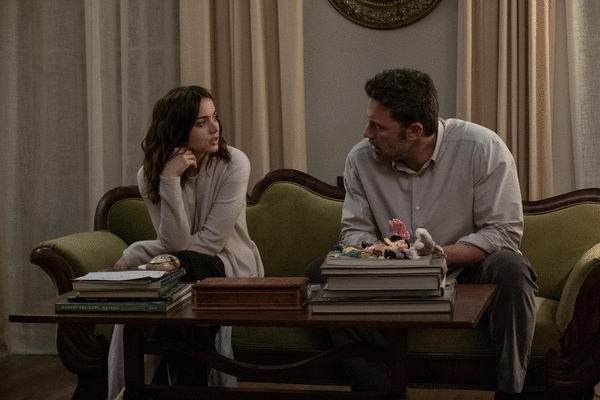
And here is where these three nights with Lyne should get truly interesting: "Deep Water," Lyne's first film in 20 years, went straight to Hulu during the pandemic and Saturday's screening will actually be its theatrical premiere. An adaptation of the Patricia Highsmith novel (with a screenplay co-written by "Euphoria's" Sam Levinson), the movie stars Ben Affleck and Ana de Armas as a couple who match each other's freak in perversely specific ways. She likes to cheat and he likes to kill.
In a twist worthy of Lyne's projects, the filmmaker will also show a few scenes that were edited out of the movie and then discuss with the audience whether they should have made the final cut.
Lyne, 85, got on the phone recently from New York City — he splits his time between there, L.A. and a country home in France — to talk about why he is undertaking this unusual presentation of his work.
Q: How do you feel about having three nights of tributes coming up here in Los Angeles?
A: Well, happy, I guess. Unless they're rushing to do it before I snuff it — I'm pretty old. [Laughs] I'm dying to do a [new] film. I've always been castigated a little bit by the critics, but happily my movies seem to have stuck around a little bit in people's memory.
Q: I spoke to you a couple years ago and you bristled at the phrase "erotic thriller" to describe your work. How do you feel about that term?
A: I always sort of hate labels, really. I guess it doesn't matter. Who cares? If they come, if they enjoy the movie, it doesn't matter what you call it. I just like doing movies about you and me. I can be impressed and love to go to "The Odyssey" — I haven't seen it yet, by the way — but I'm more interested in the smaller picture, I think.
Q: So what would you call your movies? Do you just see them as dramas for adults?
A: I hope so. I don't really think about it a lot. I like seeing stuff in a restaurant and then putting it in a movie. I love bits and pieces. I always like layers in a scene. For example, there's a scene in "Indecent Proposal," where Demi Moore is having a fight with Woody Harrelson and I was having something similar with my wife, just screaming and yelling. And during the middle of it, I saw that she was wearing yellow rubber gloves with soap coming off because she was doing the washing up. So right in the middle of this fight I thought, "F—, I've got to use that." I love that sort of stuff. Because I think the audience recognizes it. They feel that it's real.
Q: In "Deep Water," there is so much practical attention given to the couple dealing with their young daughter and the realities of childcare even as there's a baroque murder plot happening around them.
A: Sometimes when I look at the movie I think that [the daughter, Trixie] is the sanest thing in it. There were two scenes that I wondered whether I should put in the movie, in "Deep Water," and now you don't get DVDs anymore. So I'm showing the movie and I'm also showing a couple of scenes which I didn't put in. And I'm still not over it, because I torture myself, really. I wonder whether I should have.
There's a moment in the movie when the Ben Affleck character has bumped off her lover. And nobody's seen him, but she knows and they're arguing and the kid comes over, she has a little chair that she drags everywhere. I like that detail. And she sits in her chair and she says, "What's the matter?" And Ana de Armas says, "Charlie's dead, your father killed him." And the kid says, "Did you, Daddy?" And he says, "No, Trix." Then Ana de Armas calls him a liar and walks out. But the kid deals with it as if nothing's happened. And I felt it was so nuts, so surreal. It was actually in the novel. But I worried that people would sort of write it off and say, "Oh, this is insane, the kid isn't concerned about her father killing somebody." So I took it out, but I always wonder what I should have left it in.
Q: And then you're going to ask the audience whether they think it should have stayed?
A: Just to sort of make them part of the process a little bit. There's another scene as well, where the kid comes home from school and she sits in his little place where he has his snails. [Affleck's character raises snails as a hobby.] Obviously she's used to it and he says do you want to see one and he produces a little, tiny one for her to put in her hand. And she's sweet with it. She was a very good actress [Grace Jenkins], the kid who played Trixie. I think maybe I should have left it in. That tiny moment could have changed people's perception about the snails, which they found kind of nuts.
Q: On a number of your films, most famously with "Fatal Attraction" and "Unfaithful," it was very public that you would test and change the endings. It wasn't something that you seemed precious or uptight about. Can you talk about your attitude toward that?
A: There was an ending, a sort of Madam Butterfly ending in "Fatal Attraction," where she killed herself with a knife. She committed suicide and Michael [Douglas] got the blame because his fingerprints were on the knife. But Anne Archer finds a tape and on the tape, the Glenn Close character threatened suicide and this would have got him off. And I thought it was a little facile. And when we showed it to an audience, it felt a bit flat at the end.
I'm sure there's a better ending than the one that we found but what I do object to, and do feel is just not fair and not true, is this: There was no thought of we'll squeeze some more money out of it. In the end, I just want the thing to be emotionally right and for the audience to be there right till the bitter end. It wasn't from sort of commercial terms. It was just to get it right dramatically.
Q: When "Fatal Attraction" came out, there was much criticism and controversy around the film, specifically its depiction of Glenn Close's character, that became part of a larger cultural conversation about attitudes toward working women. And then "Unfaithful" really comes from the female character's point of view. Was that purposeful on your part, to try to show the other side?
A: No, not at all. She was an editor, right? And to imply that all editors are psychotic, it's just nonsensical. It's just a story. And I felt the greatest sympathy for the Glenn Close character for about three-quarters of the movie, until she walked off with the kid and terrified everybody. To make these sort of wild generalizations is just nuts. It's just a story about a lady who I think was harshly treated by him, badly treated by the Michael Douglas character. Not once but twice. And he thought that he could use her. And I think it's disgusting. But to make some generalization that all career women are psychotic because Glenn Close happened to be psychotic at the end of that movie is just silly. So they were both from the women's point of view. I'm very wary of these sort of political analogies. I'm very against it. It was just another story.
©2026 Los Angeles Times. Visit latimes.com. Distributed by Tribune Content Agency, LLC.










Comments