Chicago DIY is changing -- but Sooper Records, hitting a decade of 'genre-combusting freak music,' is here to stay
Published in Entertainment News



CHICAGO — To understand Sooper Records, the anything-goes local label, you have to understand the 2010s DIY world from whence it came. Pay-what-you-can ticketing, the collection plates piled with $1 bills. Boxes of Costco beer, sold for a buck. Apartments with sticky floors and landlords absentee enough not to notice, or care, if a living room became a mosh pit.
These days, the DIY kids are all right — but they’re very, very different from Sooper’s heyday. Label project coordinator Frances Farlee recently attended a show slinging artisanal cocktails. At another, co-founder and musician Nnamdï Ogbonnaya forked over his cover charge via tap-to-pay.
“That was my first ‘I’m the old guy’ moment,” Ogbonnaya says. “I was like, ‘Where’s the bucket?!’”
Another marker of time? Sooper Records turns 10 this year. On Aug. 22, the label throws itself a birthday party at the Empty Bottle in Ukrainian Village. Ogbonnaya, who performs under his first name, will be on the bill; so will No-Fi RPM, a live-mixing series that Curran and Farlee run with collaborators Estevan Medina, Dillon Kelley and Patrick Mitchell.
The bash doubles as a release show for Iris Temple, a groovy alt-R&B duo whose “Ghosts of the Future” was released on Sooper last month. The label also put out a compilation record earlier this year marking the milestone.
When co-founders Ogbonnaya, Glenn Curran and Steven Daoud incorporated Sooper in 2016, it started as a tape label — au courant in the mid-2010s, but also the easiest way for a scrappy upstart label to amass physical products on the cheap.
“I would print out these giant sheets of digital codes, then take them over to my wife’s office. She’d cut them for me, and then we’d pack them into all the tapes,” remembers Daoud.
Since then, the music industry — with streaming trends steered by algorithms and artists striking gold overnight on TikTok — has changed dramatically. Sooper hasn’t. Curran says the label steadfastly “avoid(s) the hype and the chase of what’s cool.”
“We platform artists who we think are making challenging, groundbreaking work, and we try to create a space for it in independent music,” he says.
For that reason, Sooper eschews a genre focus. Instead, it builds its discography through an artist-led social web. Many of Sooper’s earliest signees were part of the same DIY scene Ogbonnaya and Curran frequented. (The label’s name derives from a moniker Ogbonnaya used for his solo endeavors, after years of being a sideman: Nnamdï’s Sooper-Dooper Secret Side Project.)
“It was just all the homies,” Curran says.
From there, Sooper extended its reach to collaborators of label artists, then collaborators of those collaborators, and so on. Semiratruth, who recently relocated to New York from Chicago, makes their label debut next month; they once opened an album release show by Kaina, a singer-songwriter who released her breakthrough debut on Sooper in 2019. Musician and label co-owner Sen Morimoto was one of the first artists brought on board by Ogbonnaya; he’s releasing his fourth album on the label later this year. Even the rare non-Chicago artist on the label is plugged into the Sooper network — like the Boston-based Pile, who were connected to another band on the label’s roster.
An avid connector in the Chicago music world, Ogbonnaya tried to establish something like Sooper twice. He steered the short-lived Swerp Records in the early 2010s. Before that, he ran a community Facebook page — itself a very Millennial endeavor, in retrospect.
“It was called something very cheesy, like, ‘We’re All In It Together,’” he says.
When Curran — himself the guitarist of the band Longface, and a practicing attorney — reached out with the idea that would become Sooper, Ogbonnaya was reluctant at first.
“I was like, ‘I don’t know. I haven’t had a good track record of doing it.’ But then, the more we worked on stuff together and hung out, I thought, ‘If I’m gonna do it with anybody, this is the man to do it,’” he recalls.
Sooper’s magnum opus to date is a three-disc retrospective of the polymathic composer, pianist, dancer and DIY stalwart Charles Joseph Smith, released in April. Smith describes his music as encompassing “retro-classical, jazz, experimental, pop, ballroom, flamenco, Latin swing, and avant-opera” — the last of these represented on the release through “War of the Martian Ghosts,” an evening-length epic he feverishly composed during the pandemic.
That’s just Smith’s recorded works. “There’s so much more. … He has hundreds and hundreds of compositions we haven’t even touched,” Curran says.
Smith hopes the promotional muscle Sooper is putting into “Collected Works and War of the Martian Ghosts” will whet an appetite for future releases and bring his work to audiences outside Chicago, where he’s already a local icon. In the weeks around launch day, he says Curran acted as “a sort of road and tour manager, accountant, liaison and DJ.”
“He wore several hats during the release. Several hats,” Smith stresses.
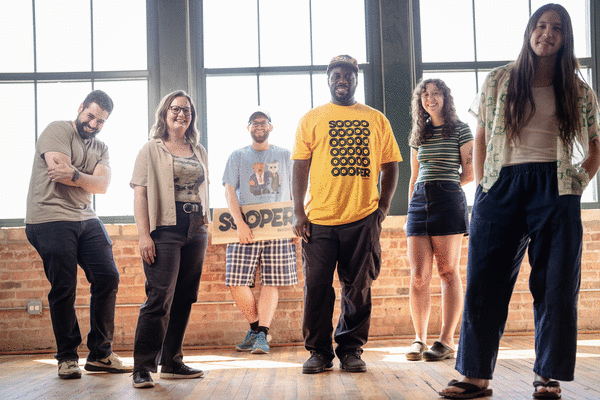
Smith’s unsummarizable music embodies Sooper’s ethos. Much of the team’s conversation with the Tribune at its airy Humboldt Park HQ was spent noodling over how, exactly, to describe its average artist. Farlee landed on “your sick friend that works at the coffee shop, who made this killer album that you know no one will hear.”
“There are people that take risks and develop artists, still, and there are people who don’t,” says Farlee, who also works at a booking agency. Sooper, she says, “is willing to take chances and help with artist development in a real way.”
“I know that this group is never gonna put out something that they just think is gonna go viral,” echoes label co-owner Jess Myers Rigoni.
Tastemakers have nonetheless taken note. Ogbonnaya and Morimoto have long been critical darlings, the former getting a 2020 Chicagoan of the Year nod in this paper. On a day enshrined in label history, RM, a member of K-pop megastars BTS, shared a track off “Some Things Take Time,” a 2022 collaboration between label stalwart Luke Titus and jazz-rap artist Cisco Swank.
“To this day, that might be the biggest watershed watch on anything we’ve ever released,” Curran says.
Though Sooper’s roster has mostly come aboveground — the team is “aging out of (DIY) a little bit,” Morimoto confesses — the label intends to spend its next decade much like it spent the first: chasing the new, no matter the tide.
“In our biased, Chicago-centric view, our music scene has always been a laboratory for new ideas that then get exported out to the coasts and the other commercial centers of the music business,” Curran says. “I’d like to think it’s this archive, and evergreen laboratory, of genre-combusting freak music happening in Chicago.”
———
©2026 Chicago Tribune. Visit at chicagotribune.com. Distributed by Tribune Content Agency, LLC.









Comments