Hidden details of 250-year-old masterpiece get closer look ahead of Getty debut
Published in Entertainment News
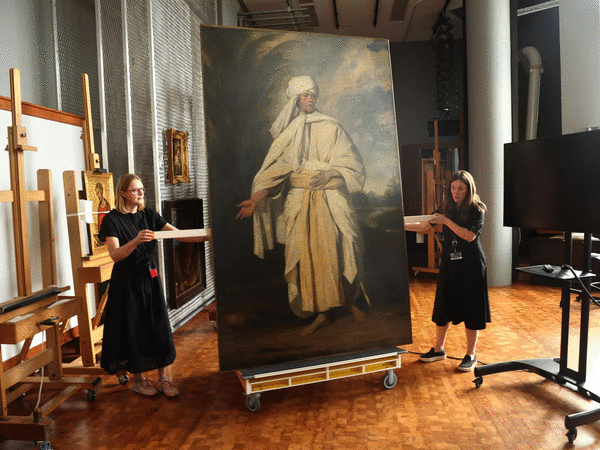




LOS ANGELES — A nearly 8-foot canvas by the great 18th century English portrait painter Joshua Reynolds recently made the journey from London's National Portrait Gallery to the Getty Museum in Brentwood, where it will make its grand West Coast debut next month.
"The Portrait of Mai," which depicts a regal-looking young Tahitian man who arrived in London with Capt. James Cook in 1774, was purchased by the Getty two years ago in a celebrated and rare joint acquisition with NPG after the privately held painting was put up for sale by its Dublin-based owner for more than $61 million.
"Mai" has received the royal treatment since being unpacked at the Getty late last month, as the museum's conservation team performs a technical study that includes capturing new imaging, and uncovering pigments and materials used by Reynolds. The team is also confirming any alterations that may have been made to the painting over the last 250 years.
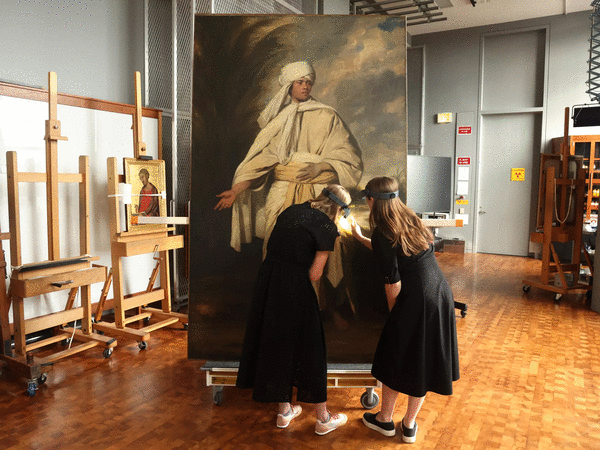
On a recent sunny Tuesday morning at the Getty — in a back room filled with other paintings, tucked into a corner of the hilltop museum — NPG's visiting conservator Sally Higgs joined the Getty's associate conservator of paintings, Kari Rayner, in an examination of the painting, which was first exhibited in 1776 at the Royal Academy in London.
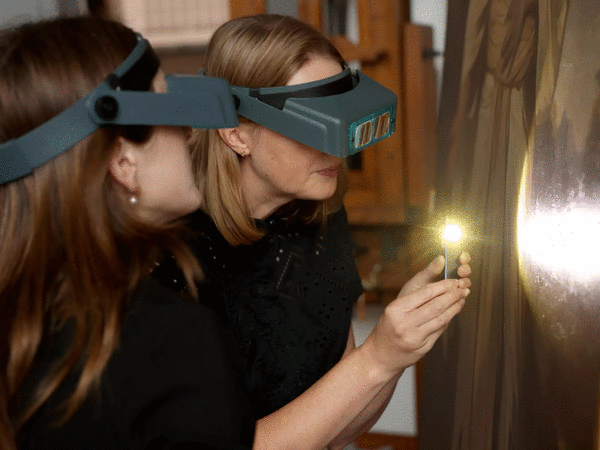
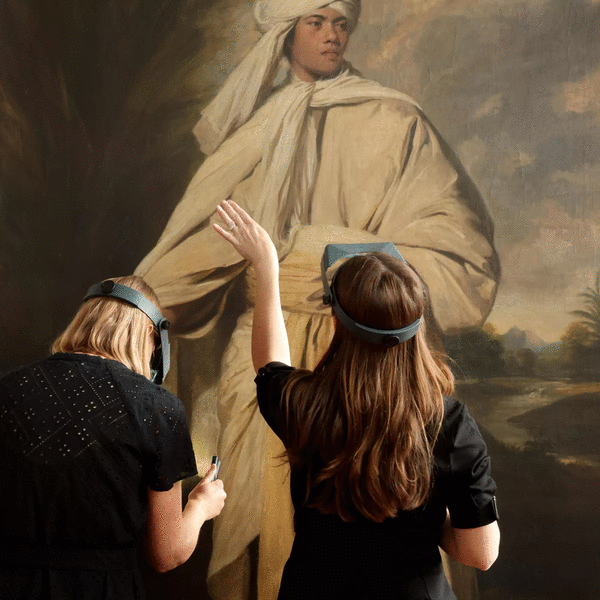
The women peer closely at the canvas wearing headband magnifiers as they pass a small bright light across its surface in order to study the brushstrokes, paint and process Reynolds used to create the painting, which was made in the Grand Manner that defined the artist's work.
"When we do these types of studies, we end up with different questions than we originally asked," Rayner said. "That's one of the things about such a condensed study period that's been a little bit challenging."
The project is an example of the interdisciplinary, cross-institutional work that happens all the time at the Getty, said Catherine Patterson, a scientist for the Getty Conservation Institute.
"It's important to note that a huge amount of the work of gathering that data is what we're doing in this very intense period," Patterson said. "Understanding what it means and what additional questions we have, it takes months."
The art of conservation isn't about changing the subject matter or making a classical painting look new. It's about preserving the historical artifact in order to decipher the artist's intentions and better understand what went into the piece, without disturbing its originality. "Portrait of Mai" stands out for telling the story of the first Polynesian to visit Britain, and is a rare example of a Grand Manner painting done of a person of color.
The artwork introduced tension between Indigenous traditions and Western conventions through the inclusion of Mai's robe, turban and hand tattoos. Upon his arrival in London, Mai became something of a celebrity among the aristocracy, and was welcomed by King George III.
"We work for the art. It's not about us. We're here to serve the object," Patterson said.
"We do our job the best if nobody notices we've done anything," Higgs said. "You'll often read articles about conservation or about art that has been conserved and the name of the conservator is never mentioned."
The most telling details of the painting are revealed through technical analysis, using a number of scans and a conservator's favorite tool — the headband magnifiers known as optivisors. The journey of discovery began with a chemical image analysis to better understand the materials present.
X-ray fluorescence spectroscopy scans identified the chemical elements that make up the painting, including lead. Reflectance imaging spectroscopy was then used to measure how the materials interact with light. The scans revealed multiple layers of paint and reworked areas, including Mai's hand placement and head.
The research also revealed that the pigments Reynolds used contained lead as well as vermilion, carbon black and one or more iron-earth pigments.
"[Reynolds] is notoriously someone that never is satisfied with what he's done," Higgs said. "And you can really see that in this painting that he just can't stop — it's never finished."
Happily for the conservators, their work also showed that the painting doesn't require any kind of additional treatment.
"It's in very good condition, especially for a Reynolds," Rayner said. "That's why we're now carrying out this technical study with the idea that, if and when treatment is needed in the future, it will help inform the treatment."
The work is ongoing. The next phase includes analyzing the binding media and examining the paint layer structure.
The research is ultimately about preserving what the painting represents: a monumental encounter of cultures, said Davide Gasparotto, senior curator of paintings at the Getty.
"It's not just a painting, it's also an anthropological artifact," Gasparotto said. "It talks about this incredibly important moment of encounter of cultures, sometimes difficult, problematic."
The painting will make its L.A. debut on Sept. 14 with a private Polynesian blessing ceremony where guests will experience the living cultural traditions of Tahiti through music, dance and food.
After its welcoming party, "Portrait of Mai" will be displayed among other portraits owned by the Getty, including those by Thomas Gainsborough, Pompeo Batoni, Francisco Goya, as well as sculptures by Jean-Antoine Houdon, Franz Xaver Messerschmidt and Francis Hardwood.
"But [Mai] will have the place of honor," Gasparotto said.
The painting will remain at the Getty through March 14, 2027, after which the Getty will close for renovations. The painting will then be transferred to the Getty Villa for about six months. It will again return to the Getty when it reopens, just in time for the 2028 L.A. Olympics.
©2026 Los Angeles Times. Visit latimes.com. Distributed by Tribune Content Agency, LLC.










Comments