Dolly Parton appreciation: The-one-of-a-kind music legend, dead at 80, forged a path like no other
Published in Entertainment News
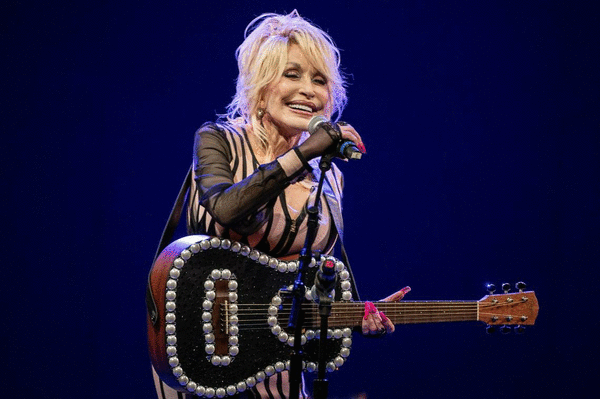
The not-so-well-kept secret to Dolly Parton’s success wasn’t just that she was a first-rate singer, songwriter, philanthropist, entrepreneur, pop-culture dynamo and champion of literacy and education. Rather, it was that while this country music queen took her music very seriously, she never hesitated to make fun of herself — on and off stage — and to play up her larger-than-life image at the same time she skillfully made it work in her favor.
Or as Parton, who died Tuesday at the age of 80, sang in 1967’s “Dumb Blonde,” her breakthrough hit: “Just because I’m blonde, don’t think I’m dumb / ‘Cause this dumb blonde ain’t nobody’s fool.”
Like no one else in — or out of — country music, Parton forged a singular path that will surely be the subject of a future biopic or two.
Her “aw shucks” demeanor led performance artist Laurie Anderson to lampoon Parton on Anderson’s 1984 spoken-word recording, “Walk The Dog.” But Parton often eviscerated the very same country-music cliches so often associated with her, be it her big hair wigs, big chest or glittery, form-hugging outfits.
A small-town girl made very good, she was almost subversive in the manner that she simultaneously embodied and transcended gender and sexual stereotypes. Parton playfully acknowledged this during her acceptance speech in Los Angeles as the Grammy Awards’ 2019 MusiCares Person of the Year.
“People say to me, ‘Well, wasn’t it a man’s world when you got into the business?’ And I say, it sure was. And, buddy, I had a ball!” a smiling Parton recalled. “I have actually worked with so many wonderful men. I’ve never met a man that I didn’t like, and I’ve never met a man whose ass I couldn’t kick if he didn’t treat me with the right respect!”
Parton was a 10-time Grammy-winner, a 2004 Library of Congress Living Legend Medal recipient and a 2022 Rock & Roll Hall of Fame inductee. She was born Jan. 19, 1946, and grew up in a rural East Tennessee shack in Locust Ridge, where she lived with her mother, father and 11 siblings. She was 5 when she wrote her first song, “Little Tiny Tassel Top,” and 10 when she began performing on a regional TV show.
Not long after Parton hit her teens, she was champing at the bit to get the heck out of Dodge — or, rather, Locust Ridge — and make her mark in Nashville and the world at large.
“The worst thing about being 16 is that I wasn’t 18! So, I couldn’t leave home, at least not legally,” Parton told me in our 2016 Union-Tribune interview. (Unless otherwise indicated, all quotes in this article are from that conversation).
“I was dying to leave home when I was 16,” she continued, “but knew my dad would send a posse after me if I did. That was the worst part. And my dad was pretty strict. I wanted a little more freedom, but I enjoyed feeling like a woman — the hormones raging and being boy-crazy. I was serious about my work, songwriting, and I didn’t go as far afield as some of my other girlfriends at that age.
“The best part of being 16 was just being young and alive, and looking to the future. And knowing I was going to arrive there, sooner or later.”
Always resilient
At the time of our interview 10 years ago almost to the month, Parton was embarking on her first North American tour in 25 years. It included a concert at Valley View Casino Center (now Pechanga Arena San Diego).
Why the quarter-century gap between her tours? Parton didn’t mince words in her response.
“Well, I stopped touring when ‘new country’ came in on radio and they stopped playing a lot of us older artists,” she replied. “And, because I didn’t have any radio hits anymore, I honestly didn’t think the fans were that interested in seeing me. I didn’t have a lot going for me, other than the classics I did in years past.
“When other people toured, Garth (Brooks) and all those people who were so successful, I just didn’t think there was a desire, or need, or want, to see me here. But we were doing so great (touring) overseas, it was just amazing. Word came back over here about how wonderful we were doing in Australia, New Zealand and Europe, and some (American) promoters said: ‘Why don’t we put together a tour here?’ I said: ‘Do you think we could sell (tickets)?’ And, sure enough, we are.”
While Parton always embraced her country music and bluegrass roots, some of her best-known songs transcended easy classification.
Her best-known hit, 1974’s “I Will Always Love You,” became an international juggernaut when Whitney Houston performed it in the smash 1994 movie, “The Bodyguard.” The soundtrack album for the film has sold more than 45 million copies worldwide.
The fact that Houston’s version greatly surpassed Parton’s original, at least commercially speaking, in no way bothered Parton.
“I certainly sent Whitney flowers when the song became a hit and any time she won an award for it. I always acknowledge her,” Parton said.
“So, yes, I will always love Whitney. My favorite Whitney/Dolly (line) is when people say: ‘That’s Whitney’s song,’ and I say: ‘I don’t care who gets the credit, as long as I get the cash!’ “
Parton was a very wealthy woman who donated millions to charitable causes. But she didn’t hesitate to turn down lucrative offers that would have required her to compromise.
A key case in point came when Elvis Presley wanted to record his version of “I Will Always Love You” in the mid-1970s. Parton turned him down flat after Presley’s management demanded a large share of the songwriting royalties, even though Parton wrote “Always” entirely on her own.
Another signature Parton song is “Jolene,” which has been recorded by the White Stripes, Norah Jones, Kelly Clarkson, Laura Marling, Mumford & Sons, Strawberry Switchblade and Alison Krauss, one of many, many artists who cited Parton as a key artistic inspiration.
Sly sense of humor
The list of memorable songs that Parton wrote and recorded is extensive. A small sampling ranges from “To Daddy,” “Coat of Many Colors,” “Smoky Mountain Memories” and “Down From Dover” to “Little Bird, “My Tennessee Mountain Home,” “The Bargain Store” and “The Seeker.”
She also had a sly sense of humor, as evidenced by “Why’d You Come in Here Lookin’ Like That?” Another example came with her 2003 gospel-music rave-up “Go to Hell,” which featured one of her most soulful vocals and such tart lyrics as: “Get thee behind me, Satan / Just leave me the hell alone / Take your wars and your politics / Your lust and your greed / And go to hell in a handbasket / ‘Cause heaven waits for me.”
“That’s one of my favorite songs, too,” Parton said. “I plan to, at some point in time, do that song in my Broadway musical that I plan to do about my life story. The way I was performing that song (on record) I brought in my Pentecostal holy-rolling church with all those ‘hahs!’ in the background
“Sometimes in life, people are too good to be real bad, or too bad to be good, and I’m straight in the middle. And in the Bible, it says: ‘Get thee behind me, Satan,’ so I thought that would be good for a song.”
Love of all kinds was a recurring theme in Parton’s work. In her 1991 song, “Family,” she sang: “Some are preachers, some are gay / Some are addicts, drunks, and strays / But not a one is turned away when it’s family.”
At the time of our 2016 interview, Parton was at work on an LGBT-friendly dance-music album. It has yet to be released, but her spirit of all-are-welcome inclusivity — rare in country music — was one of Parton’s hallmarks, as evidenced by “I’m a Wee Bit Gay,” one of the songs from the apparently shelved album.
“It’s the cutest thing!” she said of the song. “It’s about a girl who marries a guy who’s gay, and he finally comes out. It’s a funny story. It’s a dance record and I’m planning to put out a dance album, with new things and maybe remix some classics, and ‘I’m a Wee Bit Gay’ will definitely be on it.”
Not everything Parton did is worth remembering. Her 2023 double-album, “Rockstar,” is a key case in point. It featured her versions of hits by The Beatles, Heart, Journey and other classic-rock acts — with accompaniment by members of those same bands. The album was negligible at best.
But no matter, as Parton explained when asked to recall the last time she had listened to “Hello, I’m Dolly,” her 1967 debut album.
“You know, I don’t listen to my records,” she said. “After I’m finished with (making) them and approve all the (audio) mixes I absolutely never go back and listen to them. I may have to listen to a song, if we’re working it up for a show. But listening to my records, it makes me think too hard — I’m my own worst critic — about: ‘Why did I do this?’ Or: ‘Why didn’t I do that?’ ”
Her perfectionism in the recording studio notwithstanding, Parton had hoped to continue performing indefinitely. Recent health setbacks forced her to postpone a Las Vegas concert residency that, sadly, will now never happen. Last week, she disclosed she was exploring the possibility of having an avatar one day perform in her place.
“I work and I love it,” Parton said. “It gives me energy and a reason to live and not to dwell on being older. I hope to never retire … I want to be like Bob Hope, and people like that, who worked into their 90s.”
That goal, alas, eluded her. But there is no doubt Dolly Parton’s legacy will live on far beyond her — and that many of her fans will always love her.
_____
©2026 The San Diego Union-Tribune. Visit sandiegouniontribune.com. Distributed by Tribune Content Agency, LLC.






Comments