Godzilla, at 70: A history of nips and tucks, but no Botox for now
Published in Entertainment News
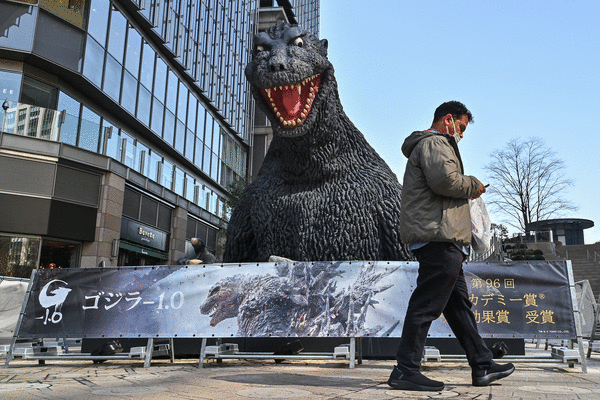

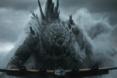
CHICAGO — Seventy years ago, “Godzilla, King of the Monsters!” debuted in Chicago theaters as half of a double bill with a Roger Corman prison flick, “Swamp Women.” Infamously, the movie had undergone an extensive face-lift between its Japanese premiere in 1954 and its landfall in the United States two years later: A pair of independent production companies purchased the American rights on an agreement that anything too Asian or unsettling be removed for American audiences. So, out went all the grim and obvious nods to the bombing of Hiroshima and Nagasaki, the subsequent radiation poisoning. In went a host of new scenes featuring Raymond Burr, playing a U.S. reporter named Steve Martin caught up in the creature’s rampage across Tokyo.
The original, far more somber Japanese version didn’t reach our shores until 2004.
Since then, Godzilla, who is now both the monster and leading man of the longest continually running film franchise ever, has seen so much reconstructive work that when “Godzilla Minus Zero” opens Friday, this sequel to the Oscar-winning 2023 blockbuster “Godzilla Minus One” will play in Japanese with English subtitles, and you won’t be able to avoid nuclear bombs, radiation, American imperialism or war trauma.
Godzilla, the individual, however, has also had a lot of work done.
If you know what I mean.
You could argue, the guy’s twin obsessions are Tokyo and cosmetic surgery.
Sure, if you’re disinterested, he’s always tall, reptilian and vaguely the same.
But that first 1950s iteration, played by both a puppet and a man lumbering in a baggy costume, had dead Muppet eyes and the sagging physique of a gym teacher. And this new Godzilla, entirely computer-generated, is an irritable muscle of spikes and scales, or like a sort of angry gothic pineapple. In July, when I attended the Godzilla convention G-Fest in Rosemont, an Ohio toy seller named Terry Webb put it this way: “Godzilla is the only monster we talk about now like he’s a car — ‘So, which do you prefer, the ’89 Godzilla? Or ’74 Godzilla? Nobody likes the ’98 Godzilla. But this latest model is great.’”
My own fascination with Godzilla, hatched on a UHF channel in the 1970s, was once so blind that my favorite toy was a nonsensical 19-inch-tall Japanese-made Godzilla with no dorsal spikes at all, just bumpy plastic green skin, a tongue of fire that hung out of his mouth like a panting pug and, for reasons that remain a mystery to G-fans, a hand that fired at enemies like a projectile. (That 1977 oddity now pulls in thousands at auctions.)
Still, you knew it was Godzilla.
He had long since entered that rarified species of pop-culture icon who can be recognizable by their silhouette alone — like Batman, Darth Vader, Mickey Mouse. Indeed, sometimes he is a sticker silhouette in the rear windows of SUVs. The other night I spotted what I thought was a giant modified Halloween skeleton on someone’s lawn, only to get closer and recognize the spikes of a bulbous 14-foot-tall inflatable Godzilla ($186), arms at his sides, palms outward, like a Kaiju Larry David at a loss for words. It’s not a reach. In Rosemont, he was also flexible enough to be a pizza cutter, a hammer, a tissue dispenser, a toilet paper holder, a tricycle, a doorbell and a humidifier. There were images of Godzilla reclining, Godzilla meeting Jesus, Godzilla playing Cookie Monster.
Godzilla’s rare mutability, though, was shown best in the homemade costumes at G-Fest, interpretations of a character who was himself interpreted with nearly every new film installment, for 70 years. Some were made of cardboard and construction paper, and some required years and technical skills. The Godzilla suit made largely of foam by Tobias Sorrell, 13, of Houston — his best of three attempts, explained his mother — brought the rage-filled eyes of mid-‘90s Godzilla to the rounded charm of mid-‘60s Godzilla. The Godzilla by R.J. Axen of Waukegan went for a bottom-heavy 2020s look, topped by a playful ’75 Godzilla face that looked a bit like a radioactive double of that ‘70s variety show staple, Wayland Flowers’ Madame puppet.
Hailey Newton-Smith of Toronto sort of wove her body into the massive, 90-pound steel frame that she constructed to recreate the crouched, lean and not-especially-Godzilla-looking Godzilla of the much-hated 1998 Roland Emmerich reboot. Her suit, a long iguana of a thing, was such a beast, she could only walk about 50 steps before quitting.
Yet, canonically speaking, even that headache fits.
The first Japanese designers of Godzilla had planned for a missing link of a monster, part muted animal, part stegosaurus, but as Arlington Heights-based author Ed Godziszewski describes in his definitive history, “Godzilla: The First 70 Years,” Godzilla’s “shape and movements were dictated by the limitations of the man-in-suit method” of imagining him. For decades, every stab at a new costume that was a little more detailed, or easier to walk in, resulted in a new Godzilla. Form, as always, followed function. That first Godzilla suit had proved so inflexible, he became a slow-moving grim reaper of a character, statue-like, empty of expression; and yet, those handicaps meant it wasn’t hard to read him as a clear metaphor for nuclear holocaust. But by the mid-‘60s, as the stories turned into creature brawls, the more toy-like he became. If he was expected now to roll around with Rodan and Mothra, his suits needed to be human-shaped. He grew into less a threat and more of a hero. His eyes became puppy-like. The monster costumes were so ill-fitting that his skin wiggled.
Eventually, though, to keep the character alive, he needed to be scary again, so by 1984, he gained fangs and the heavy brow of a dad who is very disappointed in you. Around 1999, his teeth had grown so large, older Godzillas looked like all gums. For a single 2001 film, his eyes were made ghostly, pupil-less white; for the 2016 hit “Shin Godzilla,” he received a purely zombified facade.
Of course, by this point in his career, Godzilla was no longer the property of an audience of children alone, but also adults, like myself, whose history with the character acquired layers upon layers.
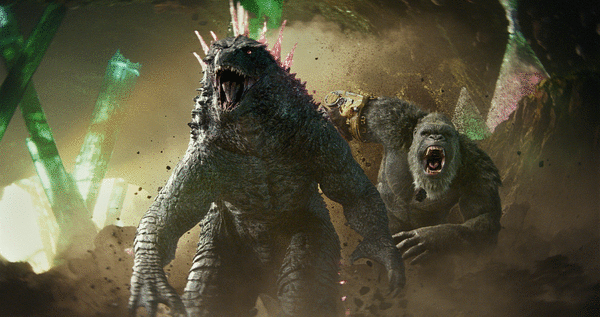
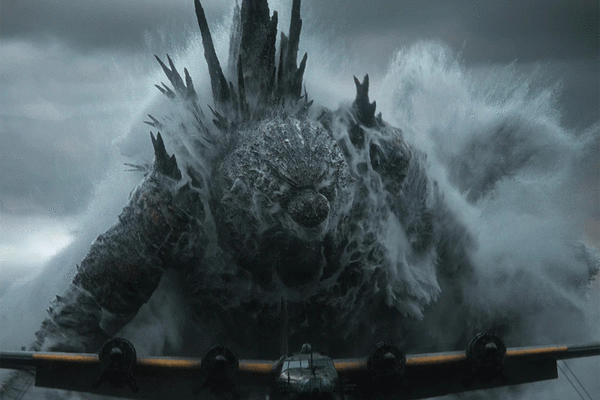
And that’s how I now read the Godzilla of the 2020s — both the American version of those “Godzilla vs. King Kong” movies by Hollywood, and the more threatening beast of Toho Studios’ “Godzilla Minus Zero.” The big guy has seen some stuff. The cragginess of the skin has only grown worse. His life is no longer a litany of light adventures but closer to disaster movies, starring monsters.
These days, Godzilla has the gravitas of age. He looks extracted from the side of a mountain, nearly carved from stone. Being digital now, he moves more fluidly through his day than when everything was analog and latex. Yet you get the sense he would be fine going to bed by 9 p.m. His eyes are tired, and his cheekbones are tightening. He’s resisted Botox. He was never going to be smooth, and he’s fine with it. But he looks angry all the time, and if he spoke, he would tell you:
That’s just what his face looks like.
©2026 Chicago Tribune. Visit at chicagotribune.com. Distributed by Tribune Content Agency, LLC.









Comments