This medical student has a 95% chance of developing a fatal neurodegenerative disease. She wants to find a cure before that happens
Published in Health & Fitness
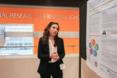
PHILADELPHIA -- Yentli Soto Albrecht is at risk of developing the same condition that claimed her father’s life two years ago.
The University of Pennsylvania medical student inherited a genetic mutation that causes amyotrophic lateral sclerosis (ALS), a fatal neurodegenerative disease in which patients progressively lose the ability to move. The mutation can also cause frontotemporal dementia, which her grandmother had.
She faces a 50% chance of getting either disease by 55, and a 95% chance by 65.
Now, at age 32, Soto Albrecht is pushing to find a cure before she’s likely affected, too.
People usually die in two to five years from the time of symptom onset of ALS, with an average survival of three years. The most common cause of death is loss of breathing. That’s how her father died of ALS at age 66.
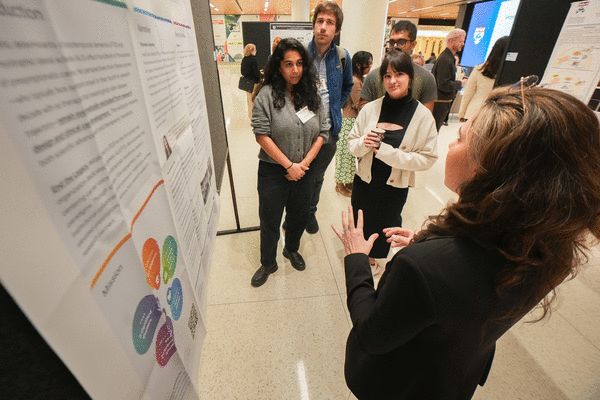
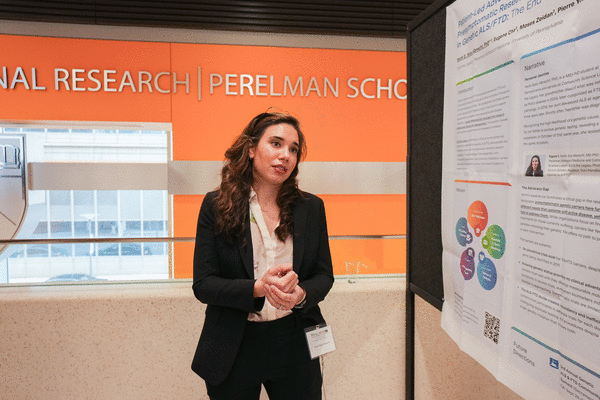
Soto Albrecht is now managing 11 projects that together aim to tackle gaps in research on ALS. They’re focused on testing potential therapeutics, identifying biological markers of the disease, accelerating research with patient samples, and building community awareness.
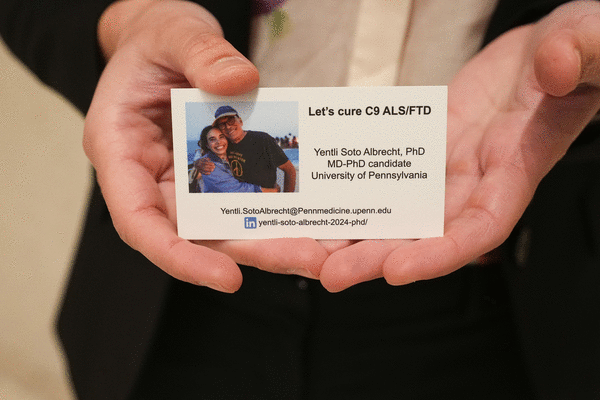
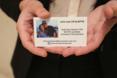
The projects arose from attending conferences related to the disease, where she would give potential collaborators a business card with a photo of her hugging her father, Frank Albrecht.
Her opening question was, “Will you help me survive?”
In her father’s honor, she’s hosting a fundraiser called Pushups for ALS to raise money for research. The event will take place virtually and in person on Wednesday at McCaskey High School in Lancaster, where he worked as a student support facilitator.
Soto Albrecht said she advocates and researches as if she’s running out of time.
“The biggest motivator that exists is survival,” she said.
An unexpected diagnosis
Soto Albrecht, who grew up in Lancaster, enrolled at Penn as an M.D.-Ph.D. student in 2018.
Five years later, her father’s foot stopped working properly.
Her mother texted her right before an important Ph.D. thesis committee meeting, telling her she worried the symptom was a sign of ALS. Frank Albrecht’s sister had died from the disease in 2019.
“It all came crashing down on me,” Soto Albrecht said.
She gave her presentation, then went home, hugged her husband, Samuel Riegel, and cried.
Soto Albrecht knew a Penn neurologist and scientist, Defne Amado, whose lab was on the same floor as hers. She asked Amado to take a look at her dad.
That same week in June 2023, Amado diagnosed him with ALS.
She also ordered genetic testing for him, which came back positive for a genetic cause: variation in the C9orf72 gene.
About 10% of all ALS cases are inherited.
Soto Albrecht tested positive for the mutation as well.
She continued her Ph.D. research, while visiting her father once a week in Lancaster as his disease rapidly progressed.
On Aug. 24, 2024, Frank Albrecht died in her arms, struggling to breathe.
An educator for 42 years, known by his nickname “Brother,” Albrecht was surrounded by friends and family singing hymns in English and Spanish.
Limited options
Care for ALS patients hasn’t changed much since the 1990s, Amado said.
For the vast majority of patients, options are limited to a drug called Riluzole, which can slow the rate of disease progression, extending life by a few months. (A second FDA-approved drug, called Edaravone, has had mixed results in clinical trials.)
Supportive care includes optimizing nutrition and physical activity, and providing breathing and feeding support.
“It is symptom management at that point,” Amado said.
And for C9orf72 genetic carriers like Soto Albrecht, there are no known options for prevention.
After finishing her Ph.D. in infectious disease research in 2024, she launched herself into the ALS community, attending nearly a dozen neurodegeneration conferences in the span of a year.
Soto Albrecht became a community science liaison for a patient-led organization called Genetic ALS & FTD: End the Legacy, which launched as a nonprofit in 2023 to advocate for affected patients. It has funded the majority of her conference trips.
As part of her projects, she has helped scientists find grants, access samples and clinical data needed for experiments, write letters of intent, and put together pitches.
One effort is trying to identify biological markers (a measurable substance or process in the body) that could help scientists better predict and track ALS progression.
Her focus is genetic carriers who haven’t yet developed symptoms.
Currently, the vast majority of trials are focused on treating patients who are already diagnosed.
“Those are really big conceptual gaps that directly impact my ability to survive or outrun my genetic predisposition,” she said.
She is collaborating on an unpaid basis with a Wisconsin-based company BrainXell to improve scientists’ access to patient stem cells for study.
She banked her and her father’s cells, a month before he died, so scientists can study the biology of a patient with active disease vs. a carrier who hasn’t developed ALS.
Soto Albrecht is also helping to fundraise for the Penn ALS Program, an effort Amado founded that is currently seeking philanthropic support following cuts to federal funding for scientific research under President Donald Trump’s administration.
Changing paths
Soto Albrecht recalled simply getting a piece of paper with her odds of getting ALS or dementia when she was diagnosed.
The experience spurred her to let go of her original dream of becoming an infectious disease scientist to study to become a neurologist.
“I want to build the type of care that I seek,” said Soto Albrecht, who expects to graduate in 2027.
She feels her advocacy carries on her father’s legacy of helping others. In his last role as a student support facilitator at McCaskey High School, Frank Albrecht helped students who were struggling to make it to school on time by finding them safe bus routes and buying them alarm clocks. He made late-night house calls to check on those who were thinking about suicide.
The fundraiser revolves around pushups, an activity her father challenged himself to do daily until he couldn’t.
The goal is to raise $65,000 to support promising, treatment-related research, she said.
“Even though he couldn’t survive, maybe we could help other people survive,” she said.
©2026 The Philadelphia Inquirer, LLC. Visit at inquirer.com. Distributed by Tribune Content Agency, LLC.






Comments