Alzheimer's deaths increase as population ages, lifespans increase
Published in Health & Fitness
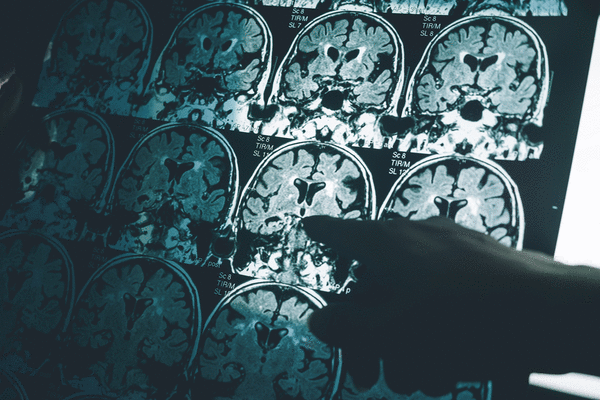
SAN JOSE, Calif. — When Art Curtis was diagnosed with Alzheimer’s and vascular dementia in 2009, the losses came one by one: first driving, then reading, then the ability to bathe on his own. His husband, Gene Girimonte, stayed by his side in their San Rafael home, balancing caregiving with a full-time job.
In that moment, Girimonte became one of the more than 12 million family members providing care to a loved one, helping people with Alzheimer’s or other dementias, according to a recent study in the scientific journal Alzheimer’s & Dementia.
“It’s a role I was not prepared for,” Girimonte said, reflecting on the mental, physical, emotional and financial toll of caregiving.
The study found Alzheimer’s-related deaths have risen 138% since 2000, thanks to lengthening life expectancies and the aging Baby Boomer generation, putting strains on caregivers like Girimonte.
As the risk and rates of Alzheimer’s increase exponentially with age, the impacts of the disease on families, medical providers and health systems could be particularly acute in the Bay Area — one of the fastest aging regions in the country. By 2040, the Association of Bay Area Governments estimates, residents over 65 will make up 22 percent of the region’s population — about 2.1 million people.
About 1 in 9 people age 65 and older, around 11%, are diagnosed with Alzheimer’s dementia. About 35.8% of people over 85 have Alzheimer’s.
For Girimonte, 74, the strain built gradually as Curtis’s condition worsened. As Curtis began falling when left alone, Girimonte had to hire an aide whenever he left the house — a decision that cut into the family’s finances. Eventually, the demands became too much. Curtis moved into a 24-hour care facility. He died in 2018.
The reasons behind the rapid growth in Alzheimer’s-related deaths, which can include deaths from swallowing disorders and malnutrition that accompany the disease, are complex.
While a portion of the increase is attributable to the growing population in high-risk age groups, success in reducing other top causes of death — like heart disease —is partially behind the shift, according to the study. Physicians and coroners are also more likely to list Alzheimer’s as a contributing factor on death certificates, as awareness of the disease has increased.
Slow progress in developing effective Alzheimer’s medications has also played a role, said Claire Day, chief mission and program strategy officer at the Alzheimer’s Association.
That lack of treatment often leaves the burden on families who begin the grieving process while a loved one still lives.
And, the cost of care isn’t cheap. Nationally, the Alzheimer’s Association estimates the 2026 bill for medical care for people with dementia will be $409 billion.
While it’s normal for people to become forgetful with age, the changes in the brain that come with Alzheimer’s and dementia are not, Day said.
“It’s important to talk to a doctor sooner rather than later,” Day said.
Proteins linked to Alzheimer’s disease, known as amyloid plaques, can begin building up in the brain up to 20 years before symptoms appear — underscoring the importance of regular checkups, said Sutter Health neurologist Dr. Minal Bhanushali.
“There’s better awareness of how the disease manifests now, which has led to better detection,” Bhanushali said.
Detection methods now include blood tests and spinal taps that identify proteins linked to Alzheimer’s. For decades, treatment focused on symptoms. In the past five years, therapies targeting amyloid plaques have emerged, delivered through infusions that can help slow, though not stop, cognitive decline.
Even as advances are made in detecting and treating Alzheimer’s, there is still no cure.
In 2019, researchers at the University of Las Vegas, the University of San Diego and Amsterdam University reported that about 99% of Alzheimer’s clinical trials had failed. After decades of setbacks, however, newer treatments are beginning to show success in clinical trials and are now moving through regulatory review. Scientists say these incremental advances could start to shift the trajectory of the disease, even as the number of people diagnosed continues to grow.
Providing families with information about the latest treatments is how Girimonte, who lost his husband to Alzheimer’s, volunteers his time now, using his experience to help others.
“After Art died,” he said, “I wanted to provide whatever assistance I could to help families understand the journey.”
©2026 MediaNews Group, Inc. Visit at mercurynews.com. Distributed by Tribune Content Agency, LLC.



Comments