From pantry staple to social media darling: BeanTok is fueling interest in the humble bean
Published in Health & Fitness
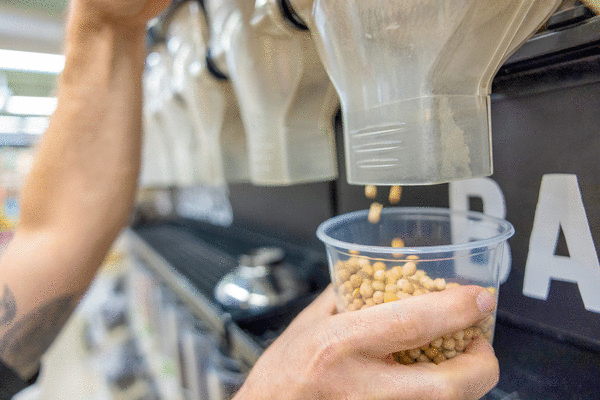
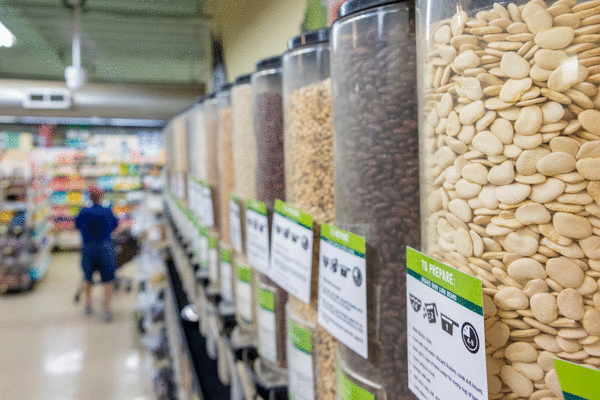


PITTSBURGH -- The social media trend known as #BeanTok has turned lowly legumes like lentils, chickpeas and black beans into unlikely internet celebrities.
Videos showcasing colorful heirloom varieties (like scarlet runner and tiger’s eye), dense bean salads (cowboy caviar) and sly substitution recipes (ever tasted black bean brownies?) have attracted millions of views, while influencers encourage followers to power up their diets with this protein-packed pantry powerhouse.
Many of the trend's loudest advocates recommend eating up to two cups of beans each day, often referring to the practice as the Bean Protocol."
Rather than simply eating a bowlful of beans, influencers showcase creative ways to work legumes into everyday meals, blending them into smoothies, stirring them into pasta sauces, piling them onto toast or incorporating them into salads and grain bowls.
The excitement over beans isn't just social media hype, said Zack Wenger, a dietitian and doctoral student in nutritional science at Penn State who studies how foods affect heart disease and diabetes risk.
"Beans, in general, are a very nutrient-dense food," Wenger said. "They provide a bunch of helpful nutrients, fiber, complex carbohydrates, [are a] great source of plant protein” and other beneficial compounds like polyphenols.
One standout is fiber. A half cup of black beans provides about 8 to 9 grams of dietary fiber, Wenger said — roughly ⅓ of the daily recommendation for many adults.
Most Americans fall well short of recommended fiber intake, research shows.
“People are usually interested in those absorptive nutrients, like amino acids,” but they often overlook the importance of fiber for optimal gut health, said Zheng Kuang, a Carnegie Mellon University professor who studies the relationship between genetics, metabolism and the gut microbiome.
Fiber is a “very important nutrient for the microbiome — the bacteria in our gut — and those bacteria are really, really important for our health,” Kuang said.
Our gut bacteria use fiber to produce a variety of helpful molecules, he said. Among the most studied are short-chain fatty acids, such as acetate and butyrate, which researchers believe help maintain the gut's protective barrier and support metabolic health. Scientists are also discovering new ways the microbiome may communicate with the rest of the body.
Researchers are increasingly exploring how gut microbes influence hormones, appetite, metabolism and even brain development. Kuang said future advances could include using artificial intelligence and microbiome testing to develop personalized nutrition plans.
Still, both Kuang and Zenger cautioned against treating any single food as a miracle cure.
"I think I should go back to my original statement, which is that beans themselves are good for health,” Kuang said, but added that one food can’t act as the be-all and end-all of nutrition. Instead, a diverse diet is a better option.
A growing interest
While researchers continue to study what beans do inside the body, growers are seeing the effects elsewhere: customer demand.
Local farmer Adrienne Nelson, who recently moved her bean growing operation from a vineyard near Aliquippa to a larger farm in Indiana County, planted about 15 varieties this season.
"Folks are really excited and curious about beans," Nelson said. The "timing is right" for beans to have their social media moment.
Nelson first began growing beans in 2019 while helping care for her grandmother in Grove City. What started as a personal project has evolved into a specialty crop business producing hundreds of pounds of heirloom beans each year.
Among her favorites is a French heirloom variety called flageolet.
"There's such interesting stories to all these beans, especially the heirloom varieties," she said. "There are reasons why people decided to grow them for so long."
The burgeoning enthusiasm extends beyond social media. Nelson said she has consistently struggled to grow enough beans to meet demand.
Many customers are interested in replacing some meat in their diets with plant-based protein sources, though Nelson said most conversations at farmers markets start with a more basic question.
"Most of the time I get asked, ‘How do I cook this?’”
Bean farmer Adrienne Nelson tends her bean fields in Aliquippa last summer.(Courtesy of Adrienne Nelson)
At the Bean Institute in Fargo, North Dakota, a nonprofit organization funded by Northarvest Bean Growers Association, registered dietitian nutritionist Kaci Vohland has watched the trend unfold online.
"There's always been an interest in beans, honestly," Vohland said. "There's always been those bean enthusiasts, even before COVID, and before all these social media trends."
But Vohland believes BeanTok succeeds because it makes beans approachable.
"It just gives people a way to share their love of beans," she said. "But then also other people, who maybe didn't know much about beans or hadn't really had them in their diet before, it just makes it more relatable."
The nutrition case for beans is compelling. Beans provide fiber, protein, complex carbohydrates and important nutrients including folate, iron, magnesium and potassium. Plus, they’re a wallet-friendly option as grocery bills continue to climb.
Wenger said beans are among the better-studied foods in nutrition research.
"BeanTok as a trend actually has a solid foundation of evidence — not as the amounts that are currently consumed on BeanTok — but just beans in general," he said.
Research has consistently linked diets rich in legumes with lower risk of cardiovascular disease and improved blood sugar management, he said.
Much of that benefit appears to come from fiber, which can help lower cholesterol by binding with bile acids in the digestive tract while also slowing the rise in blood sugar after meals.
Whether consumers choose dried or canned beans, the nutritional differences are relatively small. The same goes for which variety is consumed: They’re all about equal.
Clearing the air
Vohland and Wenger both caution against one of the more extreme interpretations of the trend: Two cups a day might be troublesome for someone new to a bean-centered diet.
Wenger noted that previous federal dietary guidelines recommended about 1½ cup equivalents of beans, peas and lentils per week for a 2,000-calorie diet.
Both recommend gradually increasing bean consumption, especially for people who are not accustomed to high-fiber foods.
"Starting small and then working your way up" is the best way to introduce beans to your digestive tract, Vohland said.
And the popular rhyme about beans causing gas misses an important point.
"It really should be, the more you eat, the less you toot," she said. "The more you eat, your body gets acclimated to that."
Wenger said the digestive discomfort comes largely from naturally occurring carbohydrates, called oligosaccharides, that are fermented by gut bacteria. Rather than avoiding beans altogether, he also recommended increasing intake gradually, in addition to rinsing canned beans, soaking dried beans before cooking and drinking plenty of fluids.
"The goal is not to avoid beans," he said. "Increase intake gradually, find an amount that's realistic and comfortable."
Even before BeanTok took off, national brand Bush's Beans was working to shift the conversation around beans from playground jokes to nutrition.
The company launched its "Musical Fruit Contest" in 2024, inviting people to rewrite the familiar playground rhyme about beans causing gas to better reflect their nutritional benefits.
The winning songwriter received $10,000, a lifetime supply of Bush's Beans and the opportunity to perform the song at Nashville's Grand Ole Opry.
The company has embraced the latest wave of bean enthusiasm as well.
“It's been exciting to see the continued growth of #BeanTok and broader conversations around beans,” a company spokesperson said in an email, adding that Bush's has been following the trend closely and has participated “in bean culture across social platforms as well.”
For many, the appeal of beans goes beyond any single health claim or viral trend. Beans offer an affordable, versatile food that supports both human health and agricultural diversity.
As social media users continue posting colorful bean bowls, recipe videos and pantry hauls under the BeanTok banner, experts say the real lesson is about embracing variety.
As Kuang put it: "Bottom line is, we should be diverse [and] try different kinds of diets.
©2026 PG Publishing Co. Visit at post-gazette.com. Distributed by Tribune Content Agency, LLC.









Comments