Profs and Pints: Psychedelics' emerging role in therapy
Published in Health & Fitness
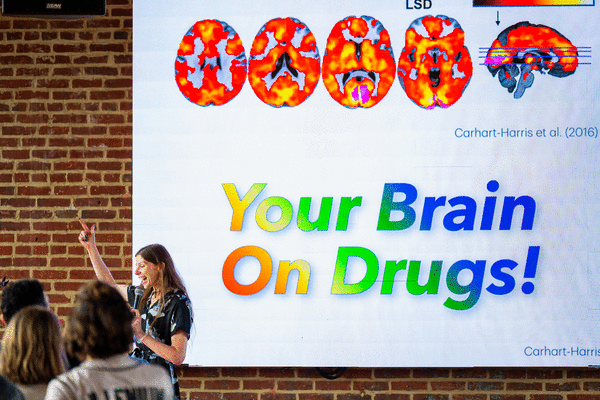
While sipping on pints of beer and eating soft pretzels at Guilford Hall Brewery, more than 100 people eagerly listened as professor Whitney Marris outlined new research in psychedelic medicine and how the drugs can be used to treat a range of conditions.
Marris, who works at the University at Buffalo’s School of Social Work, was the featured speaker at Sunday’s Profs and Pints event, a national lecture series hosted by college professors. The executive order President Donald Trump signed in April “opens doors” for a deeper understanding of how psychedelic drugs can play a role in therapy for substance use disorders and mental health challenges, she said.
“We just do not know that much about being human — we are learning something new every day,” said Marris, who is also a trauma therapist. “The research is incredibly valuable.”
Drugs like LSD, MDMA, ketamine and other psychedelics can be used to treat depression, anxiety, addiction, trauma and other challenges, Marris said. Psychedelics disrupt traditional neural connectivity patterns, allowing for new possibilities and ways of thinking.
Different drugs induce different timeframes of neuroplasticity, which is when the brain learns and adapts. The “open window” of LSD is three weeks, while ketamine’s lasts for two or three days, she said.
“There are these critical periods, and essentially the same as when you are three or four years old — you are so open to learning, you are so curious and awestruck with the world around you,” Marris said. “The way that we have the opportunity to create these new pathways between these neurons is something that is really rich during this period.”
Researchers are studying whether the “trip,” a psychedelic-induced altered state of consciousness, is necessary to reap the benefits of neuroplasticity. The president’s executive order opened the door to more studies on trips, Marris added.
The goal of psychedelic medicine is to encourage a new way of thinking and processing life events, ultimately leading people to contribute to the world differently on a social level, she said.
“We are not creating something new — it is about remembering and returning and excavating what is already there,” Marris said. “And having that cascade outward socially, because that’s really what this works about.”
Psychedelics can cause an “ego death,” or a loss of self and beliefs. But that ego death can foster a connection with the authentic self and bring previously repressed emotions to the surface, Marris said.
Similarly, “mystical experiences” — deeply meaningful moments of transcendence — can foster more neural connections and shape ideas about self-identity, she added.
The D.C.-Maryland-Virginia area is a “model” for other states in terms of psychedelics, Marris said, pointing to Maryland’s psychedelic task force and Washington’s decriminalization of some psychedelics. Legalization and decriminalization can help ensure the quality of drugs, she said.
As a trauma therapist, Marris has worked with some clients for three to five years. In that time, she said, she has seen the benefits of psychedelics — with some clients even becoming so inspired that they go on to become therapists themselves.
Katrin Ilieva attended the event after researching psychedelic-assisted therapy for her own use and wanting to hear from an expert in the field. She said she was encouraged by how the East Coast is beginning to decriminalize and accept psychedelic therapies.
“I really appreciated her talking about how [psychedelics] can be opened up to us on a greater scale — opening it up to us as a society and a way to heal and connect on a larger picture,” she said. “It’s a way to access your true self.”
________
©2026 The Baltimore Sun. Visit at baltimoresun.com. Distributed by Tribune Content Agency, LLC.





Comments