Commentary: House Democrats have big (government) plans for health care
Published in Health & Fitness
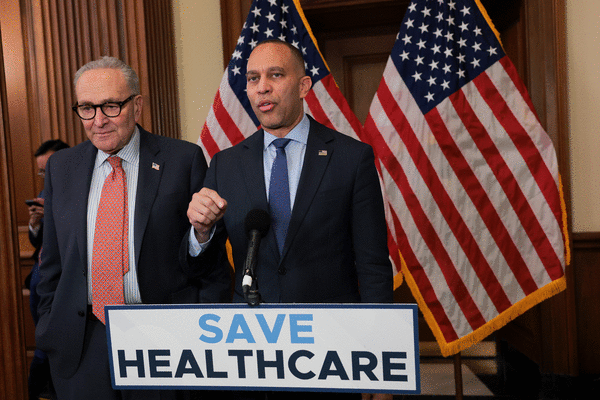
Now that Democrats have regained control of the House, they will likely embark on a mission to expand government in the name of making health care more affordable. The House Democrats’ Cost of Living Health Care Working Group put out a new plan that doubles down on old ideas of government expansion—subsidies and mandates instead of choice and markets.
In keeping with that blueprint, Democrats have outlined a raft of proposals for their first 100 hours in the majority. Unfortunately, big government plans for affordability won’t solve the underlying causes of health care costs.
Consider that while Democrats have been pointing to health care as a driver of higher living costs for decades, well before Congress and President Obama passed the Affordable Care Act, prices of health care services have continued to increase—even while government participation has increased in the vain attempt to stop it.
For example, two prominent health care bills of the past 10 years, the No Surprises Act and the Inflation Reduction Act’s redesign of the prescription drug benefit for Medicare (Part D), both ended up raising costs beyond the already-high costs they were meant to solve. In February of this year, CBO estimated Part D would cost $650 billion more than previously projected through 2035, largely because the IRA would be more costly than originally thought.
In short, the No Surprises Act took a real problem and made it worse. Patients were getting medical bills from out-of-network providers they never chose and were stuck with massive, surprise bills. Congress tried to fix this by creating an arbitration process between the insurance companies and the providers. While this process did fix the immediate problem for the patients, the result is that certain specialists, such as anesthesiologists and ER doctors, have less incentive to participate in insurance networks, impeding one of the tools insurers use to reduce costs. Now, overall costs are going up, and patients are still paying, only through premiums rather than surprise bills.
Likewise, the Part D redesign was supposed to lower prescription drug costs for Medicare beneficiaries by limiting their out-of-pocket costs. But those costs don’t just go away because the government redirects them. Whereas premiums for Part D plans grew extremely slowly over the past 10 years and were only around $50 per month for beneficiaries, federal spending on the program has exploded, and taxpayers are now paying hundreds of dollars more per Medicare beneficiary per month than they were before the redesign.
The problem we are facing now is that the Working Group’s proposals apply the same general approaches to other parts of the health care system. The results will be as dismal.
In the first one 100 hours, the Working Group proposes to re-expand Medicaid to able-bodied adults who choose not to work, restore states’ ability to engage in the provider tax scheme that even Presidents Obama and Clinton worked to reduce, and tell states they no longer need to check eligibility of Medicaid and ACA recipients as often, so if recipients are no longer eligible, taxpayers will continue to foot the bill. The total price tag comes to $1.2 trillion over 10 years, by my calculations.
A key part of the platform is to expand Medicare to cover not just hospital visits, doctor visits, tests, and medicines, but also to offer dental, vision, and hearing coverage at no additional cost. Because today’s retirees did not pay the taxes to cover these benefits when they were working, the new majority effectively wants to impose another $900 billion burden on current and future workers.
Combined with their other health policy proposals set forth in the first 100 hours program, including ones that will reduce spending such as expanding Medicare’s ability to set drug prices, the full first 100 hours will set taxpayers back more than $2.5 trillion over 10 years.
But the health care spending spree won’t stop in the first 100 hours. By the end of their first year, Democrats also intend to expand Medicare to kids and younger adults and add home care service, all while limiting patients’ out-of-pocket costs. Along with the other provisions in their agenda in their first year, Democrats plan to spend $11 trillion over 10 years, even after accounting for proposed savings from lowering the price Medicare pays for drugs and implementation of site-neutral payment reforms.
Now, can Democrats really get all that done? Maybe not. Their power will be limited by the Senate, where they don’t have enough votes to overcome a filibuster and President Trump’s veto. But expect them to push those policies nonetheless.
Certainly Democrats are on to something when they point out that health care in the United States is expensive and one of the most significant drivers of the cost of living. But the answer is not to hand more of it over to the government so it can add requirements and hide the costs. The only way to bring costs down is to remove regulations and give consumers more power over the decisions, informed by signals of actual costs (which, incidentally, is how prices for popular weight loss drugs have become so much more affordable). Like it or not, consumers are ultimately the ones who can best reduce costs, not government.
______
Jeremy Nighohossian is a senior fellow and economist with the Competitive Enterprise Institute, a free market public policy organization based in Washington, D.C.
_____
©2026 Tribune Content Agency, LLC.









Comments