Baltimore Inner Harbor water quality 'gradually declining,' report shows
Published in Science & Technology News
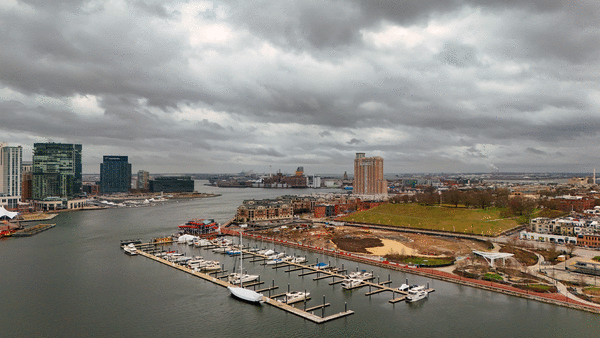
BALTIMORE — Baltimore’s Inner Harbor is getting worse — even as other waterways in the region show signs of recovery, according to a new report that sharpens concerns about the city’s long-running struggle with pollution.
A report released Wednesday by Blue Water Baltimore found water quality in the Inner Harbor has declined over the past 15 years, painting what the group called “a growing crisis” despite incremental improvements in some metrics.
“Clearly, the status quo isn’t working,” said Alice Volpitta, Baltimore Harbor Waterkeeper with Blue Water Baltimore. “The question we have to ask ourselves is: do we want our children to inherit a Harbor in decline? Or are we ready to really commit to the solutions we know do work so we can all enjoy a healthier future?”
While none of the Inner Harbor sites had 2025 data scoring “very poor” quality levels, the individual indicators going into those scores vary.
Excess nutrients like nitrogen and phosphorus can fuel algal blooms that deplete oxygen and harm aquatic life, while murky water blocks sunlight needed for underwater grasses to survive.
Other areas improve in water quality
By contrast, other parts of the Baltimore-area watershed are improving. Data on fecal bacteria — a key measure of sewage contamination — shows gradual progress over time, though pollution remains widespread.
More than 20 monitoring sites across Baltimore City and Baltimore County still recorded high bacteria levels in 2025, including stretches of Gwynns Falls, Jones Falls and Back River. Those waterways feed directly into the harbor.
Some areas performed far better. Portions of the Patapsco River — including Rock Creek, Bear Creek and the Fort McHenry Channel — earned “excellent” ratings for low bacteria levels, according to Blue Water Baltimore’s data.
Blue Water Baltimore attributed some of the improvement to years of investment in sewer repairs and expanded treatment capacity, which have reduced — but not eliminated — sewage pollution. Spills still occur regularly, particularly during heavy rain, when stormwater can overwhelm aging infrastructure.
A suspected broken pipe led to 1.7 million gallons of raw sewage flowing into the Jones Falls late last year. There have been six city sanity sewer overflows over 10,000 gallons in 2026, according to Baltimore Department of Public Works data.
A push for action
The group is calling for more aggressive action, including improving sewer infrastructure to stop the scourge of overflows, tightening stormwater management requirements and more stringent anti-pollution investigation and enforcement.
Environmental advocates say stormwater runoff — carrying nutrients, sediment and other pollutants — remains the leading source of contamination in Baltimore’s waterways and ultimately the Chesapeake Bay.
Multiple groups, including Blue Water Baltimore, recently argued their case that the state needs to revise Maryland stormwater regulations they believe are too weak to prevent environmental damage to the watershed and ultimately, the Chesapeake Bay.
Dealing with a consent decree
Both Baltimore City and Baltimore County are under longstanding federal consent decrees to fix their sewage systems. The agreements, entered in the 2000s for both jurisdictions, are ongoing.
Baltimore City now projects its Phase II plan to “eliminate” sewer overflows will be complete by 2046, missing the original deadline of 2030. Since 2002, the city has invested more than $930 million in sewer upgrades, with an additional $1.15 billion in spending projected by 2030, DPW said last August.
Between 2018 and 2024, the city saw an almost 40% reduction in the number of yearly sewer overflows, with an 85% decrease in the gallons of sewage involved, according to its modified consent decree plan published last fall.
Further up the watershed, Baltimore County approved a plan on Monday to label a narrow portion of its sewer lines south of West Joppa Road as “deficient.”
--------------
©2026 The Baltimore Sun. Visit at baltimoresun.com. Distributed by Tribune Content Agency, LLC.






Comments