Transmission lines, the arteries of the power grid, need more room to breathe
Published in Science & Technology News
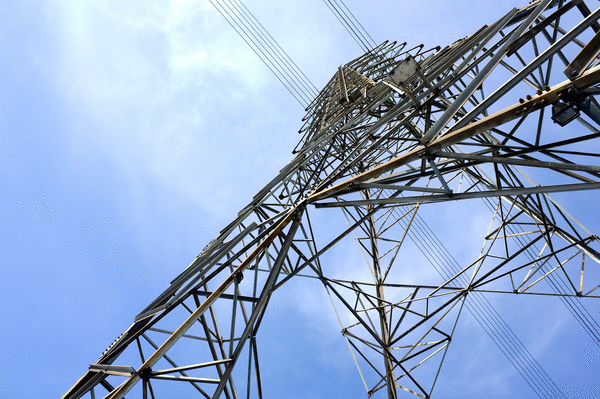
They don’t look like much — two small boxes and a solar panel mounted on some utility poles around Pittsburgh. A small weather station and a sensor, constantly updating Duquesne Light on the conditions of its transmission lines.
The system is crunching the data into a physics equation that governs how transmission lines operate. The more current they carry, the more heat is generated on the line. Heat causes transmission lines to expand and to sag, bringing them closer to trees, buildings and the ground, opening up opportunities for inefficiencies and worse: arcing, fires, and faults.
Without that real-time sensor data, transmission lines operate at their most conservative safety limit — assuming a worst-case scenario. But even a breeze can help cool a transmission line enough to safely push more electrons through it.
In 2022, Duquesne Light became the second Pennsylvania utility to install dynamic line rating systems on some of its transmission lines. Last year, it expanded that program to cover a quarter of the miles on its transmission system. The systems are a series of sensors mounted on poles.
Its pilot program showed that the utility could increase capacity on its transmission lines by 25%.
“How that shows up as a value to a consumer is you get a more affordable product,” said Josh Gould, Duquesne Light’s director of advanced grid solutions and strategic planning.
‘Not a panacea’
It’s utility consumers that end up paying for so-called congestion costs. The electricity price we see on our bills includes the consequences of the grid calling on more expensive power when a cheaper option can’t be delivered to us.
In the first three months of 2026, customers in Pennsylvania and 12 other states that are part of the mid-Atlantic grid managed by the PJM Interconnection, paid more than $2 billion in congestion costs, a 300% increase from the same period a year ago, according to PJM’s market monitor.
PPL, a utility that serves Pennsylvania’s eastern region, was the first to pilot dynamic line ratings in the state. It installed systems on three congested transmission lines in 2020 at a cost of about $1 million. The utility calculated that consumers saved $65 million in congestion costs from the unlocked capacity on those lines and PPL avoided building a new line, which would have cost $50 million.
Duquesne Light and PPL are now routinely deployed in testimony and as case studies of how advanced transmission technologies can help alleviate what’s ailing today’s electric grid: high prices for consumers, high costs and barriers to building new infrastructure, and a system that needs more capacity as soon as possible.
“It’s a really great technology,” Gould said. “We like it and we’re early adopters, but it’s not a panacea. Nor is it a replacement for traditional infrastructure investment.”
‘No one’s pushing against it’
Advanced transmission technologies are a suite of options that aim to get the most out of existing infrastructure.
The category also includes software that helps utilities figure out which circuits to open and close in order to route power more efficiently, as well as costlier options like wires made with advanced materials which don’t heat up when they conduct electricity and can therefore carry a lot more of it at once.
Efforts to encourage, if not require, advanced transmission technologies have trickled down from the federal level. The Federal Energy Regulatory Commission, which oversees interstate transmission lines, requires they be evaluated as part of transmission project plans. Some 20 states have passed legislation to nudge utilities to consider these options.
Pennsylvania may be next to join.
Earlier this month, the Pennsylvania House unanimously approved a bill that would mandate utilities and transmission owners to show they’ve analyzed using advanced transmission technologies in their infrastructure projects.
When, during a March hearing on the bill in the House Energy Committee, co-chair Martin Causer said he would need to evaluate if it helps or hinders efforts to add more generation to the grid, his co-chair and bill sponsor, Elizabeth Fiedler, said it will help do both: “get more energy on the grid and get more energy from the grid.”
“It helps us simply get more out of the infrastructure that we already have,” she said.
John Walliser, senior vice president of legal and government affairs at the Pennsylvania Environmental Council, said the vote was a rare point of agreement in Harrisburg.
“We reached out to the utility side, labor, industrial users — they liked it,” he said. “No one’s pushing against it.”
‘You can have surprises’
In a 2019 report, the U.S. Department of Energy argued that the “U.S. provides transmission owners little incentive to deliver more power over existing lines or to reduce transmission congestion.”
Instead, transmission companies have an incentive to build new, expensive infrastructure. Their investors receive an approved rate of return on such projects. That means the bigger the spend, the bigger the return.
This is why energy efficiency and consumer advocates have argued that utilities must be encouraged to adopt these technologies by mandate or through stronger incentives.
That has already started to happen.
“Partially, it is a matter of uptake and getting comfortable with the system,” said Jenny Netheron, an officer in the energy modernization program of The Pew Charitable Trusts. “Utilities are just one of the most conservative businesses we have — for a good reason.”
Gould is a believer.
It’s what he does all day — hunt for new technologies to solve grid problems. But he cautions that systems like dynamic line ratings are measurement technologies that are useful for diagnosing problems as much as opportunities.
“When you start measuring things, you can have surprises, and sometimes the surprises indicate you should actually upgrade that transmission line,” he said. “And that is expensive, but that is still necessary.”
©2026 PG Publishing Co. Visit at post-gazette.com. Distributed by Tribune Content Agency, LLC.






Comments