Boom, boom, boom: 2 Cape Canaveral launches, 3 sonic booms coming Thursday
Published in Science & Technology News
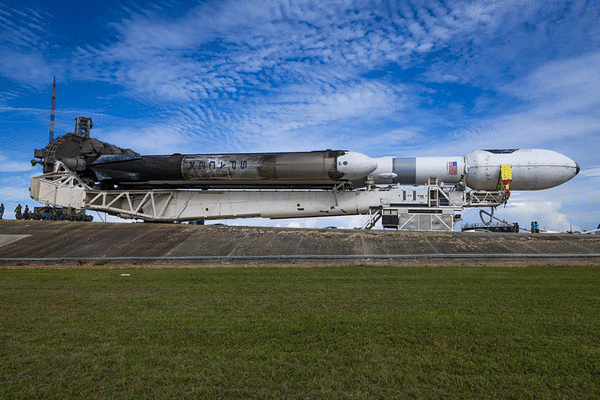
Thursday is fueling up to bring the noise with two SpaceX launches on the Space Coast that could bring three boosters back for landings that could bring sonic booms across Central Florida.
First up at 11:10 a.m. EDT is only the second crewed mission to fly from Florida this year, and one that features an astronaut raised in Volusia County.
Luke Delaney, 47, who grew up in DeBary and attended both DeLand and Deltona High School, is making his first trip to space as part of the Crew-13 mission to the International Space Station.
He will take the role of pilot alongside fellow NASA astronaut and commander Jessica Watkins returning to space after having flown on the Crew-4 mission to the station in 2022. The crew is rounded out by two more first-time space flyers: Canadian Space Agency astronaut Joshua Kutryk and Roscosmos cosmonaut Sergey Teteryatnikov.
The quartet flew into Kennedy Space Center last Saturday to prep for their launch.
“Coming here to Kennedy, coming back to Florida, it’s definitely near and dear to my heart,” DeLaney said. “I grew up pretty close to here. I got to watch Space Shuttle launches. And now I’m going to get to see it from a little bit different perspective.”
They will ride the Crew Dragon Grace, making its second trip to space after last year’s Axiom-4 mission and launching atop a Falcon 9 rocket from Cape Canaveral Space Force Station’s Space Launch Complex 40.
They are headed for a monthslong stay on the station and will relieve Crew-12, which has been on board since February.
DeLaney will be participating in some human experiments geared toward understanding the effect of long-term stays in space during his tenure on the station.
“It definitely puts things in perspective for me when I think about all the human and physiological aspects,” he said. “Everybody’s different, everybody’s body is different. We’re still trying to characterize a lot of things.”
He said his crew’s contributions are meaningful to NASA and partner agencies’ goals on the moon and beyond.
“I’m excited — well, maybe not as excited for all the blood draws, but I’m excited to be donating some blood up there and getting these changes in the body characterized so we can get the appropriate mitigations and countermeasures in place,” he said. “A huge step, and it’s hugely important for what we’re going to be doing in the years to come.”
The booster for the mission is making its third trip to space. It will then return to the launch site to attempt a touchdown at Landing Zone 40, which could bring the first sonic boom of the day to Central Florida about eight minutes after liftoff.
“There is the possibility that residents of Brevard, Orange, Osceola, Indian River, Seminole, Volusia, Polk, St. Lucie and Okeechobee counties may hear one or more sonic booms during the landing, but what residents experience will depend on weather and other conditions,” SpaceX warns in its media advisory.
The midday boom may not be as jarring, though, as those that could come from the second launch of the day when a SpaceX Falcon Heavy is set to launch just before midnight from KSC’s Launch Pad 39-A.
The powerhouse rocket is essentially three Falcon 9’s strapped together and are slated to lift off on the NROL-97 mission with a classified payload for the National Reconnaissance Office at 11:53 p.m.
So just after midnight, not one, but two of the Falcon Heavy boosters will once again make their way back to the Space Coast potentially bringing the jarring booms across the region.
Since Crew-13’s booster will be taking up the landing spot at LZ-40, the Falcon Heavy boosters will return to the double landing sites of LZ-1 and LZ-2 farther down the Space Force station as they had during the rocket’s previous historical flights since it first launched in 2018.
The Space Coast has never had three booster landings in one day before, but the frequency of sonic boom events on the Space Coast could be increasing in years to come.
That’s because SpaceX is gearing up to bring its Starship and Super Heavy rocket to the Space Coast as early as this year. The in-development rocket became the most powerful to ever make it to orbit during a test flight from Texas on Monday.
SpaceX is near completion of the launch tower for the rocket at KSC’s Launch Complex 39-A adjacent to the pad where Falcon Heavy will lift off.
The company is also constructing two more towers at Canaveral’s Space Launch Complex 37.
Each launch of Starship is designed to bring the Super Heavy booster back to launch site to be captured by the tower’s swiveling arms called “chopsticks.”
Then the upper stage could also potentially be making returns across Central Florida similar to how the space shuttle made flights back to Kennedy Space Center before it retired.
The frequency of launches and landings, though, could dwarf those of the space shuttle era, with SpaceX aiming for as many as 120 launches from the three Space Coast sites per year initially.
And compared to the Falcon rocket boosters, the Super Heavy boosters are much more potent.
Now an associate professor in aerospace engineering at Embry-Riddle Aeronautical University, Michael Kinzel told the Orlando Sentinel last year to expect bigger effects from Starship, which stands at over 230 feet tall compared to the 130-foot-tall boosters of Falcon rockets, and are much wider in diameter.
“The easiest way to think about it is it’s very similar to a wave on the bow of a ship,” he said. “So the bigger the boat, the bigger the wave. So it would create a potentially larger shock wave.”
_____
©2026 Orlando Sentinel. Visit at orlandosentinel.com. Distributed by Tribune Content Agency, LLC.






Comments