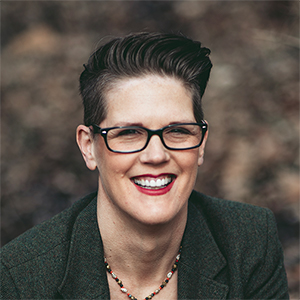
I Grew Up in a White Community. Here's How I Didn't Become a 'Karen.'
Last week, an Arizona man flying out of Dallas-Fort Worth International Airport ended up duct-taped to his seat following a tirade of racial slurs and violent language. When instances like this happen, I often wonder: Why is this person so hardwired for hatred? And why didn't I turn out that way? I'm a middle-aged white woman. I've seen plenty of vitriol spill from the mouths of people who look like me. How did I not end up a "Karen"?
I grew up on the Kentucky side of the Ohio River in a predominantly white community. The diversity in my high school class consisted of one Latina and one Asian American student. I could have easily absorbed the messages of white supremacy. I know some of my classmates did. But when I think about what shaped my views, it's my childhood experiences that come to mind. I don't remember any direct conversations at home around the topic of racism or xenophobia. My parents never used racial slurs, but we didn't talk about systemic inequities at the dinner table, either.
However, I loved the stage, and my stepmom took me to auditions in Cincinnati, Ohio. I was in two productions at the Arts Consortium of Cincinnati. The ACC was founded in 1972 as the city's first African American art hub. I was 10 years old in 1985 when I took the stage to lip sync Cyndi Lauper's hit "Time After Time" for their version of the then-hit television show "Puttin' on the Hits." A year later, I played the little girl in a play based on Hans Christian Andersen's fairy tale "The Steadfast Tin Soldier." These productions were produced by, directed by and filled with Black artists I did not see in my neighborhood. They mentored me as a young performer, and my parents welcomed the opportunity for me to learn. I thrived in that diverse, creative space.
As a teenager, my dad gave me bus money so I could take the city bus after school to work concessions at Riverfront Stadium in downtown Cincinnati. My parents encouraged my independence.
Meanwhile, I knew people in my life who were afraid to cross the river. They were afraid to go to downtown Cincinnati, saying it was dangerous. I am so grateful that my parents were not some of those people. And before anyone claims that it was safer back then: No, it wasn't. According to Our World In Data, violent crime in America peaked in the early 1990s, which is precisely when I was riding the bus to work downtown. It's actually much safer now than it was then.
There were no cellphones back then. Dad would drop me off at school in the morning and not see me again until he picked me up outside the stadium after the ballgame close to 10 p.m. My dad tells me that he did worry about me in the way all parents do, but he didn't stop me. Instead, he taught me the street names of Cincinnati and how they were laid in a grid. I knew downtown well enough that I could walk home if I ever needed to. Without a cellphone or navigation app, I could figure things out with a simple paper bus route schedule and what Dad had taught me.
Each of us gets to determine how to respond to people and environments that are unfamiliar to us. We can choose fear and let that divide us or we can choose curiosity and let that unite us. I cannot underestimate the impact of these early life experiences and how they fostered my independence as well as my faith in humanity.
Sometimes our parents show us who we don't want to be, and we have to overcome stereotypes enforced at home. But in my case, I recognize the value of my childhood experiences, and providing those experiences is one parenting skill I aim to replicate. I want my children to see community in every face they meet, regardless of race, religion, creed or socioeconomic status. Perhaps the best defense against hatred isn't telling children what to think. Maybe it's giving them enough real-life experiences that they understand the intrinsic value of all of their neighbors from the very beginning.
Do you know anyone who's doing cool things to make the world a better place? I want to know. Send me an email at Bonnie@WriterBonnie.com. Also, stay in the loop by signing up for her weekly newsletter at WriterBonnie.com. To find out more about Bonnie Jean Feldkamp and read features by other Creators Syndicate writers and cartoonists, visit the Creators Syndicate website at www.creators.com.
----
Copyright 2026 Creators Syndicate, Inc.










Comments