Mark Gongloff: Relax. Solar panels won't give you cancer
Published in Op Eds
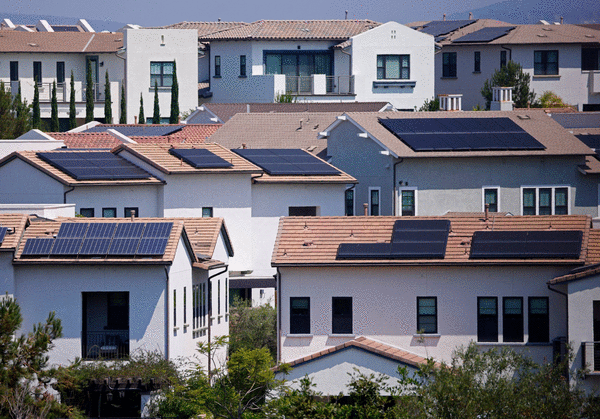
We live in an age of both scientific miracles and superstition about science, increasing more or less in tandem. One year we’re creating novel vaccines that arrest a global pandemic, and four years later we’ve got measles outbreaks because people believe nonsense about vaccines, disseminated by the nation’s chief health official.
Solar power is another example. Here is a technology that, rather than digging up fossils and burning them to unleash solar energy collected millions of years ago, miraculously sucks that energy directly out of the sky. Unlike those fossil fuels, it’s harmless, limitless and on balance doesn’t generate greenhouse gases that heat up the planet.
Solar is also cheaper than fossil fuels, which helps explain its exponential growth. Global solar power generation grew by 636 terawatt-hours in 2025, a 30% increase, according to the research firm Ember. That was the fastest growth in a year for any energy source on record, aside from a temporary rebound in coal use after lockdowns during the COVID-19 pandemic. New solar alone met three-quarters of the world’s new energy demand last year. Over the past decade, solar power has increased 10-fold, rising 27% a year, on average.
Still, not everybody loves solar. In the U.S., installations actually fell 14% in 2025 from a year earlier, bucking the global trend, according to the Solar Energy Industries Association and the consulting firm Wood Mackenzie.
Solar was still the biggest source of new energy in the U.S. last year, making up 54% of all additions, compared with just 8% for natural gas. Solar and battery storage combined made up 79% of new U.S. energy sources in 2025. But its growth has decelerated, mostly because of President Donald Trump’s whole-of-government assault on clean energy.
But another factor hurting solar in the U.S. is growing local opposition based on fears about the impacts of solar farms on human health, ProPublica reported recently. It cited the county of St. Clair, Michigan, which last year made it harder to build new solar installations on rural land, citing worries about noise pollution, “visual pollution” and the risk of toxic waste. This decision was based on memos from the county health chief suggesting these issues posed “an unreasonable threat to public health.”
Noise, ugliness and toxic waste are just a few of the health-related worries cited in recent years in Michigan, Ohio and other places to block or slow down solar development. What follows is a somewhat longer, if still only partial, list. Many of these worries are understandable. All of them are easily refuted.
Myth: Solar farms are too noisy.
Reality: Solar farms do make noise, but not nearly enough to hurt people physically or mentally. Inverters that change electricity from direct current to alternating current for the grid generate up to 70 decibels (adjusted for human hearing sensitivity, or dBA), according to the Colorado community solar company PureSky Energy. That’s about as much noise as a window air-conditioning unit. Battery storage systems and transformers produce similar sound levels. But once you’re about 100 feet away from this equipment, their sounds disappear into the background. A rural solar farm might generate 30 dBA, according to noise control engineer Michael Bahtiarian of the consulting firm Acentech. That’s about as loud as a whisper. A tractor, meanwhile, can get up to 100 dBA or more.
Myth: Solar farms are too ugly.
Reality: Ugliness is subjective, but sure. They’re not beautiful. They may even be ugly enough to harm people’s mental health. This is easily remedied by locating them remotely and surrounding them with landscaping, which can also help with any lingering worries about noise. Proper positioning and landscaping can also eliminate any glare from the panels that might affect local pilots.
Myth: Solar panels release toxic materials.
Reality: The amounts of dangerous elements such as lead and cadmium in solar panels are tiny, and they’re encased in tempered glass in the panels. Cadmium in panels is typically a variety that is 1/100th as toxic as regular cadmium, according to a Columbia Law School study from 2024. Panels are built to withstand sun, snow, rain, hail and other natural assaults, meaning they won’t crumble to bits. They also don’t burn easily, and if they do burn their elements are trapped in the fused glass.
Myth: Solar farms’ electromagnetic fields (EMF) make people sick.
Reality: If you stand next to an inverter, you’ll get the same EMF as an electric can opener, notes the Columbia study. If you get 9 feet away from it, that EMF drops nearly to zero. You get much more exposure hanging out by your fridge or microwave.
Myth: Solar farms are too hard to decommission and clean up.
Reality: Most solar panels are recycled these days. And developers are typically on the hook to clean up old solar farms, an obligation often secured with a bond. The amount of solar-panel waste is negligible compared with, say, highly toxic coal-ash waste, notes a 2023 study by Heather Mirletz, a researcher with the National Renewable Energy Laboratory.
In fact, you can’t talk about the health and environmental impacts of solar without weighing them against the alternatives. Fly ash from burning coal leaches far more lead, cadmium and other materials into the ground, harming human health and agriculture. The estimated 2 million unplugged, unused oil and gas wells in the U.S. pump oil and other toxins into the land and water and emit planet-heating methane, as a separate ProPublica investigation in 2024 noted.
Meanwhile, burning fossil fuels is making the planet hotter, raising the risks of drought, wildfire, disease and other things that will cost millions of lives and trillions of dollars in lost economic productivity if we don’t change course quickly.
The human brain is hardwired to trust things that are familiar and to distrust things that are new. This doesn’t make people dumb, but it does make them vulnerable to fear-mongering by the fossil-fuel interests often behind seemingly “grassroots” resistance to relatively new technologies such as solar and wind. In those cases, increasing familiarity should breed admiration, not contempt.
_____
This column reflects the personal views of the author and does not necessarily reflect the opinion of the editorial board or Bloomberg LP and its owners.
Mark Gongloff is a Bloomberg Opinion editor and columnist covering climate change. He previously worked for Fortune.com, the Huffington Post and the Wall Street Journal.
_____
©2026 Bloomberg L.P. Visit bloomberg.com/opinion. Distributed by Tribune Content Agency, LLC.




































Comments