Commentary: When leaders disagree, ceremony plays an important role
Published in Op Eds
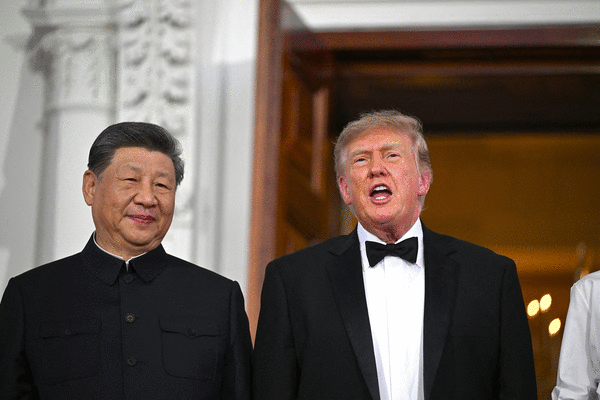
When Chinese President Xi Jinping arrived at the White House on Sept. 24, the U.S. welcomed him with an elaborate display of ceremony. The Army Herald Trumpets sounded a fanfare, the Chinese and American national anthems were played, and the Old Guard Fife and Drum Corps performed. A military review was followed by a flyover involving a B-2 bomber and four F-22 fighter jets, according to the White House.
It was an extraordinary production for two countries that still disagree on some of the most important issues in international politics.
Talks between President Donald Trump and Xi touched on trade, artificial intelligence and Taiwan. The visit was marked by warm words and some signs of cooperation, but it did not erase the fundamental competition between the United States and China. So why was all this ceremony staged?
It is tempting to dismiss political pomp as mere window dressing: an expensive historical relic surrounding the serious business taking place behind closed doors. As a music historian, however, I think this misunderstands what ceremony does. Ceremony can become particularly valuable when words alone are not enough.
Long before governments could issue statements instantly, political authority communicated through sound and movement. Trumpets announced arrivals and bells marked public events. Processions established hierarchies, while anthems and military bands allowed states to demonstrate their relationships even before anyone issued a communiqué.
Today, a president can address millions of people in seconds, while citizens can follow diplomatic negotiations almost in real time. And yet, when another head of state arrives, we still raise flags, invite musicians and perform carefully rehearsed rituals. The purpose of ceremony is not necessarily to demonstrate agreement. Sometimes its purpose is to make disagreement manageable.
Music is especially useful here because it can express recognition without requiring ideological consensus. Performing another country's national anthem does not imply approval of its government or policies. It signifies recognition of the state and the people represented by its leader. The same is true of many diplomatic rituals. A handshake does not resolve a trade dispute, and a state dinner does not ease tensions over Taiwan. These gestures instead create a temporary framework within which disagreements can take place.
Much of our public political culture is designed to highlight differences. Diplomacy sometimes has to do something more complex: acknowledge deep disagreements while preserving a relationship capable of weathering them. Ceremony offers a language that makes this possible. Of course, there is another side to political spectacle. Ritual can glorify power. Military ceremony deliberately demonstrates strength, and the B-2 bomber that flew over the White House was hardly a neutral prop.
Nor should carefully orchestrated hospitality be confused with diplomatic success. Governments can stage grand ceremonies while achieving very little, and pomp can divert attention from difficult political realities. Ceremony cannot replace successful diplomacy. But it does not lose its meaning simply because it does not lead to the signing of a treaty.
Consider the mixture of signals contained in the White House welcome. The Chinese national anthem was played alongside the American one. Xi was received with the honors accorded to a visiting head of state. At the same time, the ceremony demonstrated U.S. military might with extraordinary clarity. Hospitality and power were not contradictory messages. They were conveyed simultaneously.
This is something ritual does exceptionally well. Music historians encounter this throughout history: music has accompanied coronations, funerals and diplomatic events because it can communicate meaning without requiring everyone present to interpret that meaning in precisely the same way.
Relations between states, like relations between people, depend on more than the transmission of information. They also depend on recognition. A ceremony says: you have arrived; we recognize the significance of this meeting; for the duration of this encounter, we have agreed to occupy the same political space. None of this requires friendship.
In fact, ceremony may be most revealing precisely when friendship is absent. If two governments already agree, ritual reinforces an existing relationship. When they are deeply divided, the ritual itself can become part of the mechanism that allows them to remain in the same room.
Outside the ceremonial framework of the Trump-Xi meeting lay unresolved questions about trade, artificial intelligence and Taiwan. Inside it were trumpets, flags and carefully rehearsed movements. One did not preclude the other. The ceremony created a temporary language through which two rival powers could acknowledge one another without pretending that their differences had disappeared.
In an era when compromise is often seen as weakness and disagreement as a reason to stop listening, there may be something worth noting in this old diplomatic tradition. Sometimes the first achievement isn't agreement. It’s the fact that dialogue remains possible.
____
Stacy Jarvis is a Manchester-based music historian, culture writer and violinist. She writes about classical music, cultural history and the intersections between music, politics and society, with work appearing in The Washington Post, The Philadelphia Inquirer, The Conversation and other UK and international publications. She is also a radio contributor and is completing a PhD in Musicology at the University of Birmingham.
_____
©2026 The Fulcrum. Visit at thefulcrum.us. Distributed by Tribune Content Agency, LLC.






































Comments