One year in, what do these newcomers think of Congress?
Published in Political News
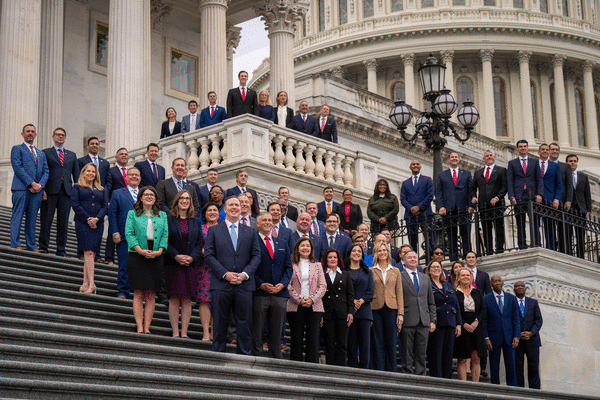
WASHINGTON — Starting a new job is hard, no matter where you work. But when your workplace is the House of Representatives, the adjustment period can be a little rocky — especially lately.
For the freshman class of the 119th Congress, it’s been a year like no other.
Republicans began with the narrowest House majority in almost a century, and that wasn’t the only thing that made 2025 stand out. Rank-and-file members aired their frustration by trying to sidestep leadership and bring their own bills to the floor, filing an unusually large stack of discharge petitions, and not just on the Epstein files.
Throw in a record-shattering government shutdown and a 54-day break as Speaker Mike Johnson kept the House floor closed for business, and what counts as a “normal” Congress was changing before their eyes.
It could have been worse, some newcomers said.
“Way better than I expected. Having never been in politics before, I expected it to be a lot worse,” said Rep. David Taylor, R-Ohio. “It was kind of a blank slate.”
Rep. Randy Fine, R-Fla., arrived in April to replace Mike Waltz, who resigned to become Donald Trump’s national security adviser.
“People often ask me, am I having fun? And the answer to that is no, but I didn’t come here to have a good time,” said Fine, one of five members so far to join this Congress midstream after winning a special election.
“My path to get here was unexpected. A lot of people thought about running for Congress for a long time. I got a call from President Trump, and then I was running,” he added.
The expectations game was not one she wanted to play, said Rep. Laura Friedman, D-Calif., a former state lawmaker who once worked in Hollywood as a film executive.
“I didn’t really think of what it was going to be like. I didn’t come in with any pre-expectations,” said Friedman, who emerged from last year’s crowded race to succeed now-Sen. Adam B. Schiff.
On a five-star scale, being on Capitol Hill can veer from one extreme to the other, she said.
“The experience is a five, an incredible honor, but the working environment here is a one, because of the chaos, partisan-ness, and just the destruction of our government that Congress has stood by and allowed,” Friedman said. “Watching DOGE destroy agencies and taxpayer investments without any congressional oversight is a stain on this body that will remain forever.”
‘Watching the Democrats go nuts’
Making Democrats sweat over a rapidly changing bureaucracy was one of the best parts of the year, according to some.
Rep. Brandon Gill, R-Texas, came to Congress promising to “demolish the woke and weaponized administrative bureaucracy.” The youngest GOP member at age 31, he was named class president by his fellow Republican freshmen.
Asked to sum up the highlights of 2025, he put it this way: “Passing a major rescissions bill, passing the tax reconciliation bill that we did earlier in the year and watching the Democrats go nuts over it.”
Many Republicans were in a celebratory mood as the House sped toward its holiday break, despite internal rumblings that only grew louder in recent weeks after Rep. Marjorie Taylor Greene, R-Ga., announced she would resign and blasted the speaker over how he’s handled his narrow majority.
“We’re now, once again, the most powerful country on the planet. The economy is picking up,” said Rep. Tim Moore, R-N.C., who served as speaker of the North Carolina House before he arrived on the Hill. “The only real disappointment that I had was the shutdown, and I was really disappointed in my colleagues on the other side of the aisle.”
Wins and losses aside, several Democrats said they worried for the institution of Congress itself, describing the feeling that norms and powers are slipping away.
“It’s been a really, really challenging year, and I don’t say that as a Democrat, I say that as a legislative branch snob who also happens to represent 45,000 federal employees and two to three times that amount in contractors,” said Rep. Sarah Elfreth, D-Md., who started her career in 2011 as a congressional intern. “This administration has made life a living hell for a lot of those people, and unfortunately, the checks and balances that our founders established in our Constitution for the legislative branch to exercise in just this very moment are not being exercised.”
Rep. Emily Randall, D-Wash., echoed those concerns.
“My dad was a Republican and I served with Republicans in the legislature who would wave around the Constitution as, like, what they stood for. The disregard for separation of powers and checks and balances (in Congress) is horrifying,” she said.
Still, compared to the Washington state Senate, she sees another difference: “I had one full-time staffer as a legislator, and now I have multiple offices of incredibly eager and smart and dedicated and passionate mostly young people who inspire me every day.”
New job, same as the old job?
More than 14% of all members were new to the House this year, even if some were no strangers to Washington.
“It’s a fascinating dynamic for me, because of course, I worked for President Trump for eight years,” said Rep. Brian Jack, R-Ga., who served Trump and his campaign in various roles, including as White House political director. “I deeply appreciate the power of relationships in being successful in this institution. … So thankfully, it was refreshing relationships, as opposed to building relationships.”
For Rep. Michael Baumgartner, R-Wash., a bipartisan trip this spring with House Armed Services ranking member Adam Smith and others brought him full circle. Baumgartner once worked at the U.S. embassy in Baghdad, and said he also met his wife while working in the Middle East.
“It was my first time back in Iraq since 2008, so that was meaningful,” he said.
For those who once served in full-time state legislatures, the day-to-day rhythms of Congress can feel familiar, but the scale and stakes are different, some said.
“Coming from … a full-time state legislature in Pennsylvania, I was very familiar with the processes and the patterns. The challenges at the federal level are just much bigger, and so that requires more challenging solutions,” said Rep. Ryan Mackenzie, R-Pa.
Asked how he would rate his freshman experience in Congress, Mackenzie said it wasn’t over yet.
“You really have to look at the totality of a term,” he said. “There’s a lot of work that’s still in the process, a lot of things still to be done.”
_____
(Jackie Wang contributed to this report.)
_____
©2025 CQ-Roll Call, Inc., All Rights Reserved. Visit cqrollcall.com. Distributed by Tribune Content Agency, LLC.



















































Comments