Gender-affirming care rules create legal quagmire, critics say
Published in Political News
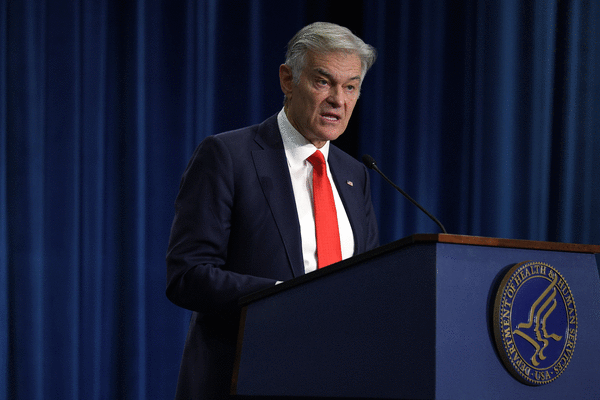
WASHINGTON — Trump administration proposals that would sharply limit pediatric gender-affirming care could face a host of legal challenges if implemented, from accusations of overriding the state regulation of Medicaid to undermining Congress, lawyers and civil rights groups say.
Accusations of subverting the will of Congress have been common in President Donald Trump’s second administration. Critics say the proposed rules, issued Dec. 18 by the Centers for Medicare and Medicaid Services, would place unprecedented limitations on hospitals and physicians that lawmakers never intended.
Organizations seeking to stop the proposals are prepping lawsuits, once again sending a Trump executive branch action to the courts, where the Supreme Court has sided with Trump frequently on other issues.
One proposal would ban federal Medicaid funds and the Children’s Health Insurance Program from paying for gender-affirming care for children under age 19. Another would ban Medicare and Medicaid reimbursements to any hospital that provides gender-affirming care to minors.
“At the end of the day, this is part of an unlawful attempt by the administration to regulate the practice of medicine in a way that Congress has not given them authority to do,” said Josh Block, senior counsel with the American Civil Liberties Union’s LGBTQ & HIV Project. The organization has said it plans to file a lawsuit against the administration once the proposals are finalized.
These policies would apply to the 33 states and the District of Columbia where gender-affirming care for minors is not explicitly banned. Roughly 50% of transgender youth live in a state that has enacted a law or policy limiting access to gender-affirming care, even before these new proposals, according to KFF, a health policy research group.
In addition to the two proposed rules, HHS Secretary Robert F. Kennedy Jr. posted a “declaration” on the agency website that claims gender-affirming care “fails to meet professional recognized standards of health care.” The declaration states that HHS would cut off Medicare and Medicaid payments to any facility that provides minors with gender-affirming care.
“This declaration rests upon the best available scientific evidence and aims to promote the health, safety, and well-being of children and adolescents, who constitute an especially vulnerable population deserving the highest standards of care,” Kennedy wrote in the document, dated Dec. 18.
A coalition of 19 states and the District of Columbia has already filed suit in Oregon to prevent the Kennedy declaration from having any legal effect.
New York Attorney General Letitia James, among the plaintiffs in the case, said in a statement that it is unprecedented and unlawful for the HHS secretary to unilaterally change standards of medicine through a decree on the agency’s web site. Federal agencies must go through the normal rulemaking process to propose new policies, she argued.
“Secretary Kennedy cannot unilaterally change medical standards by posting a document online, and no one should lose access to medically necessary health care because their federal government tried to interfere in decisions that belong in doctors’ offices,” James said.
State regulation
The proposal pertaining to Medicare and Medicaid would eliminate funding to any hospital or health care center that provides pediatric gender-affirming care. The federal government would pull Medicare and Medicaid funding to a hospital regardless of whether the patient’s private insurance pays.
“Essentially, it is pitting hospital provision of gender-affirming care for some people against all of their ability to provide health care to everybody else,” said Karen Loewy, interim deputy legal director for litigation at civil rights organization Lambda Legal. And that’s something the federal government has never done before, Loewy said.
Block called using the health programs to regulate everyone “a really sweeping power grab.”
Longstanding law stipulates that the states regulate medical care and quality stands, not the federal government, explained Katie Keith, formerly deputy director of the White House Gender Policy Council under the Biden administration and current director for the O’Neill Institute for National and Global Health Law.
Medicaid’s own website says that the states “establish and administer their own Medicaid programs and determine the type, amount, duration, and scope of services within broad federal guidelines.”
Additionally, the standards health care facilities must meet to receive payment by Medicare and Medicaid are regulated by the “conditions of participation” set by CMS. But the agency doesn’t regulate the practice of medicine.
Critics have seized on that principle as they prepare to challenge these rules.
The Trump administration’s potential legal counterargument is spelled out in the first rule governing Medicare and Medicaid payments. It argues gender-affirming care doesn’t fall under “the practice of medicine,” thereby giving the administration authority to regulate it.
‘Drastic interventions’
CMS Administrator Mehmet Oz said when the proposed rules were introduced that gender-affirming care often involves “drastic interventions that merely increase the stress” for children.
The administration has also argued that transition-related health care for minors is in conflict with the goals of Medicaid.
In an April letter to state Medicaid directors, Drew Snyder, who was a CMS deputy administrator at the time, said that pediatric gender-affirming care is not in the best interest of Medicaid recipients and not consistent with “efficiency, economy and quality of care.” Snyder also argued that Medicaid does not allow for procedures that could render a minor incapable of reproducing.
The last time CMS updated the conditions of participation was during the pandemic when the agency said health care workers needed to receive the COVID-19 vaccine.
The Supreme Court at the time upheld that decision, ruling it benefited the health and safety of the general population. Keith says it’s tough to argue that blocking pediatric gender-affirming care is a benefit for the health and safety of the general population.
‘Usurping’ Congress
The proposal pertaining to Medicaid and Children’s Health Insurance Program would prohibit those programs from funding “sex-rejecting procedures” for minors, including puberty blockers, hormone therapy and surgery.
But Medicaid could continue to pay for those procedures if a child needs them for reasons other than gender-affirming care, like the early onset of puberty or hormonal problems.
CMS rules spell out certain mandatory Medicaid and optional benefits, but the agency doesn’t have mandatory exclusions like these, critics say.
Medicaid is subject to the Hyde amendment, which prevents federal funds for paying for abortions. But such provisions are contained in federal law, as opposed to a rule promulgated by an administration.
States have the power to regulate their Medicaid spending within federal guidelines and decide which services should be covered. They must submit their Medicaid plans to CMS for approval, but generally Medicaid benefits and operations vary widely state to state. The federal government’s main role is to partially fund the programs and provide oversight.
“This is the administration claiming the ability to engage in a whole bunch of substantive policy about the practice of medicine that really has not been delegated to it,” Block said. “It’s really, in all sorts of respects, usurping the policymaking functions of Congress.”
Republicans tried to bar Medicaid funds for paying for gender-affirming care in an early version of Trump’s “big beautiful bill” signed into law this summer. The provision was removed after being found noncompliant with the “Byrd rule,” which limits what can be included in budget reconciliation measures.
But if the proposed rule is implemented, states could potentially continue to pay for gender-affirming care for minors out of their own pockets.
“So what these rules are intended to do is kind of create an environment where it’s very hard for providers to provide this care,” said Kellan Baker, senior advisor for health policy at the Movement Advancement Project, a nonprofit that advocates for LGBTQ rights, among other causes. “But it does not make it illegal. It affects the coverage of this care, and the money that is available to support the provision of care. It doesn’t actually make the care itself illegal.”
©2025 CQ-Roll Call, Inc., All Rights Reserved. Visit cqrollcall.com. Distributed by Tribune Content Agency, LLC.


















































Comments