As President Donald Trump targets Colorado, its Democrats -- and some Republicans -- struggle to play defense
Published in Political News
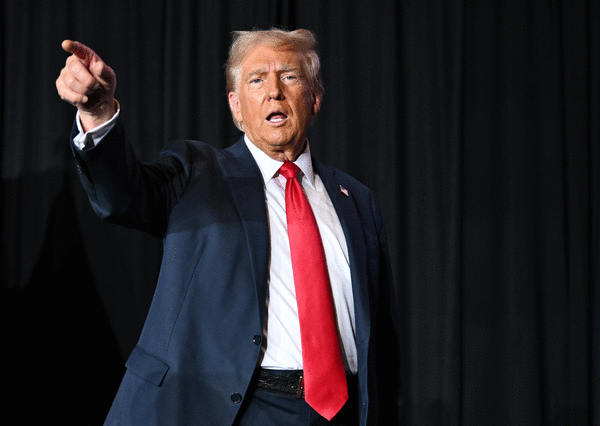
DENVER — President Donald Trump’s ongoing pressure campaign against Colorado has left the state’s mostly Democratic leaders on the back foot as they’ve tried to fend off threats to nearly $1 billion in federal funding, financing for a drinking water pipeline, the future of a celebrated research center and more over the past month alone.
The state’s elected leaders have filed lawsuits. They’ve leveraged congressional rules. They’ve sharpened their public statements — a strategy to sway public opinion ahead of the 2026 midterm elections.
And Coloradans from both parties, including U.S. Rep. Lauren Boebert, sought — but ultimately failed — to win a House override vote last week for a veto Trump issued on the unanimously passed water pipeline bill. The legislation would have helped rural communities in the southeastern part of the state finish the Arkansas Valley Conduit project.
Outside of court-ordered freezes on Trump’s actions, his administration has shown no inclination to soften its attention on Colorado. The federal government’s antagonistic posture has raised the question of how much the state’s leaders should fight the administration, versus keeping a low profile to avoid the president’s wrath.
“There are times you have to fight and go to the mattresses and throw everything you can at an issue,” said Doug Friednash, a former chief of staff to then-Gov. John Hickenlooper who now works for a high-powered law firm in Denver. “And I think there are times where you want to resolve it quietly, before things escalate. I think policymakers, especially in blue states, need to think carefully about the big picture and how to get what we need.”
Many of Trump’s recent decisions have specifically targeted Colorado or lumped it in with just a handful of other blue states that have drawn the president’s ire.
Among the top cited motivations for his fixation: the state’s mail-in voting system and its imprisonment of Tina Peters, the former Mesa County clerk.
Other moves, including the plan to shut down the Boulder-based National Center for Atmospheric Research, have fallen under the president’s broader political position of rejecting the wide scientific consensus on climate change.
Regardless of reason, the slate of actions has threatened thousands of jobs, hundreds of millions of dollars in aid to poor Coloradans across the state, and money for disaster relief in red and blue Colorado alike.
The moves have also spurred many Democrats to look for any lever they can pull to soften the federal blows. But often, they’ve found limited options.
At times, Gov. Jared Polis has been less outspoken than some other officials. His office did not accommodate an interview request last week for this story, but it provided a statement from Polis Monday evening, hours after he was pressed about Trump’s targeting of Colorado at a gathering of state senators.
“The Trump administration’s actions are hurting Coloradans across the state,” Polis said in the statement about the slew of recent federal decisions. “… This president is making life more difficult for the people in our state. I remain focused on making Colorado better for everyone and helping to lower costs, and I’m calling on the president to stop his attacks on our state and his fellow Americans and do his job.”
Trump has ‘declared war on Colorado’
In interviews with The Denver Post, some of the state’s most prominent Democrats emphasized a pattern of retribution against the state.
“It’s important to be honest and call this what it is: He has declared war on Colorado. He is not hiding it; he is being very transparent about the political retaliation he’s engaged in against our state,” U.S. Rep. Joe Neguse, a Lafayette Democrat and one of the top members of the House’s minority caucus, said.
Neguse, along with Boebert and her fellow Republican Rep. Jeff Hurd, launched a failed bid last week to overturn Trump’s veto of the previously noncontroversial pipeline project.
Neguse’s district also includes the National Center for Atmospheric Research in Boulder, a world-renowned climate research institution. The administration announced in mid-December that it would move to shutter NCAR and was considering moving some “vital functions” like weather modeling.
Administration officials defended the plan by calling the decades-old institution “the premier research stronghold for left-wing climate lunacy.” The move fits with Trump’s broader denial of climate change and support of fossil fuels.
But the announcement also landed as Trump reignited his attack on Colorado for the state’s imprisonment of Peters, a Trump ally who was found guilty of felonies related to a breach of state election systems. She’s serving a nine-year sentence.
Neguse, like many other elected officials, has linked Trump’s fixation on freeing Peters and his opposition to mail-in voting with the administration’s raft of actions targeting Colorado.
In addition to the NCAR plans and the pipeline veto, Trump and his administration, since December, have denied requests for disaster relief and tried to freeze federal payments for low-income Coloradans.
In September, Trump also announced he’d move Space Command’s headquarters from Colorado Springs, long a Republican stronghold, to Alabama — a move he explicitly tied to Colorado’s mail-in ballots, even if it was the result of a yearslong effort that began in his first term.
“All of those actions are clearly part of a scheme that the administration has been engaged in for the better part of the last two-and-a-half months, to force Colorado to somehow bend to the president’s will and to, in effect, compel the state to capitulate,” Neguse said.
He predicted that a congressional investigation into the actions — something that’s likely possible only if Democrats win the House majority in November — would show Trump issued “directives” to his cabinet to punish Colorado.
The pattern has drawn Colorado Attorney General Phil Weiser’s attention, too. He amended a lawsuit originally filed over the Space Command relocation to tie all the actions together into what he called an “unconstitutional” attempt to usurp state authority regarding Colorado’s criminal justice system and election process.
In response to the lawsuit, Trump administration spokesperson Abigail Jackson said the president was “using his lawful and discretionary authority to ensure federal dollars are being spent in a way that (aligns) with the agenda endorsed by the American people.”
She did not address allegations that the moves were tied to Peters.
The administration’s actions also aren’t being met with universal disdain by Colorado politicians. U.S. Rep. Jeff Crank, a Colorado Springs Republican, said he supports efforts to go after fraud, the administration’s stated reason for trying to halt a potential $300 million freeze to Colorado aid programs; it was among five states targeted.
“I support efforts by the Trump Administration to root out fraud and ensure taxpayer dollars are being spent appropriately across the country, including in my home state of Colorado,” Crank said in a statement. “I am eager for the state of Colorado to work with the administration and encourage transparency in our processes so we can ensure funding for legitimate programs continues.”
Crank, like other congressional Republicans, declined or did not respond to The Post’s interview request about the slate of actions the Trump administration had taken toward Colorado — which included the relocation of Space Command from Crank’s district.
‘Critical for us to fight back’
Most elected Democrats make plain their position on the Trump administration’s actions.
“It’s critical for us to fight back,” said U.S. Sen. Michael Bennet, a Democrat running for governor.
“When you’re up against a bully who is breaking the rules and harming you, the response is to stand strong and fight back,” said Weiser, who is challenging Bennet for the Democratic nomination in that race.
“We will use every tool at our disposal to fight back,” Hickenlooper, now a U.S. senator, said in a joint statement with Bennet about the plans to close NCAR.
“We have to keep fighting,” Neguse said. “We have to use every tool at our disposal.”
Weiser has filed or joined 50 lawsuits against the Trump administration. He touts dozens of legal victories to restore federal funding or pause federal policy changes over the last year since Trump returned to office. Bennet and Hickenlooper used Senate rules to halt a spending package in December as a protest against the administration’s plans to shutter NCAR.
“We cannot capitulate to his lawlessness,” Bennet said in an interview. “That creates its own set of issues. If you don’t stand up for the rule of law, if you don’t stand up for the Constitution, you pretty soon find yourself in a place where you can’t count on that institutional framework anymore.”
Polis, however, has appeared to take a less direct approach in dealings with the administration. Polis, who is term-limited, has condemned individual actions, with a particular focus on what he calls Trump’s “destructive” trade policies.
But he has avoided the sweeping declarations of the Democrats who are looking to succeed him, even as Trump has hurled specific insults and vitriol at Polis.
In a recent New Year’s Eve social media post, Trump said he hoped Polis and others involved in Peters’ incarceration would “rot in hell.” Polis, who played no formal role in her trial or sentencing, responded in a statement that he hoped Trump’s resolution was “to spend less time online talking about me and more on making America more affordable.” He went on to wish the president and all Americans a Happy New Year.
At a retreat for Democratic state senators on Monday, Polis faced questions from those in his party about his response to the Trump administration.
He said “there were probably 20 things that I’ve taken on in the last month or two attacking the president. It just depends on what he does.”
Polis cited working groups formed with other Democratic governors on Trump’s child care cuts, another defending abortion rights and one focused on democracy.
“There’s a bizarre federal context right now,” Polis said. “We are fighting on many fronts, sad to say, against our own federal government, because they are our federal government. … They are doing everything they can to hurt access to health care, child care — in policy and through administrative means.”
Polis, meanwhile, has recently publicly toyed with the idea of easing Peters’ sentence.
While he hasn’t publicly committed to a course of action, he recently called her sentence “harsh,” though his administration earlier rejected calls to move her to a federal facility where Trump might release her.
Peters, 70, is serving her sentence in state prison in Pueblo. She was convicted in 2024 for crimes related to unauthorized access to state voting machines in an attempt to prove the president’s discredited conspiracy theory that the 2020 election was tampered with. At Peters’ sentencing, the trial judge noted her lack of remorse for the crime.
The case has become a bright line for Trump and his allies — and for Colorado Democrats. Trump has personally pardoned Peters, though he doesn’t have that power for state crimes. Many state Democrats loudly proclaim that any leniency toward Peters would undermine democracy and equal capitulation to a presidential plot to bend blue states to his will.
“Should Gov. Polis bend the knee to Donald Trump’s retribution, it is yet another instance of the go-along, get-along politics that is making Coloradans furious with both Democrats and Republicans in this political moment,” state Sen. Julie Gonzales, a Democrat and former chair of the Senate Judiciary Committee, said. She is mounting a primary challenge against Hickenlooper this year.
“People want fighters, not folders,” she said, “and we have to stand up on behalf of everyday Coloradans.”
Friednash, the Democratic analyst who now works for the law firm Brownstein Hyatt Farber Schreck, said he’d heard from officials in some blue states — he wouldn’t say which — who found wisdom in a “don’t poke the bear” strategy with the current iteration of the Trump administration. Trump promised during the 2024 campaign that he would serve as “your retribution” for people he saw as wronged by Democrats.
Friednash urged an overall measured approach and for officials to look for ways to work with the administration, even with a president “driven by grudges.” But with a fired-up Democratic base — and election campaigns in full swing — there’s a duelling urge to fight harder, he said.
He saw Polis as falling somewhere in the middle on the fight-versus-lay low scale. While the administration has seemed to single out Colorado, Friednash credits Polis’ approach for avoiding the more severe crackdowns experienced in states like Minnesota, Illinois and California.
“(Polis isn’t) out politicking in a way that hurts Colorado,” Friednash said. “It doesn’t put him front and center in a way that damages the state. I think he’s thoughtful with his approach. He fights when he has to fight, but uses the tools he has.”
_____
Recent Trump moves against state
Among actions taken by President Donald Trump’s administration in recent months that targeted Colorado:
—Sept. 2: The administration announces it will move Space Command headquarters from Colorado Springs to Alabama. President Donald Trump explicitly says Colorado’s use of mail-in ballots helped motivate his decision.
—Dec. 2: The administration warns that it will withhold federal food aid from most Democratic-controlled states, including Colorado. A judge later pauses the move.
—Dec. 8: The U.S. Department of Justice notifies Gov. Jared Polis it will investigate “policies and practices” within the Colorado Department of Corrections and Division of Youth Services to determine whether they are violating the constitutional rights of adult inmates and youth detainees.
—Dec. 11: Trump pardons Tina Peters, the former Mesa County clerk convicted of felonies related to an attempted breach of the state election system — a power he does not have for state-level crimes. Peters was seeking to prove the president’s discredited election conspiracies. Her conviction is still under appeal.
—Dec. 17: The administration announces it will shut down the National Center for Atmospheric Research in Boulder.
—Dec. 18: The administration orders Colorado to recertify eligibility for 100,000 Coloradans who participate in the Supplemental Nutrition Assistance Program. It issued the directive only to Colorado and Minnesota.
—Dec. 21: The administration rejects federal disaster declaration requests for the Elk and Lee fires near Meeker and for flooding in southwestern Colorado.
—Dec. 30: Trump vetoes a bill that would help deliver clean drinking water to southeastern Colorado communities by financing a pipeline. Federal lawmakers later fail to override the veto.
—Jan. 6: The administration announces it will freeze $10 billion in federal child care and low-income aid for five Democratic states, including Colorado. A judge later pauses the move.
Sources: Post archives, legal filings.
---------
—Denver Post staff writer Seth Klamann contributed to this story.
©2026 MediaNews Group, Inc. Visit at denverpost.com. Distributed by Tribune Content Agency, LLC.


















































Comments