Trump's drug pricing plan gets lukewarm reception
Published in Political News
WASHINGTON — President Donald Trump’s unconventional plan to lower prescription drug prices is being met with a skeptical eye from Republicans as Congress places a greater focus on drug pricing ahead of the midterm elections.
Trump’s plan is to establish “most favored nation” pricing to bring U.S. prescription drug pricing more in line with what other countries pay, part of a push for broader health care legislation from Congress. Trump didn’t wait for Congress or traditional rulemaking, taking matters into his own hands by striking individual deals with drug companies to lower their prices, largely using the threat of tariffs as leverage.
Now he wants Congress to codify what he’s done. Centers for Medicare & Medicaid Services Administrator Mehmet Oz came to the Hill late last month to pitch Senate Finance Committee Republicans on the president’s health care plan, of which drug pricing is a major part.
But some key Republicans say they still have questions about their role in Trump’s plan for most favored nation pricing, a policy idea that involves referencing international drug prices when determining prices in the U.S. market.
Sen. Bill Cassidy, R-La., a Senate Finance Committee member who chairs the Health, Education, Labor and Pensions Committee, said he had spoken with White House staff about the proposal.
“It has to be codified, right?” Cassidy said. “But there’s a lot of details to work out if you even think it’s a good idea.”
During the signing ceremony for the appropriations package, Trump touted the plan as delivering “the lowest prices of anywhere in the world” and urged Republicans to campaign on the issue in the midterms later this year.
“The Republican Party should be able to win the midterms on that alone,” Trump said. “That’s the biggest thing there is.”
His health care plan states that congressional action would build off Trump’s “landmark actions that made insulin more affordable in his first term and the successful voluntary negotiations following his recent Executive Order to lower drug prices.” Voluntarily negotiated deals with the administration will be grandfathered in, it states.
Not a ‘big fan’
Selling the proposal to the president’s allies in Congress may require further outreach to Republicans.
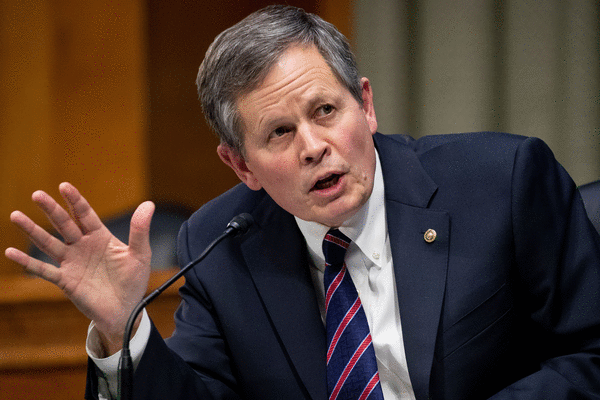
Sen. Steve Daines, R-Mont., who is on the Finance Committee and was in the meeting with Oz, said he had questions about how to maintain U.S. innovation in drug manufacturing.
“We still have a lot of questions we’re asking, but I found the briefing to be very valuable,” he said.
Currying support among Republican leadership might be even more of an uphill battle. Trump previously attempted to include most favored nation policy in the reconciliation law, but leadership poured cold water over it, with Speaker Mike Johnson, R-La., saying he wasn’t a “big fan” of the proposal.
Republicans have historically been averse to health policies that would interfere with the free market. For example, many spoke out against giving Medicare the authority to negotiate drug prices in President Joe Biden’s 2022 reconciliation law. Cassidy, for example, raised serious concerns that the policy would put a damper on research and development.
“Most favored nation pricing sure looks a lot to me like an effort to regulate drug prices and establish some form of price controls within the pharmaceutical sector,” Juliette Cubanski, the deputy director of the program on Medicare policy at the health research organization KFF, said in an interview. “That has historically not been a popular idea with Republicans.”
‘Nothing has happened’
Senate Democrats, for their part, said they were open to working with Republicans on such legislation.
Several bills on the issue have already been introduced in this Congress. Rep. Ro Khanna, D-Calif., leads a bill that would direct CMS to implement rules directing drug companies to lower prices to be comparable with what other developed countries pay.
Sen. Peter Welch, D-Vt., sponsors legislation alongside Sen. Josh Hawley, R-Mo., that would prohibit drug companies from charging list prices in the United States that are higher than the international average.
Speaking during a news conference last week, Welch was skeptical about whether Republicans are serious about passing most favored nation legislation despite the bipartisan nature of his bill.
“I talked to the president about reference pricing in 2017,” he said. “It’s 2026. Nothing has happened.”
“I just haven’t seen any evidence in our committees of Republicans being interested in this issue,” Sen. Ron Wyden, D-Ore., said during the same briefing. “We’re ready to go.”
Further complicating the policy’s future is that Trump released sparse details about the individual deals, which Cubanski said makes it hard to discern what the administration actually wants to codify.
She added that some manufacturers may have been incentivized to come to the table with Trump to forestall an even broader implementation of most favored nation pricing. She added that many of the deals were strictly for drugs in Medicaid, which already pays among the lowest price for drugs.
The White House did not return a request for comment seeking details on the drug pricing proposal.
The Pharmaceutical Reform Alliance, a group advocating lower drug pricing policies that backs most favored nation policies, said in a statement that codifying the policy will help lower drug prices and shield consumers from industry influence.
“If Congress wants to truly tackle America’s affordability crisis and notch a win with the American people, codification is the way,” J.D. Hayworth, a former congressman from Arizona who is the group’s spokesperson, said in a statement.
Tangential to the administration’s push for most favored nation is Trump’s push for direct-to-consumer prescription drug access. Trump on Thursday unveiled his TrumpRx website, which essentially serves as a hub connecting people to coupons and direct-to-consumer links to access popular medications, like GLP-1s.
Cubanski said TrumpRx is attractive for pharmaceutical companies because they can access consumers directly, but the initiative might be limited in scope because most Americans access medications through their insurance.
“Clearly, that’s another pathway that manufacturers are hoping to increase revenue by increasing their sales of drugs directly to consumers, bypassing their insurance, which may not be to the benefit of patients with insurance,” she said.
©2026 CQ-Roll Call, Inc., All Rights Reserved. Visit cqrollcall.com. Distributed by Tribune Content Agency, LLC.




































Comments