Complicated Democratic plan to fill Swallwell's seat in special election risks confusing voters, expert warns
Published in Political News
A scramble by top Democrats to fill Congressman Eric Swalwell’s seat for his remaining term has led to a bizarrely convoluted slate of candidates for a special election on June 16 — which voting advocates say could lead to plenty of confusion at the ballot box.
Former California governor hopeful Swallwell resigned from his position following accusations from several women that he sexually assaulted them. State Sen. Aisha Wahab, BART Board President Melissa Hernandez and Fremont businesswoman Rahki Israni are among the 15 candidates who have already indicated that they plan on running to replace him, with Thursday the deadline to be placed on the ballot.
Others vying for the 14th Congressional District seat include two Republicans — businesswoman Dena Maldonado and retired tech executive Wendy Huang, as well as former state Sen. Steve Glazer.
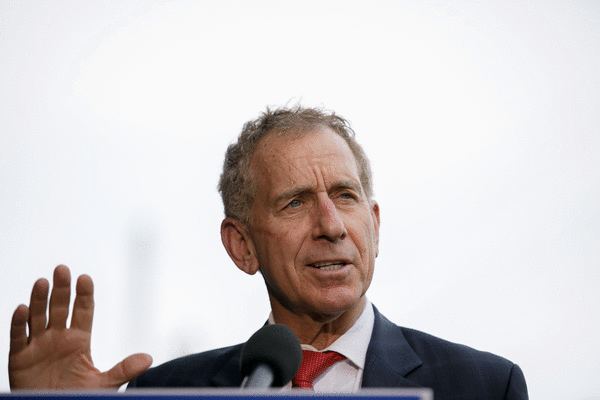
Former state Sen. Bob Wieckowski was a surprise candidate to many — including himself, he said.
Wieckowski, 71, told this news organization on Wednesday that he decided to run as a “caretaker” for the vacant seat at the behest of other Democratic leaders in Congress, including U.S. Rep. Zoe Lofgren. Wieckowski, who lives in Fremont, formerly represented the state’s 10th Senate District between 2014 through 2022.
“I wasn’t planning on doing it,” Wieckowski said.
Following Swallwell’s lightning-quick downfall, Wieckowski said national Democratic leaders — including representatives in the Congressional Progressive Caucus such as Rep. Alexandria Ocasio-Cortez, D-N.Y., and Rep. Ilhan Omar, D-Minn. — hatched a plan to get a Democrat in the seat as quickly as possible.
“The people of the 14th Congressional District should have representation,” Wieckowski said. “It’s a challenging time, and I am so honored that people thought of me, or think of me, as a steady rock, or a level-headed person. And what little bit I can do for a six-month term, I’m honored to be considered.”
Wieckowski said Lofgren and other Democratic leaders petitioned candidates in the full-term primary election on June 2 to abstain from running in the special election so Wieckowski could hold the seat through Swalwell’s current term. Wieckowski said he and Glazer agreed to withdraw if the other candidates wanted to run in the special election.
If all the others don’t pull out, Wieckowski said, then everybody will likely run against each other and he will withdraw his candidacy.
A spokesperson for Hernandez’s campaign said Hernandez agreed to step aside for Wieckowski if the others also agreed. Wahab previously told this news organization she was planning to run in the special election, though did not confirm Wednesday whether or not she would still be running against Wieckowski.
The Alameda County Democratic Party and Wieckowski have endorsed Wahab in the full-term primary. Wieckowski said he will drop out of the special election if Wahab decides to run.
Meanwhile, Alameda County Supervisor David Haubert is trying to get the state to waive candidate filing fees for the special election, according to several letters he’s written to leaders in Sacramento, including Gov. Gavin Newsom.
Charging filing fees for candidates in the special election is a “burden” and “risks limiting participation in our democratic process to those with greater personal or institutional means,” he wrote in a letter to Secretary of State Shirley Weber on Monday.
In an email Wednesday, Interim Registrar of Voters Cynthia Cornejo said the special election is estimated to cost the county $6 million.
With nine candidates set to compete in the full-term June 2 primary, the decisions left to residents of the district are “ripe for voter confusion,” according to Mindy Romero, director of the Center for Inclusive Democracy and a political sociologist at the University of Southern California.
“Just the fact that there’s two elections, period — we don’t have special elections very often — that in and of itself can be confusing for voters,” Romero told this news organization. “Voters generally are information low. Most people don’t know their congressional representative, let alone understand the details of how the position gets filled.”
Romero said some might not even care enough to vote in the special election, instead just directing their attention to the full-term race.
“There’s probably going to be, not only voter confusion, but low voter turnout,” Romero said. “They might feel like it’s just not going to be consequential.”
©2026 MediaNews Group, Inc. Visit at mercurynews.com. Distributed by Tribune Content Agency, LLC.












Comments