Supreme Court yet to decide on Election Day, Trump firings
Published in Political News
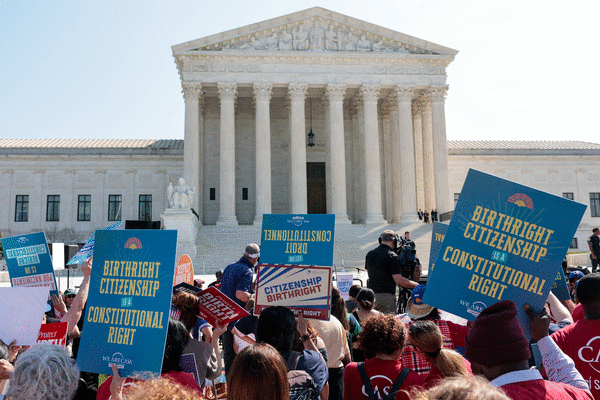
WASHINGTON — The Supreme Court finished the last of its oral arguments for the term last week, and the justices now turn to the dozens of cases they are expected to decide by the conclusion of the term at the end of June.
The court has already issued major decisions invalidating Louisiana’s congressional map and wiping out President Donald Trump’s worldwide emergency tariff scheme, but experts say plenty of potential blockbuster decisions remain in the nearly three dozen cases left.
Those cases include the constitutionality of state laws banning transgender girls from participating in girls and women’s sports, the meaning of Election Day, deportation protections and Trump’s push to curtail birthright citizenship through an executive order.
Many of those cases have the conservative-controlled court facing a Republican administration asserting broad executive powers.
The administration has sought to disallow citizenship for children born in the United States to undocumented immigrant parents or those with temporary legal status, a change from more than 125 years of legal precedent. In court filings, states and others have said the order could strip citizenship from hundreds of thousands of children each year.
The administration’s arguments faced the justices last month and Trump himself took the unprecedented step of attending arguments in person.
Brianne Gorod of the Constitutional Accountability Center pointed out at a recent event that several key justices were skeptical of the administration during oral arguments, including Justice Neil M. Gorsuch.
“It certainly appears this may be a case where the administration gets a loss,” Gorod said.
Additionally, the justices are expected to issue several decisions remaking the executive branch, including on when presidents can fire officials without cause and when federal agencies must bring civil cases into federal court.
A decision in Trump v. Slaughter could determine whether Trump can fire a member of the Federal Trade Commission, Rebecca Slaughter, and a decision in Trump v. Cook will determine how to handle the attempted firing of Federal Reserve Board member Lisa Cook.
Jennifer Bennett, an attorney at Gupta Wessler, said at the CAC event that the rulings in the firings cases could give Trump a large amount of power over the executive branch. Bennett said the next steps may be for the administration to target lower-level federal officials.
Deciding in favor of Trump would be “an enormous arrogation of power both to the court and also to the executive and particularly to dismantle the government,” Bennett said.
Mark Chenoweth, president of the New Civil Liberties Alliance, a public interest law nonprofit focused on administrative overreach with cases before the court, said there “might be a bit of a tell” that the justices allowed Trump to remove Slaughter from her position while the case was pending, but not Cook.
On the Cook case, Chenoweth said the justices are deciding a much smaller issue: how much process does Trump have to provide before removing Cook.
“The Supreme Court has shown a reluctance or reticence to mess with the Federal Reserve,” Chenoweth said. “They’re less willing to upset the apple cart when it comes to some of the long-standing institutional kind of arrangements.”
Major term
The justices are also set to decide whether the federal Election Day statute means that states cannot count late-arriving ballots. The decision there could impact more than half of states in the coming midterm elections.
Melissa Murray, a professor at New York University’s Law School, pointed out that the justices were skeptical of mail voting during oral arguments and a decision could have drastic impacts on the election process.
“That could have huge effects on this year’s midterm elections because it will create a lot of uncertainty with a lot of states,” Murray said.
The justices are also set to decide when federal agencies must turn to the courts to enforce civil violations, rather than imposing fines on their own. Experts said the case could bring more federal fines and forfeiture cases before federal juries, if they are brought at all.
Already this term the justices have issued major decisions on the Voting Rights Act and on Trump’s effort to enact global tariffs.
Numerous experts and congressional Democrats criticized the VRA decision as a partisan one. House Minority Leader Hakeem Jeffries, D-N.Y., called the court “illegitimate” over the decision. At the same time, some observers credit the tariffs decision and others as evidence of its independence.
Those decisions come amid broader shifts in the conservative-controlled court, which has increasingly decided major issues without oral arguments and has continually moved American law to the right.
Chenoweth said the court will continue to be focused on textual interpretation of statutes and the Constitution.
“The court continues to be a textualist court; the tariffs decision is the best example of that,” Chenoweth said. “I think the folks who have been beating up on the court need to give full credit on that case because it is just not accurate to say it has been ignoring the law in the decisions it has been rendering.”
Murray said that ultimately, the justices came out ahead with the tariffs decision. “The real winner of this case was the court, they got to burnish their independence,” Murray said.
_____
©2026 CQ-Roll Call, Inc., All Rights Reserved. Visit cqrollcall.com. Distributed by Tribune Content Agency, LLC.

















































Comments