Unpacking the fight over telehealth access to abortion medication
Published in Political News
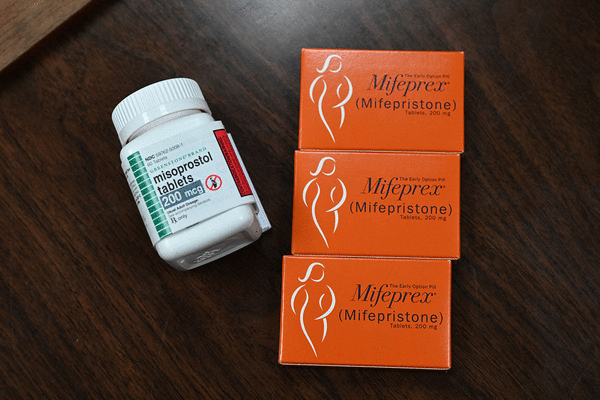
Advocates and opponents of abortion access say they’re wondering what happens next in a critical telehealth medication case that created chaos and confusion over the past week after an appeals court blocked nationwide access to the drug and, days later, U.S. Supreme Court Justice Samuel Alito issued a temporary stay.
Alito’s stay preserves telehealth access until May 11. But it’s unclear what happens next for patients and providers.
The Supreme Court on Monday temporarily blocked the 5th U.S. Circuit Court of Appeals’ Friday ruling to suspend a federal rule allowing telehealth prescriptions of the drug mifepristone while the lawsuit Louisiana v. U.S. Food and Drug Administration unfolds. Abortion providers are determined to continue providing the service, though potentially without mifepristone, the drug at the center for the case, which has had a high record of safety and efficacy since 2000.
Anti-abortion advocates have pushed to reverse the 2023 policy, enacted under former Democratic President Joe Biden, that allowed the FDA to drop its requirement that a patient see a provider in person before the medication can be prescribed. One similar national case already failed unanimously before the Supreme Court, but anti-abortion advocates are hoping this time around, with a more tailored approach, they will be successful.
Abortion-rights advocates say they’re prepared for whatever might happen in the courts, with contingency plans and a message that abortion will still be available even if the particular medication — mifepristone — is not.
Has the abortion pill been banned?
No. Mifepristone is still a legally approved FDA drug commonly used to terminate a pregnancy before 10 weeks’ gestation and is used off-label to treat miscarriages.
Is telehealth abortion still legal?
Yes, for now. Under the U.S. Supreme Court’s administrative stay that expires on May 11, it is still legal to obtain abortion medication through telemedicine under the FDA’s regulations. Mifepristone is commonly used with a second drug, misoprostol, in medication abortions. The case doesn’t include misoprostol.
Who would be affected if telehealth access is struck down?
According to the Society of Family Planning’s #WeCount report, 27% of all abortions in the first six months of 2025 were obtained through telehealth, adding up to more than 162,000 cases.
Mifepristone is also used for patients experiencing a miscarriage; those patients also would have to visit a provider in person.
The ruling would apply nationwide, meaning that health providers couldn’t prescribe mifepristone without an in-person visit with the patient, even in states with abortion access.
What are the arguments on each side in Louisiana v. FDA?
Louisiana says the Biden-era policy undermines a state law banning abortion, and that the federal rulemaking process allowing telehealth prescriptions was flawed.
The Food and Drug Administration says the state doesn’t have standing to sue, but also notes that it’s taking more time to review the drug’s safety.
Two mifepristone drugmakers, meanwhile, have intervened on the FDA’s side.
What could happen next?
The Supreme Court has many options available moving forward, but a few options are most likely, said Katie Keith, founding director of the Center for Health Policy and the Law at the Georgetown University Law Center. The justices could extend the stay when it expires May 11, or the court could make a longer-term ruling.
That could mean sending it back to the 5th U.S. Circuit Court of Appeals, with or without upholding the initial ruling blocking the 2023 provision while the appeals case proceeds. Or justices could decide to take up the case and bypass the rest of the 5th Circuit appeal.
If it did that, the manufacturer defendants Danco Laboratories and GenBioPro have asked for an expedited process with a decision by June. That seems unlikely, Keith said, but the court has conducted expedited cases related to abortion before, such as the Moyle v. United States case in 2024 related to the federal Emergency Medical Treatment and Labor Act.
What will providers do if they can’t use the combination of mifepristone and misoprostol?
Brittany Fonteno, president and CEO of the National Abortion Federation, said providers have been preparing since 2023 for the possibility of losing access to mifepristone. There have long been plans to switch to a misoprostol-only protocol, which is the main method of pregnancy termination across much of the world, she said.
“A lot of providers had created these policies and just needed to dust them off,” Fonteno said.
Dr. Angel Foster, co-founder of the Massachusetts Medication Abortion Access Project, which provides telehealth abortions to patients in all 50 states, said she and her team spent the weekend scrambling to contact patients waiting on medication abortion pills they had ordered before the ruling, and implementing a contingency plan that many abortion providers have been planning for since the lawsuits against mifepristone began in 2023.
That contingency involves pivoting from the FDA-approved mifepristone-misoprostol regimen to a misoprostol-only regimen.
Early Monday, Foster said her team was getting ready to ship misoprostol-only packages to patients at 2 p.m., but after the Supreme Court stayed the appeals court’s ruling on Monday morning, she said they were able to switch back to the mifepristone-misoprostol regimen.
Foster also said her organization was inundated with requests for pills that people could stockpile — people who didn’t need an abortion but were worried about losing access to the pills. Normally that’s a small fraction of the requests they receive, she said, but on Tuesday, they sent out more than had been sent in the entire month of April.
“Over the last two days, we’ve had a huge increase in the number of people from Louisiana requesting pills, especially pills for future use,” Foster said.
What are the pros and cons of the misoprostol-only regimen?
Dr. Maya Bass, a family physician in New Jersey who also provides abortions in Delaware, said misoprostol-only regimens are still safe and highly effective, but that the regimen has a lower efficacy rate than the combination of the two drugs and comes with potentially more side effects and risks.
Misoprostol-only regimens vary between 85% and 90% effective, while the combination is between 93% and 99% effective. The effective rates are lower as the gestational age increases.
The combination works well, Bass said, because mifepristone stops the hormone that allows the pregnancy to continue and signals to the body that the pregnancy is over. The misoprostol then helps soften the cervix and prompts the uterus to contract and expel the pregnancy tissue.
Without that hormonal signal, Bass said, a higher dose of misoprostol is needed to empty the uterus. The usual side effects of nausea, diarrhea, chills and sometimes fevers can be more severe because of the higher dosage. And it may lead to more people needing to seek in-person follow-up care to fully remove all of the pregnancy tissue, which can cause infection if it stays in the uterus.
“A lot of the people who are using telehealth for their medication abortion are not necessarily in places where they can safely access that care,” Bass said. “So it is concerning that we might be relying more on a regimen that means that many more people needing to seek care.”
What are the details of the legal arguments?
Louisiana officials, including Republican Attorney General Liz Murrill, argue that the state is harmed by the 2023 telehealth policy because it undermines a state law banning abortion at all stages of pregnancy, with few exceptions that don’t include rape or incest. The state also challenged the Food and Drug Administration’s process in deciding to eliminate the in-person dispensing requirement, saying it was based on flawed or nonexistent data.
The state also said the rule has resulted in $92,000 in Medicaid bills from two women who went to the emergency room because of complications related to mifepristone in 2025. And the state says the rule harmed the other plaintiff in the case, Louisiana resident Rosalie Markezich, who said her ex-boyfriend ordered the medication online and pressured her into taking it. That wouldn’t have been possible if the medication had to be dispensed through an in-person visit, the state argues.
“The priority of safety supersedes the priority of access, and that is what ultimately, I believe, needs to be looked at directly,” Sarah Zagorski, senior director of public relations at Americans United for Life, told Stateline on Wednesday. The anti-abortion organization submitted a brief supporting Louisiana’s case to the U.S. Supreme Court this week.
The FDA’s response has been to try to dismiss the claims in part on the grounds that Louisiana doesn’t have standing to sue, but agency officials have also said they are in the middle of conducting a safety review of mifepristone and need more time.
GenBioPro and Danco Laboratories, two of the manufacturers of mifepristone, intervened as defendants in the case, which can happen when the party that is sued may not be willing to fully defend the case for various reasons.
The two companies argue that Louisiana does not have proper standing to sue because the state does not prescribe or use mifepristone and is an “unregulated party” as it relates to the 2023 telehealth provision. They also noted that the FDA reviewed 15 studies evaluating medication abortion outcomes for more than 55,000 patients before approving the rule, “all of which supported the safety and effectiveness of dispensing mifepristone by mail, courier, or through pharmacies.”
How does this compare to the 2023 case Alliance for Hippocratic Medicine v. FDA?
Both lawsuits were designed to restrict access to mifepristone. The plaintiffs in the Alliance for Hippocratic Medicine case included a group of anti-abortion doctors who said they would be harmed by having to care for people who took mifepristone. They also argued that the FDA’s approval of the drug was improper.
The 5th U.S. Circuit Court of Appeals was involved in that case as well, and determined that the FDA should roll back its decision to ease restrictions on the drug, including the 2023 telehealth rule. But the U.S. Supreme Court unanimously decided in June 2024 that the Alliance plaintiffs didn’t have proper standing and sent it back to the lower court.
After that ruling, the attorneys general of Missouri, Idaho and Kansas stepped in as plaintiffs, and the case was transferred to Missouri’s U.S. district court, where it’s still pending.
The Louisiana case is more limited because it would strike down one provision of mifepristone regulation, noted Jenna Hudson, senior counsel at the Center for Reproductive Rights. The Alliance plaintiffs sought to revoke the drug’s approval altogether.
_____
_____
©2026 States Newsroom. Visit at stateline.org. Distributed by Tribune Content Agency, LLC.





















































Comments