Commentary: Donald Trump's board of irrelevant peace
Published in Political News
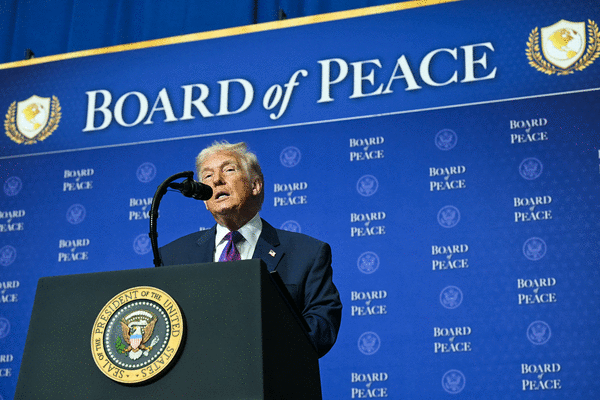
In February, three months after his administration facilitated a ceasefire between Israel and Hamas that helped break two years of full-scale war in Gaza, President Donald Trump strode onto the stage in Washington with pep in his step. Optimistic about the future and confident in his own negotiating abilities, he addressed the so-called Board of Peace, the international consortium designed to turn Gaza from destruction to abundance, like he was at a ribbon-cutting inaugurating a new building in Manhattan.
“What we’re doing is very simple — peace,” Trump told the group. “It’s called the Board of Peace, and it’s all about an easy word to say, but a hard word to produce — peace, but we’re going to produce it.”
Trump’s words have proved prophetic. Peace, in turns out, is indeed very hard to produce. Seven months after the ceasefire arrangement was struck, progress toward peace has been afflicted by repeated roadblocks, a lack of attention and stubbornness of the combatants, who continue to wager that a return to large-scale war is a more likely outcome than a negotiated settlement. The Board of Peace, Trump’s pet project, increasingly looks like the diplomatic equivalent of an appendix, an organ useless to us.
On paper, Trump’s 20-point peace plan in Gaza is a level-headed document with noble goals: Demilitarize the Palestinian enclave, build it up and gradually turn the area over to Palestinians officials who would prioritize caring for their people over fighting Israel. The plan is prefaced on reciprocity — in exchange for Hamas giving up its weapons and newly vetted Palestinian police officers taking charge of security, the Israeli military would fully withdraw from Gaza. This, in turn, would allow international reconstruction efforts to occur at scale.
In terms of governance, an interim Palestinian administration would rule over Gaza under the supervision of the Board of Peace until such a time as the Israelis and Palestinians are ready for final-status peace negotiations.
Unfortunately, the most well-crafted agreements don’t mean much if the implementation is poor.
In the context of Gaza, “poor” is likely too generous a word. The suspension of hostilities in Trump’s plan is in reality a ceasefire in name only. Although Israeli tanks are no longer battling Hamas militants in Gaza’s major cities, Israel continues to launch airstrikes on Hamas targets on a near-daily basis. Palestinian civilians have been killed. Palestinians who come near the so-called Yellow Line dividing Israeli and Hamas-controlled areas of the strip are frequently shot at.
More than 800 Palestinians have died since the start of the ceasefire in October, a far cry from the casualty rates before the deal but still a larger number than what we’ve seen in some previous wars between Israel and Hamas.
Israeli Prime Minister Benjamin Netanyahu argues these strikes are necessary to prevent Hamas from rearming. He’s not entirely wrong. Hamas is indeed consolidating power in the roughly 40% of Gaza it currently controls. The group spent the first few days of the ceasefire going after the Israeli-armed Palestinian militias that posed a threat to its dominance. To Netanyahu, Hamas is simply using Trump’s peace plan to stall.
Hamas has its own complaints. While the Palestinian terrorist group is willing to hand over civic responsibility to a new Palestinian administration, it remains opposed to demilitarizing and points to ongoing Israeli military activity in Gaza as to why. The Trump administration is therefore facing a chicken-and-egg problem. What comes first: Israel’s withdrawal or Hamas’s weapons handover?
Until everyone is satisfied with the resolution of this question, everything else is essentially stalled. The International Stabilization Force (ISF) that’s meant to gradually manage the territory’s security and make way for an Israeli military withdrawal is nowhere to be found. It’s not even clear which nations are contributing to the ISF or whether those that do would be willing to allow their soldiers to disarm Hamas by force. The internationally vetted Palestinian police force won’t be deploying anytime soon. Nobody wants to put up money for Gaza’s reconstruction either, let alone invest in a region where warfare could erupt again. Not a single member of the new Palestinian administration has entered Gaza, which is a visible sign of fecklessness.
For members of the Board of Peace, all of this looks a bit hopeless. Nickolay Mladenov, a veteran peace negotiator and Trump’s Board of Peace envoy, spoke for many during a depressing update last week on the status of Gaza’s peace process. “For many Palestinians in Gaza, in fact for all Palestinians in Gaza, the war does not yet feel fully over,” he said. Hamas, Mladenov said, is making the lives of Gaza’s residents even more miserable by taxing them and preventing humanitarian workers from distributing aid.
It’s difficult to see this improving anytime soon. Trump, who chairs the Board of Peace and has a personal stake in the organization’s success, is spending most of his time these days on trying to dig himself out of the hole he created for himself in the Persian Gulf after launching an unnecessary war against Iran. Arab states with diplomatic influence such as Saudi Arabia and Qatar are too busy knocking down the occasional Iranian missile and drone attack to spend much capital on the Gaza file. The Europeans are downright useless on this front, at least in Israel’s eyes. And the United Nations has its plate full, even as its annual budget is dwindling.
Can the Board of Peace accomplish the goals it set for itself? The odds aren’t particularly great, and the disappointment is only compounded by Trump’s tendency to treat everything he touches as a historic accomplishment.
____
Daniel DePetris is a fellow at Defense Priorities and a foreign affairs columnist for the Chicago Tribune.
___
©2026 Chicago Tribune. Visit at chicagotribune.com. Distributed by Tribune Content Agency, LLC.

















































Comments