Fiscal 2027 NDAA approved by House Armed Services Committee
Published in Political News


WASHINGTON — The House Armed Services Committee approved its fiscal 2027 National Defense Authorization Act late Thursday after a series of politically charged debates about the Iran war, Pentagon acquisition rules, defense spending and vestiges of the Confederacy in the military.
After contending with about 900 amendments over the course of 14 hours, the committee approved the sweeping measure in a resounding vote of 44-12.
The House is expected to take up the bill by the July recess.
The Senate Armed Services Committee plans to mark up its version next week.
The chairman’s mark of the House bill endorsed about $1.15 trillion for defense programs, mostly at the Pentagon. The funds must still be appropriated in separate legislation.
President Donald Trump asked Congress to send $350 billion more via a reconciliation bill, for a total request of $1.5 trillion.
That amount of money would be the most ever spent on national defense in the U.S., and many Democrats assailed the proposed spending level as profligate, particularly in the context of cuts to nondefense programs and a ballooning national debt.
Amendments galore
The last few hours of the markup were dominated by a handful of passionate debates.
The most contentious and lengthy debate of the day was over an amendment by Rep. Marilyn Strickland, D-Wash., that would restore the Army’s 2023 decision to give nine of its bases new names not associated with the Confederacy, as recommended by a congressionally chartered naming Ccmmission the year before.
Defense Secretary Pete Hegseth undid the commission-driven changes in 2025.
The House included a similar Strickland provision in its fiscal 2026 NDAA, but that was not included in the final measure. The vote on Thursday was 29-27 in favor of Strickland’s proposal.
Rep. Austin Scott, R-Ga., who served on the commission, said the Trump administration’s names for the bases “will not stand the test of time.”
Strickland, who is African American, fought back tears as she spoke of her father serving in a segregated Army. She said keeping the Confederate-linked names would disrespect Black men who have served.
“I ask you one more time: Who are we as a nation?” she said. “And more importantly, who are you?” she said, pointing at some of her GOP colleagues.
Rep. Pat Harrigan, R-N.C., who served at one of the bases in question, Fort Bragg, disagreed with Strickland. He said the person a base is named after does not matter to soldiers, but continuing the name of a base retains its tradition.
Rep. Pat Fallon, R-Texas, asked: “Where does it end? Are we going to dynamite a couple faces off of Mount Rushmore? It is a slippery slope.”
Another feisty debate on Thursday night preceded the committee’s 29-27 vote to adopt an amendment by Rep. Ronny Jackson, R-Texas, to codify the Trump administration’s preferred name for the Pentagon: the Department of War.
Jackson argued that the name “sends an unmistakable message to our adversaries” of U.S. strength and resolve.
Rep. Adam Smith, D-Wash., the committee’s ranking member, offered a withering rebuttal.
“I wish our adversaries were that stupid,” Smith said.
Right to repair
The committee adopted by voice vote an amendment from Rep. Maggie Goodlander, D-N.H., that would revive efforts to give the military the right to fix its own equipment, an issue that emerged as a flashpoint in last year’s NDAA debate.
The underlying bill contains some “right to repair” language, but amendment supporters argued that did go far enough. Harrigan, who supported Goodlander’s proposal, said the amendment would fix a “genuine readiness” concern.
“We have planes that cannot fly. We have ships that cannot sail. We have vehicles that cannot drive and tanks that cannot crawl. And in some of our services that number is approaching 50% of the force,” he said.
While lawmakers and defense officials maintain “right to repair” legislation could save billions of dollars and allow the military to more quickly fix its equipment, defense contractors have fiercely lobbied against the efforts and argued the legislation would require companies to relinquish their intellectual property.
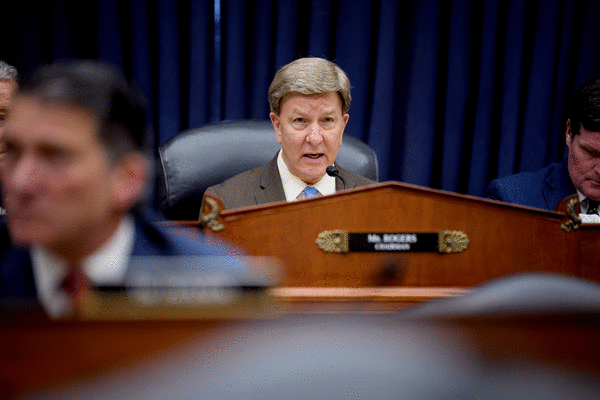
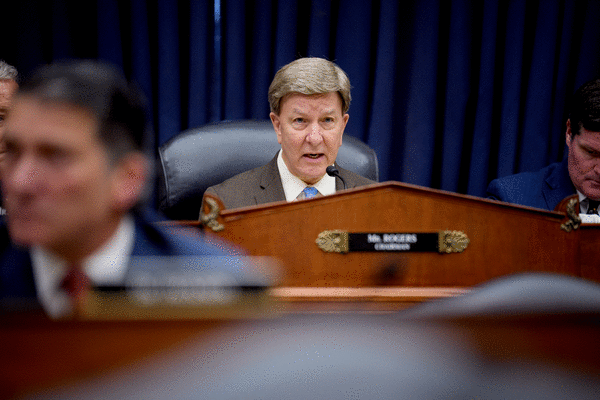
In opposing the amendment, Rep. Mike D. Rogers, R-Ala., the committee’s chairman, highlighted that several industry groups have urged the committee to reject the measure.
He argued the amendment “regrettably creates a much larger problem” than it solves because it would “force companies to choose between protecting their IP and working with the Department of Defense.”
Another adopted amendment that was a redux of a fiscal 2026 provision came from Rep. Donald Norcross, D-N.J. His amendment, which was adopted 30-26, would block implementation of a 2025 executive order that would take away certain collective bargaining rights for federal workers, including Pentagon civilians.
The White House strenuously objected to that provision last year.
Promotions controversy
The committee knocked down a flurry of Democratic amendments, a host of which were ruled out of order, typically over jurisdictional issues.
The committee voted down, 26-30, another Strickland amendment responding to recent reports that Hegseth has removed women and Black servicemembers from officer promotion lists.
Specifically, her amendment would have empowered only the president to remove officers from the lists generated by promotion selection boards and shorten the time to notify Congress of any removals from 30 days to five days. Right now, the secretary and deputy secretary of Defense can remove names for promotions below the one-star general or admiral level.
Scott, in supporting Strickland’s amendment, said he wrote a letter to Hegseth about the removals, and he expressed frustration that the secretary has not explained his decision.
“I’m not saying that his actions weren’t justified; maybe they are, “Scott said. “But if they are justified, then he should give a public reason why they were removed from the list.”
Democratic defeats
Also on the list of defeated Democratic proposals:
•An amendment by Rep. Pat Ryan, D-N.Y., defeated 26-30, that would prohibit funding for military action in or against Iran absent congressional authorization or a war declaration.
•An amendment by Rep. William Keating, D-Mass., defeated 27-29, that would require release of unclassified video of the second strike on the survivors of an attack on an alleged drug-running boat in the Caribbean on Sept. 2, 2025.
•An amendment by Rep. Sara Jacobs, D-Calif., defeated 25-31, that would cap at $250 million the amount that can be transferred in a fiscal year without reimbursement from the Pentagon to another department, such as the Department of Homeland Security.
•An amendment by Jacobs, defeated 25-31, that would prohibit U.S. military force in or against Mexico without congressional approval.
•An amendment by Ryan, defeated 25-31, that would prohibit funding for National Guard quick reaction crowd-control forces, the creation of which Trump ordered last August.
Daytime debates
In the early portion of the marathon markup, the committee adopted relatively few amendments and rejected more than two dozen others.
For example, the committee defeated a Democratic amendment that would cut the nearly $1.15 trillion authorized level of overall spending by $150 billion, and another that would authorize $1 billion less than the president sought to procure a new Trump class of battleships.
The panel also defeated a GOP amendment that would establish gender-neutral fitness standards in the military, which Democrats argued was a stealth attempt to disqualify women from serving in combat jobs.
Also in the early portion of the proceedings, the panel adopted by voice vote as part of a bloc of amendments one by Rep. Jared Golden, D-Maine, that would authorize $500 million to start building a second destroyer in fiscal 2027, proposing a shift of the money from two other ship programs–a submarine tender and Littoral Combat Ship modernization — and from research on Air Force tankers.
The additional $500 million would come on top of the $500 million for the same purpose in the underlying bill. The Pentagon asked for $2.95 billion to fund procurement of just one of the ships in its fiscal 2027 request.
©2026 CQ-Roll Call, Inc., All Rights Reserved. Visit cqrollcall.com. Distributed by Tribune Content Agency, LLC.




















































Comments