Bipartisan bill targets government censorship threats
Published in Political News
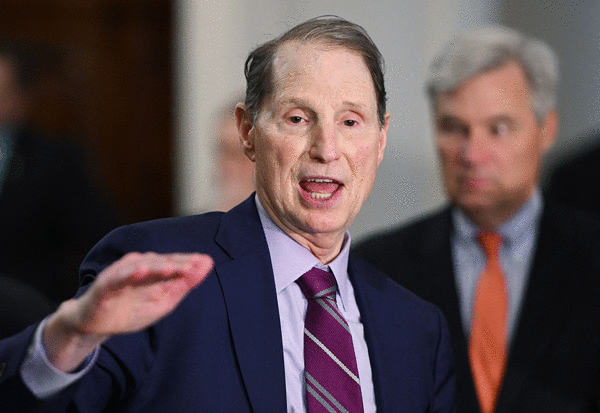
WASHINGTON — A Biden-era push to remove certain social media posts about COVID-19 and the 2020 election and more recent pressure by the Trump administration against TV broadcasters have brought together a bipartisan Senate duo to try and prevent indirect government censorship.
Senate Commerce Chairman Ted Cruz, R-Texas, and Sen. Ron Wyden, D-Ore. unveiled legislation Thursday that would prohibit government agencies from “jawboning” Americans through social media platforms, artificial intelligence systems or broadcasters.
The bill is not the first to attempt to take on jawboning. Sens. Eric Schmitt, R-Mo., and Rand Paul, R-Ky., have both tried before. This effort is new in its bipartisanship. It takes a more comprehensive approach to the issue than Schmitt’s bill.
Cruz and Wyden’s as-yet unnumbered bill would set up monetary, but not punitive, damages for individuals or platforms, require the government to defend employees in potential cases and establish a portal for the government to report its communications about platforms’ content decisions.
In a statement on the bill’s release, Cruz said the Biden administration had “weaponized” the Homeland Security Department’s Cybersecurity and Infrastructure Security Agency, or CISA, in its interactions with tech companies.
“Holding the government accountable and giving Americans the tools to fight back is essential. The JAWBONE Act ensures the First Amendment is protected, not undermined,” Cruz said.
Cruz first announced plans for an anti-jawboning bill in September as part of what he called a “light-touch” AI framework.
In September, Wyden, the ranking member on the Senate Finance Committee, signed a letter to Nexstar and Sinclair after the broadcasters temporarily stopped airing Jimmy Kimmel Live!
The letter connected the move to widely-criticized comments by Federal Communications Commission Chair Brendan Carr threatening the broadcast licenses of stations that aired Kimmel’s show after comments the host made in the wake of Charlie Kirk’s death. Cruz also criticized Carr’s comments.
Also in a statement Thursday, Wyden referenced threats against late-night shows, adding that “jawboning isn’t partisan, and it isn’t new.”
“Nearly all of Americans’ speech – including TV news, online streams and social media — flows through private corporations that are highly susceptible to government pressure. Regular Americans can’t count on those companies to stand up to government jawboning, they need a way to level the playing field,” Wyden said.
The ACLU and the Foundation for Individual Rights and Expression both endorsed the bill, along with eight other free-speech focused organizations.
The bill comes several months after the Commerce Committee held two hearings on government jawboning, including hearing from individuals who say their speech was suppressed online after government efforts.
At the second of those hearings, executives from Meta and Google both offered qualified support for anti-jawboning legislation, though they left room to decide based on the specific bill text.
Details
A summary accompanying the bill listed three potential barriers to preventing jawboning under existing law: proving the violation, recourse after government officials leave their post and a lack of transparency.
“Under current legal precedent, a plaintiff must show that the government caused a removal or a change to the expression at issue,” the document said, going on to add that, “This also makes the judicial inquiry about whether the government succeeded in its coercion, not whether the government attempted it in the first place.”
The bill would prohibit the government from coercing platforms into making content decisions, and directs courts to take into account the tone of a communication, referring to potential adverse consequences and the regulatory or enforcement relationship between the platform and the government employee.
The bill would make exceptions to the jawboning prohibition for investigations into violations of state or federal law, actions authorized by a warrant and directions related directly to a federal agency’s official use of a platform. In case of a lawsuit, the government would be responsible for proving that an exception applied.
Individuals or platforms could sue for compensation and attorney fees, but not punitive damages. States could also sue the federal government on behalf of their residents.
The bill builds on previous bills introduced by Schmitt and Paul, both of which included a private right of action for jawboning.
Schmitt’s bill would establish liability for government employees if they caused “deprivation of any rights, privileges, or immunities secured by the First Amendment.” That liability could include attorney’s fees.
Paul’s bill would prohibit government employees from using “any form of communication (without regard to whether the communication is visible to members of the public) to direct, coerce, compel, or encourage a provider to take, suggest or imply that a provider should take, or request that a provider take any action to censor speech.” It would allow individuals to sue for “attorneys’ fees, injunctive relief, and actual damages.”
The Cruz-Wyden bill would state that the government would not be immune from liability because of a “subjective belief” that the speech at issue was not protected by the First Amendment.
It would require the Department of Justice to defend government employees being sued in their individual capacity, but only if the employee requested defense. The government would also be required to indemnify employees for monetary verdicts against them, unless the employee acted in a “willful and wanton” manner. In that case, the employee would need to reimburse the government for the cost of their defense.
The bill also responds to calls for transparency from free-speech experts concerned with jawboning.
It would task the White House Office of Science and Technology Policy with establishing a portal through which federal agencies would be required to submit records, including the contents, of their communications with social media platforms, AI providers or broadcasters.
The office would then provide a public website summarizing each communication and identifying requests for the alteration or removal of content. The public website would also allow platforms to submit complaints alleging that the government violated the jawboning prohibition.
The bill would allow for redactions in the public website, but would require that the chairs and ranking members of the Senate Commerce and House Energy and Commerce committees have access to the full, unredacted record of the communications.
Paul’s bill, similarly, would establish reporting requirements for communications between the government and social media platforms or broadcasters.
©2026 CQ-Roll Call, Inc., All Rights Reserved. Visit cqrollcall.com. Distributed by Tribune Content Agency, LLC.









































Comments