Boafo won 90% of Maryland's 5th Congressional District, precinct data shows
Published in Political News
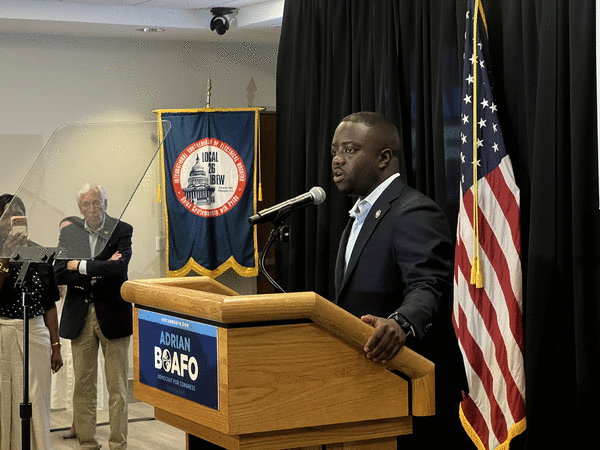
Prince George’s County Del. Adrian Boafo’s victory in Maryland’s crowded Democratic primary for the 5th Congressional District wasn’t just decisive. It stretched across nearly the entire map, new precinct-level election results revealed.
Democratic voters across Southern Maryland overwhelmingly coalesced behind Boafo despite a field of 23 candidates competing for Maryland’s first open congressional seat in more than four decades.
The results show Boafo carried 204 of the district’s 227 precincts — about 90% — defeating his closest rival, Quincy Bareebe, by more than 15,500 votes. In a race with so many candidates, political analysts told The Baltimore Sun they would have expected a patchwork of hometown victories and regional strongholds. Instead, the map shows Boafo winning in nearly every corner of the district, which stretches from Prince George’s and Charles counties to Anne Arundel, Calvert and St. Mary’s counties.
5th Congressional District (Democratic) results by precinct
Sources: Data: Maryland State Board of Elections | Geography: Maryland State Board of Elections, Anne Arundel County, Calvert County
The few exceptions largely reflected candidates’ political home bases.
Former Prince George’s County Councilmember Wala Blegay won seven precincts clustered around Upper Marlboro and Mitchellville, where she represented constituents. Bareebe, who won nine precincts, had the strongest showings in parts of St. Mary’s County, including Great Mills and Lexington Park, as well as a handful of Prince George’s County precincts. Former U.S. Capitol Police officer Harry Dunn won three precincts, while former Prince George’s County Executive Rushern Baker carried two around Bowie and Mitchellville.
“I was surprised at the amount of saturation Boafo had across the district,” said Niambi Carter, a political scientist at the University of Maryland. “His reach was very far.”
Support generally followed where candidates were best known, Carter said, but unlike a typical crowded primary, those hometown advantages rarely extended beyond neighborhood strongholds. “People’s votes seem to comport with where they’re from in the county,” she said, adding that Boafo “was able to penetrate the county … and move across the district in a way that I don’t think any of his competitors were able to do.”
Boafo’s broad reach came despite a race that appeared ripe for fragmentation. Candidates included current and former elected officials with established constituencies, including Blegay and Charles County Sen. Arthur Ellis, yet none built a regional coalition large enough to threaten Boafo’s advantage.
Analysts said several factors likely helped Democratic voters consolidate around Boafo. He secured an early endorsement from longtime Rep. Steny Hoyer, followed by backing from Gov. Wes Moore and U.S. Sen. Angela Alsobrooks. His campaign also benefited from nearly $8 million in outside spending that funded television advertising, mailers and campaign signs throughout the district.
“Hoyer’s endorsement, more than any other endorsement, was the one that really tilted the race,” said John Dedie, a political scientist at the Community College of Baltimore County. “For a lot of candidates, when Hoyer made his endorsement, they should have gotten out of the race.”
Flavio Hickel, a political scientist at Washington College, said endorsements also generate something equally valuable in a low-information primary: name recognition. “It creates its own news cycle. When Moore endorses, you get articles about it,” he said. “It all stands to benefit him.”
That familiarity may have resonated with a Democratic primary electorate that has spent decades represented by Hoyer, Carter said. Much of the district, particularly southern Prince George’s County and neighboring Charles County, includes older, middle-class voters.
“[For] people who Steny Hoyer has been their representative all their life,” Carter said. “It matters to them that there is some sort of continuity in leadership.”
That continuity, combined with Boafo’s status as Hoyer’s former staffer and endorsed successor, likely helped him build support well beyond his legislative district, she said.
Analysts added that the primary’s historically low turnout statewide also shaped the results. Some precincts recorded only a handful of votes, making individual margins less significant than the broader geographic pattern.
Still, analysts cautioned against reading Boafo’s few losses as evidence of ideological divides within the district. “I don’t think those losses were significant, considering that the district next door, he dominated,” Dedie said.
If the precinct map revealed anything, Carter said, it is that Democratic voters overwhelmingly rallied behind one candidate across nearly every corner of the district. Whether that coalition proves durable now depends on whether Boafo can build the same long-term relationship with constituents that Hoyer maintained for more than 40 years.
“I think he’ll have a lot of eyes on him,” Carter said. “It remains to be seen if he’s going to have a Steny Hoyer-esque hold on this district.”
________
©2026 The Baltimore Sun. Visit at baltimoresun.com. Distributed by Tribune Content Agency, LLC.




































Comments