Members of Congress question Trump administration's contradictory Haiti policy
Published in Political News
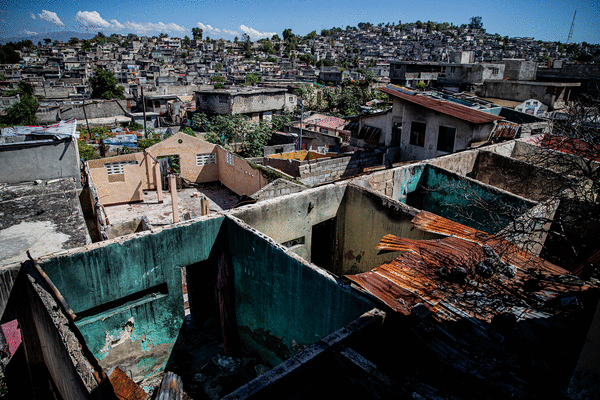
Members of the House Foreign Affairs committee challenged the Trump administration Tuesday over what Democrats described as a contradiction in U.S. policy: ending deportations protections for hundreds of thousands of Haitians living in the United States while simultaneously spending millions of dollars to support a new gang-fighting force in the Caribbean country.
“Even as the administration warns Americans against traveling to Haiti, it claims the island is safe enough to end Temporary Protected Status and deport some 350,000 Haitians,” New York Rep. Gregory Meeks, the ranking Democrat on the committee, said. “This is not just cruel; it’s contradictory, and it will only exacerbate instability in Haiti.”
Meeks’ criticism came during a hearing with Michael Kozak, the State Department’s senior official in the Bureau of Western Hemisphere Affairs, and Col. Justin Gorkowski, one of the leaders of the Tiger Team of the Gang Suppression Force’s Tiger Team at the Defense Department. While both focused opening statements on American efforts to help Haiti curb escalating gang violence through the new United Nations-authorized gang-fighting force, lawmakers repeatedly shifted the focus to the Trump administration’s decision to terminate Temporary Protected Status for Haitians.
“There’s a contradiction,” Rep. Bill Keating, a Massachusetts Democrat, said as he questioned Kozak. “It’s not safe. We have a task force, a Gang Suppression Force there, and these people were given status because of that danger. Now, it’s all of a sudden safe to send them back. Can you explain that contradiction? It’s an obvious contradiction.”
Kozak said he did not view the situation as contradictory, arguing that while he didn’t know the exact figures for Haiti, when he looks “at TPS beneficiaries in other countries, usually one thing you’ll find is that a great deal of that total number are people who’ve already adjusted status and have [legal permanent resident] status in the United States. So they probably won’t be going back.”
That assertion conflicts with how the program works. Created in 1990 by Congress, TPS allows citizens of countries affected by natural disasters, armed conflict or other extraordinary conditions to live and work temporarily in the United States, but it does not provide a legal path to permanent residency or citizenship.
Maryland Democrat Rep. Kweisi Mfume challenged Kozak’s effort to minimize the impact of ending TPS, which ends on Friday.
The president and the Department of Homeland Security have said they’re planning to round up Haitians who no longer have TPS and sending them back to Haiti, Mfume said after schooling colleagues on Haiti’s history of tyrannical rulers and failed U.S. policies over two centuries. “It is going to be a massive effort to deport all 350,000.”
“I know that ripping Haitians from their jobs and citizens’ kids that’ll be the administration’s priority,” Mfume added. “That’s an unacceptable situation, and it’s one that we should not accept.”
Supreme Court ruling
The Supreme Court last month cleared the way for DHS to end TPS protection against deportations for Haitians, ruling 6-3 that the decision by Kristi Noem, secretary of Homeland Security Secretary at the time, is not subject to judicial review. The administration had appealed two lower court rulings that blocked the termination.
Twice during Tuesday’s hearing lawmakers asked Kozak whether the State Department had been consulted before Noem ended Haiti’s TPS designation, as required by statute.
“I don’t believe so,” he said.
He argued not all of Haiti was under gang control and quoted Prime Minister Alix Didier Fils-Aimé as saying seven of the country’s 10 regional departments could hold elections “tomorrow.”
“They’re stable and life goes on as normal,” Kozak said. “It’s Port-au-Prince and Artibonite and the West that are the problem.”
U.N. officials have warned that armed groups now control large swaths of the West, which includes Port-au-Prince, and are expanding their territory. Gang violence has spread into southeastern Haiti, while there were mass killings in the hills above Port-au-Prince earlier his month. Children, meanwhile, account for nearly half of all gang recruits, according to the U.N.
Republicans defended the administration’s approach while arguing that U.S. taxpayers have shouldered too much of Haiti’s security crisis.
“The administration has rolled out bilateral assistance piece by piece, up to $40 million in bridge and sustainment funds, $68 million in equipment, a police recruitment surge, support for Haiti’s armed forces, and now counterterrorism funds, with no specific dollar figure attached,” Florida Republican Rep. Brian Mast said. “That money, by the State Department’s own accounting, is going toward, among other things, buying meals ready to eat and bottled water. A bill that the department itself says belongs to those countries.”
Mast, the committee chairman, said the purpose of the hearing was to examine the U.S. response to the security crisis and the gang-fighting force after what he and others called the failure of an earlier effort by the Kenya-led Multinational Security Support mission.
“I’d like to see the ledger of what Kenya grifted off of the United States of America for this, off the American taxpayer,” Mast said.
In his opening remarks, Mast noted that Haiti lies 700 miles from Florida and terrorist organizations effectively control the capital.
“They hold an estimated 90% of Port-au-Prince. They have displaced more than 1.4 million,” he said. “They murder, they kidnap, they rape, they castrate, they feed people what they castrate.
“They extort the Haitian people on a massive scale. They seek to replace the Haitian state with something that answers to them. The consequences of a fully collapsed Haiti will not just stay in Haiti,” Mast added. “It goes without saying that mass illegal immigration from a country explicitly governed as a safe haven for terrorists and traffickers would be harmful to America’s interests, those of our allies.”
Pennsylvania Republican Rep. Scott Perry said it would seem that his Democratic colleagues “would export all 12 million Haitians to America because it’s so dangerous there.
“If every good person in Haiti that’s not involved in organized crime, gang activity…leaves Haiti, how is Haiti ever going to get better? Somebody has to love Haiti and want to save Haiti,” he said.
Perry noted that the U.S. has provided more than $5.1 billion in assistance to Haiti since a massive earthquake in 2010 and that international donors pledged more than $13 billion. Much of that promised aid, however, was never delivered. Meanwhile, Canaan, a massive settlement created after the earthquake under U.S. pressure, has today become one of the country’s largest gang strongholds.
Members of Congress also tried but failed to get answers to growing concerns over the use of American-linked private military contractors in Haiti’s anti-gang campaign. A Human Rights Watch report has said drone strikes in Haiti carried out by private contractors working for Vectus Global and Haitian security forces have killed at least 1,243 people, including 17 children.
“We cannot confirm or deny whether any particular license has been issued to any company or not,” Kozak said when asked for details about the firm’s dealings. The firm is owned by Erik Prince, the former U.S. Navy SEAL officer who founded the private military contractor Blackwater.
“Haiti’s very important, especially to us in the great state of Florida. But it’s significantly important to me as the only member of Congress who went and traveled over to Haiti in April of 2024 and conducted rescues,” Florida Republican Rep. Cory Mills said.
During one mission, he said he rescued 59 mentally and physically disabled children who had been targeted by gang leaders who “would take their food and their medicine to watch them slowly die,” Mills said.
“This is the type of barbarism that we can’t accept, especially this close to our own shorelines,” he said. “We need Congress to have better reporting and briefings, and we need to have the information so that we can use tools.”
‘Proto-insurgency’
Despite their disagreements over TPS, lawmakers from both parties appeared to agree on the scale of Haiti’s security crisis.
“The absence of governance in Haiti has created opportunities for informed power structures to thrive through use of force, financial independence, intimidation and terrorism. Over 20 different gang leaders deploy their foot soldiers to fight for control over Haiti’s territory and dwindling resources,” Gorkowski said in his opening. “These are not simple gangs that can be jailed and prosecuted.”
Previous international efforts, including the Kenya-led force, had mischaracterized the conflict, he argued.
“They thought of this as a criminal problem. It is not,” said Gorkowski, who helped design the new gang-fighting response. “This is a proto-insurgency, and these folks really are on the verge of something significant.”
Haiti’s security forces number only a fraction of what is needed, he said, estimating the country requires 30,000 security personnel to restore order. Until then, he argued, Haiti will remain dependent on the Gang Suppression Force and international support.
Defeating the gangs, Gorkowski said, require four elements to be dismantled: “Arms and ammunition, illicit revenue generation, safe havens and alliance.”
Failing to do this, Kozak said, means allowing gangs to basically take over a failed state, “operating, running drugs, running human trafficking, exporting all manner of chaos in the region and directly to the United States, and a huge, massive outflow of additional people who would be fleeing that chaos. So that that’s what we don’t want.”
©2026 Miami Herald. Visit at miamiherald.com. Distributed by Tribune Content Agency, LLC.








































Comments