How would Proposition 5 overhaul how California conducts recall elections?
Published in Political News
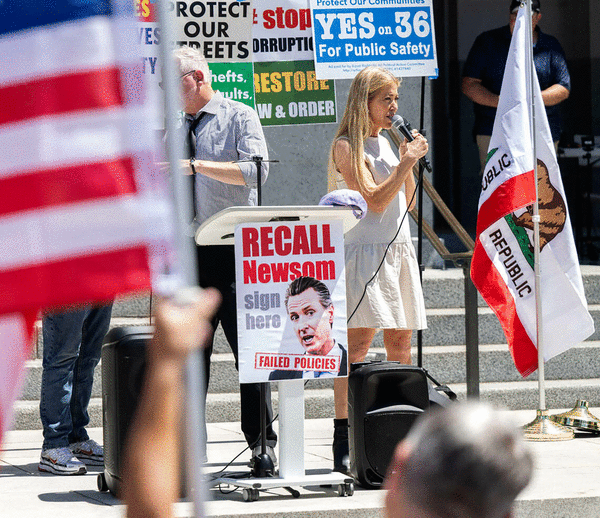
SACRAMENTO, Calif. — California recall elections could get a makeover if voters approve a constitutional amendment this November.
Under current rules, voters casting ballots in recall elections face two choices at once: whether a politician should be recalled, and who should replace them.
Proposition 5 would drop the question over who should fill the vacancy. Under the new rules, a vacancy created by a recall election would get the same treatment as one created by death or early retirement. The posts would be filled later using a special election or an appointment depending on the office and the timing of the recall.
Prop. 5 would also remove the current ban on recalled politicians running for the office they’ve been removed from, but it would ban them from being appointed to that post.
Backers of the proposal say it will reduce the incentive to use recall votes as a political tool rather than a referendum on an elected official’s performance. Supporters include Common Cause California and the League of Women Voters.
Former state Sen. Josh Newman, who sponsored the amendment when he was in the Legislature, said it came out of a series of hearings in the aftermath of the 2021 attempted recall of Gov. Gavin Newsom. The governor decisively won the first question, on whether he should remain in office in the face of backlash over his pandemic policies.
But Newman noted that had Newsom lost, the top vote getter on replacements was conservative talk show host Larry Elder, “somebody with no prior experience in government” who — thanks to a large number of voters who did not pick a successor — was selected by about 28% of the people who cast ballots in the election.
“That doesn’t make sense to many voters,” Newman said.
Under Newman’s proposal, the lieutenant governor would take over for a recalled governor. If a governor who is recalled early in the first half of their term, before the nomination period in their second year in office, voters would choose a replacement candidate in a special election consolidated with that primary. If no one won a majority of the vote, the top two candidates would face off in a November general election runoff.
If the recall occurred after that cutoff, there’d be no replacement election. The lieutenant governor would complete the recalled governor’s term.
For Newman, the issue is personal. In 2018, he became the sixth California politician to be successfully recalled. Republicans targeted Newman over his vote for a gas tax, but Newman said the election had more to do with breaking Democrats’ supermajority in the Senate. The Democrat won back his old seat in 2020 by several percentage points — proof, in Newman’s view, that the recall election hadn’t fully reflected voters’ will.
That argument doesn’t hold water to Assemblymember Joe Patterson, a Republican, who is one of two listed opponents to the measure, alongside GOP Senate Minority Leader Brian Jones.
Patterson disputed the notion that the current recall system wasn’t working given how rarely it’s been successfully used. He argued Newman’s change ultimately disempowered voters while protecting the party in power. Lieutenant governors usually come from the same party as the executive.
“He’s fixing a problem — or he thinks he’s fixing a problem — that just doesn’t exist,” Patterson said.
Anne Dunsmore, a Republican political strategist who led the 2021 recall, said she supported separating the recall vote from choosing a successor, saying support for the 2021 effort “plummeted” after Elder announced his candidacy.
Still, Dunsmore said Newman’s amendment narrowed the options for voter participation.
“I think it’s more limiting as far as the people’s voice of discontent is concerned,” Dunsmore said.
_____
©2026 The Sacramento Bee. Visit sacbee.com. Distributed by Tribune Content Agency, LLC.



































Comments