'People just don't see it': Trump's midterms messaging sounds a lot like Biden
Published in Political News
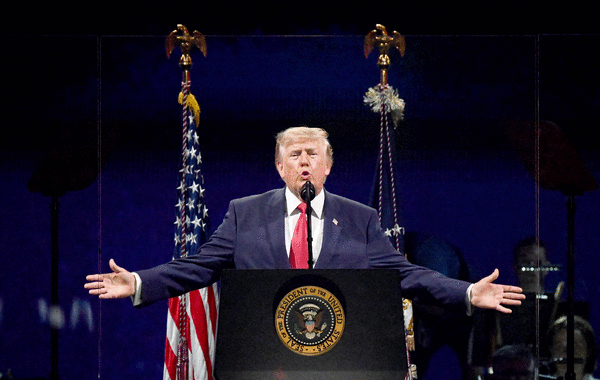
WASHINGTON — President Donald Trump could be falling into some of the same messaging potholes as his predecessor, regularly telling voters to trust him on war and the economy ahead of November’s elections as he places big bets and pushes unproven predictions.
As he repeatedly shrugs off voters’ concerns about pain at the pump and grocery checkout, polls suggest storm clouds appear to be building for Republican congressional candidates.
Speaking Monday in the key midterms battleground of Michigan, the 47th president sounded a lot like the 46th, Joe Biden. The message from the Biden White House often was: Don’t believe your lying eyes — on the economy, on Israel’s brutal conduct of its military operation in Gaza, on the administration’s chaotic Afghanistan withdrawal and on Biden’s age.
“You know, a lot of people were against that war. ‘We don’t want the Venezuela [operation]. Why are you doing [it], what are you doing?’ After we won in about 48 minutes, approximately, they said, ‘Oh, that was a good move,’” Trump said at a General Motors facility in Milford, Mich. “Well, the same thing is happening in Iran.”
So why is the conflict so unpopular at home? Trump offered a very Biden-like explanation.
“People just don’t see it,” he told a group of autoworkers and invited guests to light applause.
During the same event, Trump touted the declining inflation rate — but did not acknowledge that gas and consumer prices have not followed suit. And he compared managing the Iran conflict and prices to “ playing a banjo.” Biden and his top aides also often pointed to a slowing inflation rate and dismissed questions about still-high prices.
Then there are a series of big bets on what amount to a series of predictions.
On some days, Trump has described Iranian officials as eager to make a deal. On other days, he has threatened to strike civilian energy and infrastructure targets there.
Downplaying the economic impact of a closed Strait of Hormuz during a campaign stop last week in Georgia, Trump declared “we don’t need” the key global shipping chokepoint.
“If you combine us and Venezuela, we have about 62% of the world’s oil market, so we don’t need straits, we don’t need anything,” Trump said on July 22. “We don’t need the Hormuz Strait. But we do [the war] because we have to do it. Because we cannot let Iran have a nuclear weapon.”
The International Energy Agency calculated that 500,000 barrels of crude oil moved through Hormuz to the United States per day last year, meaning any disruption would have an economic impact here.
To be sure, Trump is making a major political and economic bet on Venezuela’s underperforming and undeveloped energy sector. ExxonMobil CEO Darren Woods, during a Jan. 9 Trump-attended White House roundtable, made clear that for Venezuela to substantially increase production with the help of major American oil firms, big changes were necessary.
“To reenter a third time would require some pretty significant changes from what we’ve historically seen here and what is currently the state,” he said, noting his company has had its assets there seized twice. “If we look at the legal and commercial constructs and frameworks in place today in Venezuela today, it’s uninvestable. And so significant changes have to be made to those commercial frameworks, the legal system, there has to be durable investment protections and there has to be a change to the hydrocarbon laws in the country.”
Fast forward six months and one war. The president’s almost-daily changing-of-tune about new Iranian leaders’ interest in making a peace deal led one foreign policy-focused Democrat to suggest Trump rushed to war without a clear exit strategy.
“I imagine they’re talking to somebody, but that is the jeopardy of carrying out a targeted assassination campaign to wipe out a whole bunch of leaders of another country,” Virginia Democratic Sen. Tim Kaine, a member of the Foreign Relations and Armed Services committees, said in a brief interview. “You do that, and then you’re surprised when you have a hard time finding a partner to negotiate a deal with?
“Wow! It doesn’t take Sherlock Holmes to figure that out,” added Kaine — who described his Senate GOP colleagues as “frustrated” by Trump’s Iran war stewardship and other antics.
‘Extremely hawkish’
A CNN-SSRS survey released Wednesday found 73% of respondents believe the president has not been focused enough on the country’s biggest problems.
Support for the Iran war among Trump’s MAGA base appears increasingly tied to its economic impact. Thirty-seven percent of self-identified MAGA-Trump voters said the United States should remain involved — but only if the conflict does not increase costs at home, according to a Public First-Politico survey released last week. That was up from 29% in May. Nearly 1 in 5 self-described MAGA respondents said the United States should end the war — regardless of the costs.
An average of 10 public opinion surveys conducted in recent weeks put Trump’s approval rating for his handling of the Iran conflict at 36.7%, according to a RealClearPolitics calculation. His average disapproval rating stood well underwater, at 61%.
The national average price of a gallon of unleaded gasoline on Wednesday — at the heart of the summer vacation travel season — was $4.09 up 3 cents per gallon from one week ago, according to the American Automobile Association. One month ago, the price per gallon was $3.86 and one year ago it stood at $3.14, according to AAA.
Trump’s pausing of U.S. military strikes inside Iran earlier this week after 13 consecutive nights of bombing seemed as directed at oil markets as his stated reason: giving hot-and-cold negotiations room to proceed.
On Tuesday, while eulogizing the late Sen. Lindsey Graham, the South Carolina Republican who had proselytized what he saw as the merits of the U.S.-Israeli war with Iran, Trump excluded any mention of the conflict. But he did not ignore Graham’s regular calls for the use of American force around the globe.
“Above all, Lindsey Graham believed in a strong America,” Trump said at the Washington National Cathedral. “He had unwavering faith in the righteousness of American power. … He was extremely hawkish. I will tell you, he never saw a war that he didn’t like.
“It was this conviction that took him as a senator to almost every country on earth, confronting America’s adversaries and standing up for America’s friends. He had tremendous friendships all over the world,” Trump told a packed chapel. “It’s a testament to his towering impact that among those joining him here today are leaders — presidents, prime ministers from all over the globe — they’re sitting right here before you.”
Yet, months of polling and a number of primary results suggest that all that global relationship-building, which senators expect to fade after Graham is laid to rest Wednesday in South Carolina, is unlikely to lower prices or ease voters’ concerns.
Trump’s ongoing Iran vacillations and predictions-based promises are coming at a politically perilous time for Republican candidates and congressional leaders.
“If the 2026 House map was worse for Democrats than the 2018 map, we’d expect that if we applied the 2018 win percentage for Democrats in each of these categories to the 2026 map, they would win fewer seats, not more,” University of Virginia political analyst Kyle Kondik wrote in a Monday analysis. “But if Democrats could win the House on the 2018 map, they can win it on this one, too.”
_____
©2026 CQ-Roll Call, Inc. Visit at rollcall.com. Distributed by Tribune Content Agency, LLC.














































Comments