Minnesota candidates race to the finish in high-stakes primary
Published in Political News
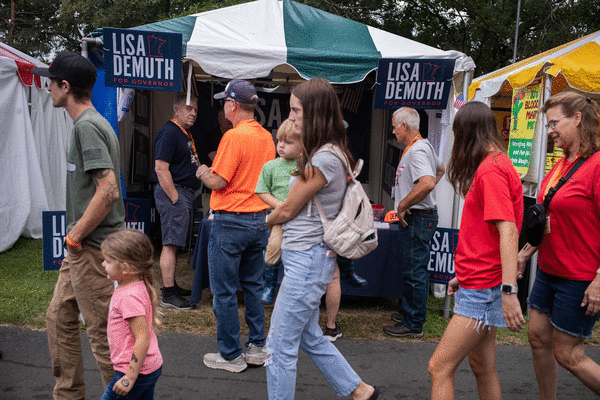
The mud was thick, the dogs were everywhere and duck calls blared almost constantly across the Game Fair grounds in Ramsey on Sunday, occasionally interrupted by the crack of a shotgun somewhere in the distance.
Through it all, Minnesota’s political campaigns were making their final pitches.
Two men in square-toed cowboy boots walked past a booth advertising “Sportsmen for Klobuchar.” One, wearing a camouflage shirt, read the sign aloud to his companion.
“Sportsmen for Klobuchar,” he said. “Now that’s an oxymoron.”
Days before Minnesota voters settle the state’s most consequential primary contests, candidates and their supporters fanned out across the state this weekend to rouse any remaining undecided voters and turn enthusiasm into votes on Tuesday.
At Game Fair on Sunday, Republicans and Democrats worked booths amid stuffed geese, hunting dogs and thousands of outdoors enthusiasts.
A day earlier in St. Paul, Lt. Gov. Peggy Flanagan rallied supporters in a packed neighborhood bar, sharpening her case against U.S. Rep. Angie Craig in their increasingly bitter Democratic contest for U.S. Senate. On the other side of the metro, Craig mobilized volunteers before door-knocking on Saturday in Brooklyn Park.
Across the campaigns, the final appeals reflected battles larger than any one race: immigration and President Donald Trump, money and influence in politics and what it means to be a Democrat or Republican in Minnesota in 2026.
The winners of Tuesday’s primary will advance to the November general election.
At Game Fair, the political temperature was not always as hot as the campaigns surrounding it might suggest.
Wayne Grimmer, second vice chair of the DFL’s Sixth Congressional District, said Democrats expected some hostility at an event that draws a more conservative crowd. Mostly, he said, they didn’t get it.
“We don’t have a lot of negative interactions out here,” Grimmer said. “Usually we get great conversations with people interested in actually understanding what’s going on and trying to engage in that dialogue.”
He recalled a conversation Friday between a volunteer and a visitor who disagreed over transgender athletes. They talked through their differences, he said, and neither persuaded the other.
But they walked away understanding each other.
A short distance away, Republican volunteers were making their own case to voters.
Mary Amlaw, who has volunteered with the Minnesota Republican Party for about two decades, said people had been stopping by to meet candidates and learn more about races farther down the ballot.
“We are excited to win,” she said.
The U.S. Senate race was particularly visible.
Former Navy SEAL Adam Schwarze, the Republican-endorsed candidate, is trying to overcome former NFL sideline reporter Michele Tafoya. His pitch Sunday was framed as a battle over the identity of the party.
“Minnesota Republican values are on the ballot,” Schwarze said.
He described the primary as “a contrast of values never seen before in a Republican primary” and framed his campaign as a grassroots effort battling Washington influence.
Supporters of Republican House Speaker Lisa Demuth, who is running for governor, were also working the crowd. Barry Cenaiko said the event was friendly territory for Republicans.
Much of the work at this point, he said, was simple: reminding people to vote Tuesday.
If Game Fair offered moments when Minnesota’s political divisions seemed more porous than expected, the scene a day earlier at the Black Hart of St. Paul showed how sharply those divisions have hardened elsewhere.
More than 50 people crowded inside the Midway bar Saturday for Flanagan, some fresh from knocking on doors. Easels held poster boards where supporters could answer two questions on sticky notes: “What gives you hope?” and “Who are you fighting for?”
Again and again, the conversation returned to the federal immigration crackdown known as Operation Metro Surge — and the fear and disruption it brought to Minnesota communities amid the killings of Renee Good and Alex Pretti.
For Flanagan, those events have also become central to the closing argument against Craig.
Craig voted in 2025 for the Laken Riley Act, legislation requiring federal detention of some immigrants accused of crimes. She was among nearly 60 congressional Democrats who supported it and later said she regretted the vote after the Trump administration’s immigration operation in Minnesota.
Flanagan told supporters Saturday that the reversal came too late.
“There is a real choice in this primary election,” she said. “We can stand with the immigrant community, and not just when it’s politically expedient for us.”
Earlier on Saturday in Brooklyn Park, Craig joined supporters for a door-knocking event, casting herself as an experienced fighter who could take on Trump while delivering for working-class Minnesotans.
“You know I grew up in a mobile home park. I’m always going to be that trailer park kid because that trailer park kid knows how to fight,” Craig told supporters.
She argued that younger Minnesotans have fewer economic opportunities than previous generations and pointed to her record in Congress as evidence that she could deliver.
“If you want experience, if you want someone ready to take on the administration on Day One, I am your choice to be the next U.S. senator for Minnesota,” Craig said.
Craig has argued that her history of winning a competitive congressional district demonstrates the kind of broad appeal Democrats will need in November. She has also defended herself against criticism from the left by pointing to a voting record overwhelmingly aligned with fellow congressional Democrats.
Two other key divides in the Democratic Senate primary were on display at Saturday’s events: money in politics and the state’s fraud crisis.
Flanagan has refused corporate political action committee contributions and has sought to turn the millions of dollars in outside spending in the race into an argument for her candidacy.
Maryland Sen. Chris Van Hollen, who traveled to Minnesota to campaign with her Saturday, distilled that argument for the crowd at the Black Hart: “I think the choice boils down to people power versus special-interest PACs.”
Craig pitched herself as the most electable candidate come November since Flanagan was in the Walz administration as fraud was exposed in Minnesota’s social services programs — a key campaign message Republicans are making against Democrats on the ballot this fall.
“As much as I like the lieutenant governor, the truth is she has a unique vulnerability on fraud that I do not possess,” Craig said. “Republicans are going to have a really tough time getting that attack to stick to me.”
By Sunday at the Ramsey Game Fair, Republican volunteers were handing out literature, introducing candidates and asking passersby whether they planned to vote. Democrats set up shop in a crowd that might not have naturally been their own and waited to see who stopped.
The settings were different. So were the arguments.
But with the primary bearing down, the task was largely the same: find a few more voters and persuade them that Tuesday’s choice means something larger than the name beside a bubble on a ballot.
________
(Kyeland Jackson of the Minnesota Star Tribune contributed to this story.)
©2026 The Minnesota Star Tribune. Visit at startribune.com. Distributed by Tribune Content Agency, LLC.

































Comments