After indictment and resignation, Cherfilus-McCormick asks voters to return her to Congress
Published in Political News
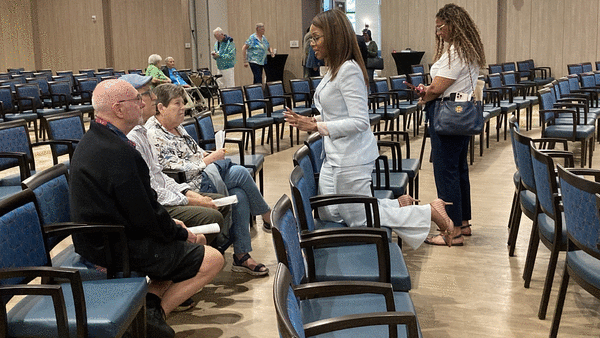
FORT LAUDERDALE, Fla. — Sheila Cherfilus-McCormick is asking voters to return her to Congress — less than four months after she resigned from the House of Representatives.
Cherfilus-McCormick is one of five Democrats seeking her party’s nomination in the reconfigured Broward County 20th Congressional District in the Aug. 18 primary. The district is so overwhelmingly Democratic — President Donald Trump finished 39 points behind Kamala Harris in the 2024 election — that the winner of the congressional primary is all-but-guaranteed to win the November election.
In April, Cherfilus-McCormick resigned from the House. A bipartisan adjudicatory subcommittee found she committed 25 ethics violations. And she faces federal criminal charges.
On the campaign trail, Cherfilus-McCormick has asserted from the debate stage, in media interviews and in conversations with voters that she’s done nothing wrong. Instead, Cherfilus-McCormick is telling voters she is the victim of politically motivated investigations, a description that echoes the claims Trump made about the investigations into his conduct before he was elected to a second term in 2024.
She has suggested political motives involving both the yearslong congressional investigation, which culminated in her resignation, and the investigation by the U.S. Department of Justice, which secured an indictment against her. The government said she stole federal disaster funds, laundered the proceeds and used the money to support her first successful election campaign.
“In the United States there is a presumption of innocence, especially when we see weaponization of the DOJ, not just from one party, from both sides in a political climate,” Cherfilus-McCormick said in a July interview with South Florida Sun Sentinel opinion writers and a news reporter. “And I say this over and over again, we have to go back to actually what our Constitution says and we have to go back to the reality of it because these political politics always try to tear people down during these moments, during these moments when our district is under attack, during these moments when we actually have elections.”
“If we turn a blind eye to political weaponization and injustice, then we are a part of it,” she said. “If we continue on this pathway where we just turn a blind eye to it and say it’s OK, that’s what actually ruins our nation and lacks accountability.”
“I’m innocent,” she said. Cherfilus-McCormick, 47, has entered a not guilty plea. Until these issues arose, she said she had “never been accused of anything, ever, in my life.”
Investigations into Cherfilus-McCormick long predated the 2026 election season. Documents show Cherfilus-McCormick’s activities faced official scrutiny for most of the 51 months she was in office.
The Justice Department, according to court files, was investigating her in July 2024, when prosecutors filed an application for a search warrant. President Joe Biden was in office at the time, and both the Justice Department and the U.S. Attorney’s Office for the Southern District of Florida were run by Biden nominees.
An independent, nonpartisan Office of Congressional Ethics, which has since been renamed, initially referred her case to the House Ethics Committee in September 2023. The Ethics Committee formed an investigatory subcommittee that year 2023 to examine her activities.
Unlike most congressional committees, the House Ethics Committee and its investigatory and adjudicatory subcommittees all operate with equal numbers of Democrats and Republicans.
Committee announcements and decisions involving Cherfilus-McCormick were issued jointly by the chair, a majority party Republican, and the senior Democratic member of the panel.
Her view of the Ethics Committee process changed over time. In a May 2026 statement, Cherfilus-McCormick said she “fully respect(s) the process and remain committed to cooperating with the Committee as it works to bring this inquiry to a close.”
House ethics
An adjudicatory subcommittee found on March 27 that Cherfilus-McCormick committed 25 ethics violations, including breaking campaign finance laws. It determined that the improper activities, detailed in a report from the investigatory subcommittee, “had been proven by clear and convincing evidence.”
The allegations centered on Cherfilus-McCormick’s receipt of millions of dollars from her family’s healthcare business after the state of Florida overpaid roughly $5 million in federal disaster relief funds. Cherfilus-McCormick was accused of using that money to fund her 2021 special primary campaign and 2022 special congressional campaign through a network of businesses and family members.
The adjudicatory panel didn’t find her guilty of two other ethics violations.
The subcommittee reached its conclusions after a five-hour public hearing at which committee staffers presented the case against her and her attorney — with Cherfilus-McCormick at his side — said she wasn’t guilty of the charges and asked for a delay in the proceedings.
After the subcommittee’s action, the full Ethics Committee set an April 21 meeting to determine what sanction it would recommend to the full House of Representatives, with expulsion from Congress one of the possibilities.
Minutes before the panel was to convene in April, Cherfilus-McCormick resigned.
In an interview last month, she reiterated what she’s been saying about her decision, that she resigned “because it was very clear that they weren’t interested in having a fair hearing…. It just became very clear what this was about, that this was politically motivated.”
Half a dozen of her fellow House Democrats had called for her resignation or expulsion. And in April, The Associated Press reported, House Majority Leader Steve Scalise, R-La., rejected her characterization of the committee’s determination. “Well, if you steal money, it’s called theft. It’s not called a witch hunt, and stealing taxpayer money is not going to be tolerated,” he said.
Family company
A common element of the congressional subcommittee’s findings and the indictment is Trinity Health Care Services, where Cherfilus-McCormick was CEO.
The family-run company received a contract from the state to conduct COVID-19 testing and outreach in minority communities during the pandemic. Federal money paid for the contract.
In spring 2021, the congresswoman’s brother submitted an invoice to the state requesting $50,578.50 for work that Trinity had done in Jacksonville. The state paid $5,057,850, which the indictment described as “the result of a clerical error” by the Florida Division of Emergency Management.
The indictment alleged that she and others kept the money and “falsely and fraudulently” converted it through wire transfers and personal checks into accounts they controlled, including to fund her campaign committee.
Years after the overpayment, the state sued to get the money back. Trinity settled the state case last year and agreed to repay the money over 15 years, with the final payment set for the fourth quarter of 2040.
The federal indictment indicates that on or about the date the overpayment was deposited, Cherfilus-McCormick sent her brother a text message with a screenshot of the account’s $5 million balance. Cherfilus-McCormick said she was no longer working at the company though she was still getting paid.
“I was no longer working there. I was getting a paycheck, but I was no longer working because I was campaigning,” she said. “So the facts, if you’re actually looking through it, you would see it’s not as simple as people have been making it.”
Criminal charges
She faces charges including conspiracy to commit theft of government funds; theft of government funds; conspiracy to commit money laundering; multiple counts of money laundering; conspiracy to make and receive straw donor contributions; making and receiving straw donor contributions; conspiracy to make a false and fraudulent statement on a tax return; and aiding and assisting a false and fraudulent statement on a tax return, according to the indictment.
The government also said Cherfilus-McCormick and another person arranged additional contributions using straw donors, and funneled money from the COVID-19 contract to “friends and relatives who then donated to the campaign as if using their own money.”
Cherfilus-McCormick faces a February 2027 trial on the criminal charges, which would come five weeks after she’d be sworn in as a member of Congress if she wins reelection. She has entered a not guilty plea.
Cherfilus-McCormick, who has a law degree from St. Thomas University Law School in Miami Gardens, was indicted in November. When the Justice Department announced the indictment, it said that if convicted on all charges she faced up to 53 years in prison.
Nonetheless, she said seven months later on a questionnaire that she had never been charged with a crime.
The candidate questionnaire she submitted to the Sun Sentinel Editorial Board asks, “Have you ever been arrested, charged or convicted of a crime, received a withheld adjudication or had a matter sealed or expunged? If yes, please explain.”
Cherfilus-McCormick’s answer: “no.”
Political implications
The month after she resigned, she told reporters outside a gathering of Broward Democratic clubs that she was running to return to Congress.
“Who am I to shy away when every day my constituents get up and they fight every single day despite what they have coming at them?” she said.
Four other candidates are seeking the Democratic nomination: rap music icon and civic activist Luther Campbell, former Broward Commissioner Dale Holness, progressive civic activist Elijah Manley, and U.S. Rep. Debbie Wasserman Schultz, who decided to run in this district after congressional boundaries were changed.
Manley was the first to announce his candidacy, in February 2025. At the time, Cherfilus-McCormick was still in Congress, under investigation by the subcommittee and had not yet been indicted. It was before boundaries of the 20th Congressional District were redrawn.
He has been the most outspoken of the four about the former congresswoman’s ethics. Manley traveled to Washington and sat in the audience behind her at the adjudicatory subcommittee hearing on March 26.
“We cannot afford to send someone to Congress who will be either expelled or have to go through a criminal federal trial in February when our district needs to combat Donald Trump,” Manley said in a July interview. Cherfilus-McCormick said people should not expect she’d be expelled if voters send her back to Congress.
Finance reports show Cherfilus-McCormick’s fundraising stalled after the criminal indictment was announced on Nov. 19.
From Oct. 1 through Nov. 19, her campaign raised $116,000 in contributions greater than $200 each, or from political action committees. Post indictment, her campaign reported just two such contributions through Dec. 31, totaling $1,800.
From Jan. 1 through June 30, she received $22,345 in contributions, campaign reports show. Her biggest expense this year was a $98,000 payment to her former criminal defense attorney. She also paid him $100,000 five days after the criminal indictment was announced.
Her campaign’s current financial situation isn’t publicly known.
The Federal Election Commission website doesn’t show a pre-primary report for Cherfulis-McCormick’s campaign, covering income and expenses from July 1-29. The report, which had a filing deadline of Aug. 6, wasn’t posted as of Wednesday morning. The other four candidates filed their reports.
It’s unclear how voters will view the charges and her explanation.
A Brennan Center poll in May found 92% of voters nationwide believe corruption is a “big problem” in U.S. politics and government. And a YouGov nationwide poll in May found 49% of Americans think most members of Congress are corrupt.
Cherfilus-McCormick’s issues didn’t come up during a half-hour debate July 31 among all five District 20 candidates at John Knox Village in Pompano Beach.
But they were on the minds of some voters.
Afterward, three friends who attended lingered in the room discussing the candidates. At the same time, Cherfilus-McCormick, like all effective politicians, circulated shaking hands and talking to voters.
She ended up in a conversation with the three that lasted until almost everyone else in the crowd of some 200 people had left. The trio said later they were talking among themselves about Cherfilus-McCormick’s ethics controversies when she approached.
Fran Goldberg said she was direct, telling Cherfilus-McCormick that “we were just talking about your ethics situation.”
The ensuing conversation, Herb Bachmann said, was “really all about the scandal and why she resigned.” His message to her: “I said you’re really going to have to overcome this.”
Frank Ferri said Cherfilus-McCormick told them “there was no wrongdoing.” Pointing to the Trump administration’s Justice Department, the entity that secured the indictment against Cherfilus-McCormick, Ferri said she made a somewhat convincing case that “we have a corrupt government right now and they want to put her out.”
Goldberg remained skeptical. “I couldn’t really follow her answer,” she said. “Basically she said they did this as a political move.” Goldberg’s assessment: “I heard a political answer that didn’t really say anything.”
_____
©2026 South Florida Sun Sentinel. Visit at sun-sentinel.com. Distributed by Tribune Content Agency, LLC.














































Comments