Trump's convention promises face tough road even If GOP wins
Published in Political News
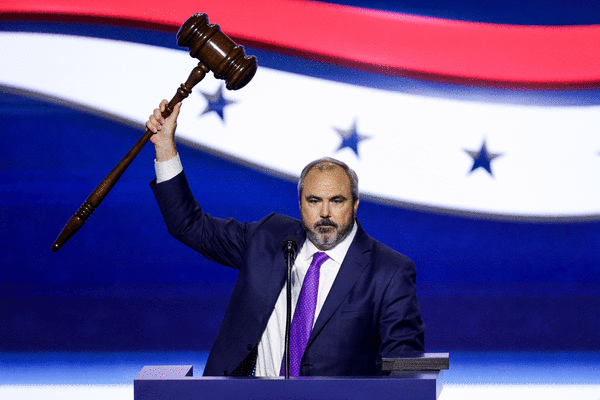
WASHINGTON — President Donald Trump and top Republicans made several concrete policy promises during their Dallas midterm convention, but they all face massive headwinds in Congress even if the GOP retains control of both chambers.
In total, the plans add up to tax cuts in at least the hundreds of billions of dollars, alongside more than $1 trillion worth of new spending. Yet with the U.S. gross debt now exceeding $40 trillion and borrowing costs rising for Americans as a result, Republicans are internally divided over the idea of more deficit spending.
Some suggestions would require gutting the Senate’s 60-vote filibuster rules, which the GOP doesn’t have the votes to do, or seeking bipartisan buy-in from skeptical Democrats.
Here are the top proposals featured at the Republican convention, and their prospects:
—$5,000 Checks
The biggest news out of the convention was Trump’s promise to deliver $5,000 “dividend” checks to all adult Americans if Republicans win the midterms.
That’s a budget-busting promise, with a price tag that could reach $1.2 trillion paid all at once. Without offsets, that would heighten the deficit, set to clock in at $2.1 trillion this year, by half. And even if it were paid for, legislative rules give Congress 10 years to pay for up-front spending, meaning deficits would likely increase before recovering even under the best case scenario.
Trump mused that the White House could send out the checks without Congress, but it’s hard to see how the administration could get around the Constitution’s requirement that Congress appropriates money the Treasury provides.
National Economic Adviser Kevin Hassett told Bloomberg Friday that the proposal could be part of a special budget reconciliation bill that requires only Republican votes, but that would require near unanimity from a party that has often groused about deficit spending, and sometimes struggled to pass basic legislation.
Already some conservatives are calling for the money to be fully offset with spending cuts, a tall order that could require cutbacks in entitlements. Ways and Means Committee Chairman Jason Smith said in an interview he was supportive of the idea but it wouldn’t be an easy matter to get the votes. Bond traders largely shrugged off the proposal, with a muted reaction when Trump floated the plan indicating markets don’t see it as likely in the near term.
—Tax Cuts
Republicans at the convention promised to make permanent a slew of new tax breaks aimed at tips, overtime, seniors and auto loans that expire at the end of Trump’s term.
Extending them would cost hundreds of billions and trigger even more demands for unpopular spending cuts from fiscal hawks. The bill would almost certainly require negotiations on an extension of the $40,000 deduction for state and local taxes to appease Republicans from New York, New Jersey and California – another big-ticket item. Making the expanded SALT deduction, which reverts to $10,000 in 2030, permanent would add $165 billion to the provision’s 10-year cost.
—Voter ID
Trump received sustained applause from conventioneers for vowing to pass a voter identification and voting restriction bill, known as the Save America Act, if his party wins the midterms. The problem is that the GOP has been unable to pass it for nearly two years because of the Senate filibuster.
Senate rules require 60-vote requirement to shut off unlimited debate on most legislation. Senate Majority Leader John Thune has said repeatedly there aren’t 50 votes in his chamber to end the filibuster — and it is not even close. As long as that remains the case, Democrats will be able to bottle up the proposal in the Senate.
—Defense Budget
Republicans at the convention vowed to “finish the job” in Iran by forcing the regime to reopen the Strait of Hormuz and forgo developing a nuclear weapon. To do so, Republicans say the Pentagon needs more money.
Trump has proposed increasing the base defense budget by $500 billion to $1.5 trillion annually, but so far has been unable to get Republicans in Congress to agree. A proposal to funnel $60 billion to the Pentagon to cover direct Iran war costs was shelved until after the elections given how toxic the Iran war has become politically.
While that smaller proposal is likely to pass by the end of the year, the $500 billion plus-up is in doubt, as is a smaller $200 billion supplemental funding request specific to Iran. Conservative Republicans want the amount fully offset with spending cuts. And a proposal to crack down on fraud without cutting benefits wouldn’t yield savings at that level.
If Republicans can’t pass a fast-track budget bill to enact the defense increase themselves, they would need to cut a deal with Senate Democrats that would likely involve the GOP agreeing to back some of their domestic spending priorities.
—Health Insurance
During his nearly two-hour convention keynote address, Trump vowed to pass his plan to send subsidies directly to consumers to buy their own insurance, echoing a similar proposal he made in January while battling Democrats over expiring Obamacare premium subsidies.
That plan went nowhere. Now that the subsidies have been allowed to fully expire, it would be even more difficult to convince small-government conservatives in the party to revive them in a different form. At the same time, moderates are unlikely to back a plan that repeals the underlying Obamacare law itself, a long-held conservative goal.
The White House framework also called for codifying voluntary deals the president has made with pharmaceutical companies to lower the price of some drugs and make more medicines available over the counter. The GOP hasn’t moved to do so yet this year.
—Energy Dominance
Speakers at the convention vowed to expand production of domestic fossil fuels to insulate the U.S. from foreign energy supply shocks, including those since the start of the Iran war that have elevated retail gasoline and diesel prices.
The White House, along with Congress, is expected to mount a new push for permitting reform which would hasten the federal approval time for massive energy projects and possibly electric transmission lines. But analysts say the long-sought reform effort faces difficulty in getting the votes needed for passage.
Because of Senate filibuster rules, permitting reform needs 60 votes. And that means at least some Democrats have to be on board, too.
Congressional negotiations over legislative plans to fast-track permits for major energy and other infrastructure projects stalled earlier this year after Democrats balked at the Trump administration’s moves to halt already approved projects, including solar and wind farms.
More recently, key Democratic negotiators came back to the table after the administration allowed some projects to proceed. Still, analysts cite partisan differences on electric transmission line authority and environmental rollbacks as obstacles to any deal on a compromise package.
(John Harney contributed to this report.)
©2026 Bloomberg L.P. Visit bloomberg.com. Distributed by Tribune Content Agency, LLC.

















































Comments