Rep. Gabe Evans embraced much of Trump's agenda. Now he's running from an unpopular president's long shadow
Published in Political News
DENVER — As U.S. Rep. Gabe Evans stood inside a heated tent in Lochbuie earlier this month, he spoke about the need to protect “the economic engine” in Colorado’s 8th Congressional District as he marked the opening of Scotts Miracle-Gro’s brand new $50 million, 66,000-square-foot production facility.
Gray, leaden clouds dominated the sky while a brisk wind occasionally blew under the tent flaps, bringing a chill to the several dozen company executives, employees and local officials inside.
“This is jobs, this is the economy, this is people’s American Dream,” the Republican congressman said to the gathering. “These are the actual stories that economic engines like this create.”
But with significant political headwinds blowing at him, the 40-year-old freshman legislator can’t help but wonder if his address at the Oct. 15 ribbon-cutting — less than three weeks before the Nov. 3 election — turns out to be one of his last acts as a member of Congress.
Evans unseated a Democratic incumbent in 2024, but now he’s in the political fight of his life as the Republican president — weighed down by an unpopular war, stubborn inflation and tumult over immigration enforcement — threatens to derail the congressman’s reelection hopes.
The challenges facing Evans are part of a larger wave of anti-GOP sentiment that has bubbled up among the electorate. The potential blue wave is forcing party operatives and fundraisers to shore up races across the country, including ones in districts that were once considered conservative strongholds, as Republicans fight to keep their slim House majority.
Those political realities have forced Evans into a delicate dance of sorts. He’s aligned with President Donald Trump’s agenda writ large, including voting last year for his massive tax-and-spend bill, known as the One Big Beautiful Bill Act — which extended tax cuts and trimmed back safety-net programs, among other components. At the same time, Evans has attempted to temper his allegiance to the president on certain issues, including the government’s immigration enforcement priorities, where there could be friction within his district.
He has appeared in the 8th District alongside high-level Trump officials — like Energy Secretary Chris Wright and Agriculture Secretary Brooke Rollins — in recent months, but the president himself gets little mention in the barrage of campaign ads Evans has put on the air.
Kyle Saunders, a political scientist at Colorado State University, said Evans is walking a tightrope when it comes to the president.
The congressman co-sponsored the Dignity Act, which would back away from a mass-deportation agenda in an attempt to provide some form of legal status for longtime immigrants in the country. Evans, Saunders said, has also shown a desire to reach across the aisle by joining the Problem Solvers Caucus, a group in Congress that advances legislation designed to bridge partisan divides.
“But on the big votes, he’s with Trump. And that’s hard to get away from,” Saunders said. “That’s the problem with incumbency. It has a lot of advantages, but the disadvantages are the votes.”
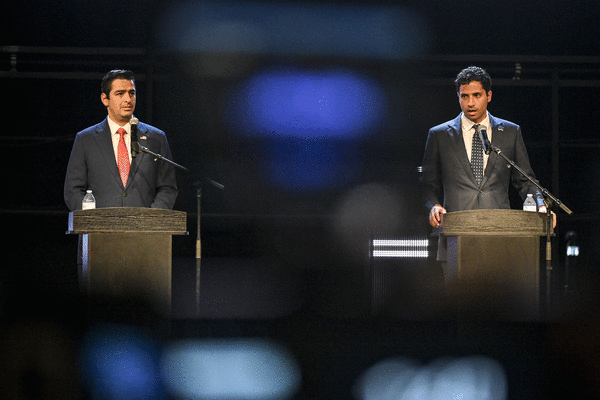
Evans' Democratic opponent, former state Rep. Manny Rutinel, has hammered the theme that Evans is merely a puppet of the president. At a recent debate in Berthoud — the only scheduled face-off between the men — Rutinel repeatedly tied Evans to Trump, at one point saying his opponent “seeks the approval of one man."
But Chad Franke, the president of the Rocky Mountain Farmers Union, separates the man from the maelstrom of national politics. He sees Evans, a former Arvada police officer and U.S. Army Black Hawk helicopter pilot who earlier served a term in the state legislature, as someone with an admirable background and life story.
Franke's organization represents farmers and ranchers in Colorado, Wyoming and New Mexico. The 8th District, which stretches across parts of Adams, Weld and Larimer counties north of Denver, has a heavy agricultural presence.
Evans often mentions his small ranch in Fort Lupton, and he has featured himself in campaign ads hauling hay and feeding animals on his property. That imagery matters in farm country, Franke said.
"It provides us some feeling he understands," he said. "To understand that cows need fed every day, and to understand that a farmer and a rancher provide the food we eat, is a step in the right direction — and it provides credibility."
The political arm of Franke's organization, the Farmers Union Rural PAC, endorsed Evans in February.
Franke said disparaging comments that Rutinel has made in the past about ranching and meat production — calling it “a horrific, exploitative industry” at a conference at Yale University, where Rutinel earned his law degree — didn't go unnoticed.
Rutinel has since downplayed his animal-rights activism.
"That's a reason the PAC would not support him," Franke said of the Democrat.
Incumbent faces Trump's long shadow
But farmers and ranchers won't necessarily be the deciding factor in the 8th District, which also takes in Greeley and a wide swath of Denver's northern suburban communities, including Federal Heights, Commerce City, Thornton and Northglenn, where working the land is not top of mind.
The district, created in 2021 to account for Colorado's growing population, was deliberately drawn to be as competitive as possible, and its residents are 40% Latino. Democrat Yadira Caraveo was first to claim the seat in 2022. She lost it to Evans two years ago.
The margin in both races was less than 3,000 votes. Most national politics watchers — including the Cook Political Report and Inside Elections — still rank the race as up for grabs, though the Center for Politics at the University of Virginia shifted Evans' race from a toss-up to "leans Democratic" in recent days.
For Evans, there are built-in political headwinds, like the tendency of the party out of power to make major inroads during midterm elections. Add in a Republican president with an anemic approval rating of 37%, and his prospects get even murkier.
Weld County Commissioner Scott James, an Evans supporter, doesn't deny that Trump's shadow over the race is a long one.
On the same day Evans made his appearance in Lochbuie, the U.S. Department of Labor announced that its producer price index — which captures inflation before it reaches consumers — soared 6.3% in September compared to a year ago, the biggest increase in nearly four years.
"The administration thing is a difficult challenge for him, no doubt," James said.
But not an insurmountable one, he said. If voters in the 8th District recognize that many of the nation's travails cannot reasonably be laid at the feet of a solitary Colorado congressman, Evans could prevail.
That might mean putting special focus on the bread-and-butter aspects of the job, James said — showing what Evans has done for the district. He cited a $3.5 million Federal Aviation Administration grant the congressman helped secure last month for the construction of an additional airport taxiway at the Greeley-Weld County Airport.
"He has done well in bringing home some targeted operational revenues, especially in transportation," the Republican commissioner said.
James also praised Evans' sponsorship of the FIRE Act, a measure that would allow states to exclude air pollution caused by wildfires and prescribed burns from counting against air quality readings that could spur federal penalties for high emissions.
"Anything we can do to rein in some of these high ozone days due to wildfire — that's imperative for Weld County," he said.
Platteville Mayor Michael Cowper also applauded Evans for bringing home the bacon to his district. He said the congressman was instrumental in requesting $2.5 million to build a new police station in the city. He credited Evans for reaching out during his first week in office to see what help the town needed.
But whether voters will look past the Trump connection and give heavier sway to more pedestrian legislative mechanics is in question.
"I think Evans is in more of a box than Rutinel is," CSU's Saunders said. "And part of that is the (Trump) approval rating ... but it’s also that you can't really separate too much from Trump, because Trump is the de facto party leader and (his aligned party PAC) has money to spend. And you need that support."
Evans has gotten some support from the president's orbit. No Going Back PAC, financially backed by MAGA Inc., the main super PAC supported by Trump, has funneled money at the 8th District in an effort to defeat Rutinel.
But that outside money has gone both ways, with party and independent expenditure committees spending at least $19 million — which may be a low estimate, by some counts. Rutinel's and Evans' campaigns, for their part, have spent roughly $11 million on the race combined this cycle.
Paul Teske, a professor at the University of Colorado Denver's School of Public Affairs and a longtime observer of state politics, said Evans should have done more to separate himself from the president.
"I think Evans is a pretty good candidate," Teske said. "Candidate quality matters — I remember hearing him when first running against Caraveo. He’s charismatic, on point."
But Evans' general unwillingness to criticize the Trump administration on issues that would resonate in his district has given his opponent red meat to dangle in front of the electorate.
"It puzzles me a little," Teske said. "He seems to be presenting a strong individual candidate quality, even when he's not going out of his way to separate himself."
Evans portrays self as 'commonsense conservative'
Evans said he's not always in lockstep with the president.
Last year, he joined other congressional Republicans in raising concerns to U.S. Immigration and Customs Enforcement about its enforcement strategies — and questioned whether ICE was still prioritizing the deportation of criminals, amid emerging media reports showing many new detainees did not have criminal backgrounds. He also introduced the Dignity Act.
Evans and fellow Republicans in Congress wrote to the president a year ago to oppose his plans to import beef from Argentina to reduce beef prices.
When asked in a recent interview if he identified himself as MAGA — Trump's Make America Great Again movement — Evans demurred.
"I'm a commonsense conservative that votes my district," he said.
He said he's been part of nine standalone bills that have passed the House, though they remain hung up in the Senate. The legislation ranges from making sure ratepayers aren't saddled with paying for electric power needed by data centers to a bill, dubbed the Stop Pills That Kill Act, that would crack down further on the manufacture and distribution of fentanyl.
Evans, who is of Mexican heritage, boils down his immigration agenda to three things: "We got to secure the border, we got to get the bad guys out — the cartels, the drug dealers, the auto thieves — and we've got to fix the broken system for the people that are trying to do it right."
But immigration advocates have pointed out that around the time he was pushing back against ICE on enforcement, Evans' vote for the OBBBA tax-and-spend law unleashed tens of billions of dollars for ICE and immigration enforcement.
"Donald Trump and Gabe Evans are trying to find new ways to torment our immigrant neighbors. They are using masked ICE agents without judicial warrants; they are raiding schools and hospitals to rip families apart," Rutinel said during the Berthoud debate, as some in the audience shouted "shame."
While Evans in some ways has diverged from Trump on mass deportation, he said voters must not forget what caused the problem in the first place — a dereliction of duty at the southern border by President Joe Biden's administration that resulted in the highest wave of immigration on record, much of it illegal.
"There was zero accountability for literally negligence on the border and (for) letting tens of millions of people come into this country illegally," the congressman said. "And then, with this new administration, when (former Homeland Security Secretary) Kristi Noem was messing things up — within a year she was fired.
"So that's more accountability than we saw throughout the entirety of the Biden administration."
On the Iran war, which has sharply pushed up the price of gasoline and diesel, Evans said the specter of the country possessing a nuclear weapon required action.
"Every administration since 1979 has said Iran cannot have a nuclear weapon," Evans said. "You think negotiations over the Strait of Hormuz are rough now? Try negotiating with a nuclear-armed Iran that can project a nuclear threat over the Strait of Hormuz."
But Mary Young, who represented a state House seat encompassing Greeley for five years, said Evans had his chance. She said his vote for the OBBBA, which also made cuts to social programs like Medicaid and food assistance, showed his true colors.
"If (voters) look at him objectively, it will be very difficult to decouple him from Trump," said Young, a Democrat. "People voted for him expecting him to be a moderate and listen to what people were saying, which was to bring down prices."
Evans wins praise from U.S. Rep. Brett Guthrie, a Kentucky Republican who chairs the powerful Energy and Commerce Committee in the House. He said Evans asked him for a seat on the committee at the beginning of his term. No freshman member of Congress had joined the committee in 16 years, he said.
"He's always asking questions and doing his homework," Guthrie said of Evans. He likes Evans' willingness to get in the weeds of crafting bill language and moving legislation forward, saying Evans "holds his ground with senior members (of Congress)."
"Some people want to be on TV, some people want to be in leadership," Guthrie said. "And there's a track in Congress that does the committee work — and that's where bills are created. Gabe is the right age and right temperament to lead the Energy and Commerce Committee someday."
Whether that is in the offing will become more apparent after Nov. 3.
In the meantime, Nate Baxter, the president and CEO of Scotts Miracle-Gro, said there was no doubt that inflation was hurting his customers and suppliers. Trucking mulch and compost hundreds of miles requires plenty of diesel fuel, the price of which recently hit a record high.
"We have consumers under a lot of pressure, and that's concerning to us," he said. "I would love to see Congress do more."
—Denver Post reporter Seth Klamann contributed to this report.
©2026 MediaNews Group, Inc. Visit at denverpost.com. Distributed by Tribune Content Agency, LLC.





































Comments