Serbian politics enter new era with leaderless bloc in power
Published in Political News
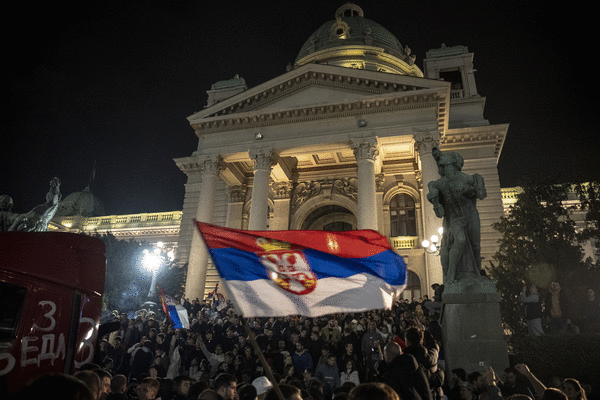
Serbia’s surprise rejection of veteran leader Aleksandar Vucic hands political power to an opaque protest movement with no track record.
The Student List, formed from backers of mass anti-government protests that gripped the nation for nearly two years, won an outright majority in a snap general election promising to stamp out corruption and boost democratic norms.
But hours after polls closed and Serbs flooded the streets of Belgrade in jubilation, the group remained silent on who the next prime minister is going to be, or about priorities and specifics on how it will govern biggest former Yugoslav republic.
“This is the victory of the conviction that Serbia can and will do better,” said Radomir Saicic, one of the movement’s leaders in a public statement by the group on Sunday.
Contrary to fears of possible violence, Vucic conceded defeat just 90 minutes after the polls closed, handing victory to the grassroots movement that built its mass support with a rallying cry to fight corruption and creeping authoritarianism. The Student List won 53% of votes compared with 39% for Vucic.
Serbia is now headed for an unprecedented political shakeup and potential probes into deals and policies of the previous ruling elite.
It’s unclear for now how that revamp will play out. The Students List has operated without a single leader and hashed out its decisions in a patchwork of plenums. It also chose paid academics — professors and postgraduates — and members of other professions as main candidates in the race.
This arrangement may struggle in contact with the harsh realities of everyday politics. Especially in a country at geopolitical faultlines, where Vucic perfected the art of juggling relations with Balkan neighbors, Russia, China, the European Union and the U.S. administration of President Donald Trump.
“You can have a movement without a name to topple an autocrat, but you cannot run a country that way,” said Florian Bieber, professor of Southeast European studies at the University of Graz. “Now it’s a different world for them. And that’s a big demand.”
Serbia’s foreign-currency bonds gained after the election, with yield on 10-year eurobonds falling 17 basis points to 5.19%, the lowest in seven weeks. The country’s dollar-denominated notes due in 2036 were the best performers in emerging markets early on Monday.
Meanwhile, the shares of Strickland Metals, an Australian miner with a gold and base metals project in Serbia, slid as much as 33% as the company said the election outcome “may have influenced investor sentiment.”
Once the official results are released, the movement will aim to have a government in place within 90 days, as required by law, according to Miljan Salata, an incoming lawmaker from the List.
The main task ahead is to review “all domestic and international contracts left over from the previous regime,” he said in a phone interview. “Everything that is not in accordance with the law and the constitution, or presents a risk to safety of citizens” will be struck out, he added.
Serbian officials who tried to promote the controversial Trump tower project in Belgrade to please the U.S. president’s son-in-law Jared Kushner and his real estate partners will be fully prosecuted, Salata said.
Serbia’s outgoing Culture Minister Nikola Selakovic has been accused of abuse of power in relation to the project and is facing a court hearing. Selakovic denies all allegations.
Others initiative in focus include contracts related to Vucic’s pet project of EXPO 2027, he said.
Vucic, 56, was the second longtime leader to lose an election in eastern Europe this year, following the ouster of his ally Viktor Orban in Hungary six months ago. The former Serbian president pledged to make a comeback, saying “I’ll defeat them much sooner than they think.”
His exit amounts to a tectonic shift for the nation. The parliament will now effectively have only two sizable political camps, removing an array of mainstream groups from liberal to conservatives and nationalists. Also out for the first time in 18 years are the Socialists, once led by late strongman Slobodan Milosevic.
A new parliament may convene as early as next month.
Vucic called the election more than a year ahead of schedule after unrelenting anti-government rallies, triggered by the collapse of a train station canopy that killed 16 people in 2024. University students spearheaded the protests, blaming corruption and incompetence among ruling officials for the deaths.
With the ex-president now out of the picture, his geopolitical balancing act is likely to prevail. Ahead of the vote, the movement’s representatives were cautious on sensitive issues like the nation’s rejection of Kosovo’s unilateral secession or on adopting sanctions against Russia.
The opposition, which gained traction for the first time in more than a decade, pledged to focus on fighting corruption, overhauling the judiciary, improving election conditions and boosting media diversity.
Meeting E.U. membership conditions isn’t an immediate priority. The Student List representatives have said the country can decide on that in a referendum, if invited by the bloc.
Still, E.U. Commission President Ursula von der Leyen welcomed the change of power in a post on X, saying the bloc was “ready to support reforms.”
Russia, one of Vucic’s traditional allies, intends to continue developing relations with Serbia, though “it takes two to tango,” Kremlin spokesman Dmitry Peskov told reporters.
Moscow hopes the new authorities in Belgrade understand that cooperation with Russia is beneficial for Serbia, he said. “We very highly appreciate Vucic’s contribution to the development of our bilateral relations,” according to Peskov.
—With assistance from Tony Halpin and Peter Laca.
©2026 Bloomberg L.P. Visit bloomberg.com. Distributed by Tribune Content Agency, LLC.


































Comments