Trump administration sues the state of Michigan over cage-free egg law
Published in Business News
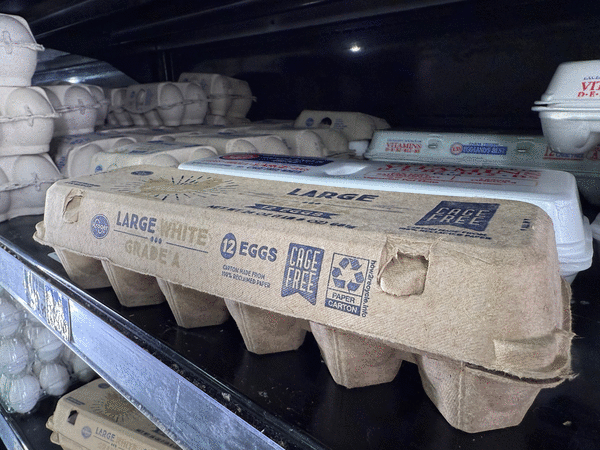
LANSING, Michigan — The U.S. Department of Justice is suing the state of Michigan over its prohibition on eggs laid by caged hens, arguing it is the responsibility of the federal government alone to regulate eggs bought and sold over state lines.
In a lawsuit filed Thursday, the Trump administration named the state of Michigan, Attorney General Dana Nessel and Michigan Department of Agriculture and Rural Development Director Tim Boring as defendants in the case, which the Justice Department says is in part triggered by cost-of-living increases made more burdensome by unnecessary regulations like the one in Michigan.
"The state of Michigan has contributed to the historic rise in egg prices by imposing unnecessary red tape on the interstate market for eggs," according to the complaint filed in U.S. District Court's Western District of Michigan. "At issue here is Michigan's ban on selling eggs that fail to meet certain state-imposed criteria."
The case was assigned to U.S. District Judge Jane Beckering, an appointee of Democratic former President Joe Biden.
Michigan's cage-free egg law went into effect Dec. 31, 2024, and requires eggs sold in the state to come from hens raised in cage-free housing systems, including eggs imported into or out of the state for sale. The one exception to the law is the sale of eggs from farms with fewer than 3,000 egg-laying hens.
Nationally, egg prices have gone from $4.95 per dozen of grade A large eggs in U.S. cities in January 2025 to $2.71 per dozen in December 2025, according to the U.S. Bureau of Labor Statistics compiled by the Federal Reserve Bank of St. Louis.
Michigan is seventh in the nation for egg production, producing more than 5 billion eggs a year, some of which are sold to commercial customers who have demanded cage-free eggs in recent years.
The law was passed more than 15 years ago, in 2009, and then expanded in 2019 in response to a pressure campaign from the Humane Society, which threatened a ballot initiative with stricter limits if lawmakers didn't pass cage-free legislation.
The 2019 legislation delayed implementation until Dec. 31, 2024, which happened to be in the middle of a statewide struggle against the highly pathogenic avian influenza.
When the Senate approved the legislation in 2019, Sen. Ed McBroom, a Republican from the Upper Peninsula, dissented and argued that the measure would raise the price of eggs and unconstitutionally restrict interstate commerce.
But Sen. Kevin Haley, a Republican from Lum in Lapeer County, said the main measure “synchronizes Michigan’s hen-housing law to state and national retail and restaurant commitments of only buying eggs from 100% cage-free farms by 2025.” The new law would be critical in helping "our farmers meet the industry demands and remain competitive in retail markets,” said Daley, the bill sponsor.
In its lawsuit Thursday, the Department of Justice maintained that when it comes to interstate commerce, it is the responsibility of the federal government alone to regulate the inspection and quality of eggs.
The lawsuit noted that Michigan is allowed to impose animal husbandry requirements on hens within its borders, but the law, because of its effect on eggs imported from other states, runs afoul of the federal government's jurisdiction over interstate commerce.
The federal Egg Products Inspection Act, passed by Congress in 1970, is intended to establish uniform egg standards, the lawsuit said.
"Michigan’s prohibition on selling eggs with certain disqualifying characteristics operates as a substantive standard on eggs themselves — one that disqualifies a category of eggs from interstate commerce based on state-imposed criteria that federal law does not recognize," the lawsuit said. "The Supremacy Clause does not permit such supplementary state regulation."
Cage-free housing means that hens are free to roam unrestricted in an indoor or outdoor environment, with the only allowable limits on that space being exterior walls, multi-tiered aviaries and enough space for employees to provide care to the hens while standing in their floor space. The law also requires those enclosures to include scratch areas, perches, nest boxes and dust bathing areas.
Advocates of the legislation had long sought to eliminate the use of “battery cages,” or stacked cages that give a hen about as much space as an 8.5-inch by 11-inch sheet of paper to move about.
©2026 www.detroitnews.com. Visit at detroitnews.com. Distributed by Tribune Content Agency, LLC.










Comments