Bay Area ban on new natural gas water heaters, set to take effect in seven months, may be relaxed over cost concerns
Published in Business News
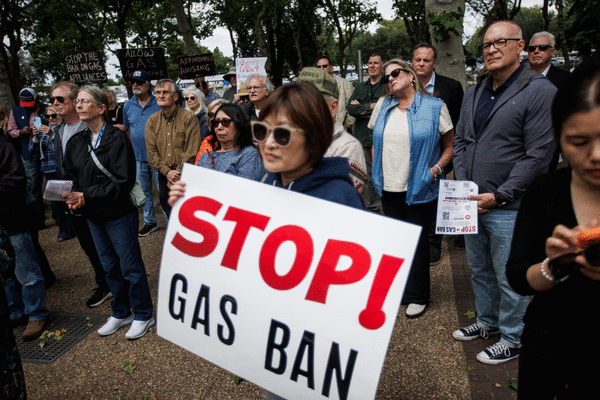
Bay Area air regulators have touted sweeping new rules that ban the installation of natural gas-powered water heaters and furnaces as a way to reduce smog and greenhouse gas emissions.
But with polls showing Americans’ top concern is the rising cost of living — and residents facing a roughly $3,500 cost increase for new electric heat pump models once traditional tank water heaters are prohibited — a plan is afoot to turn down the temperature on the ban.
On Wednesday, the board of the Bay Area Air District, a government agency based in San Francisco, was scheduled to discuss softening the first-in-the-nation rules, which are set to take effect Jan. 1, to allow exemptions for low-income residents and for people who would need significant, expensive upgrades to their electrical breaker panels or structural changes in their homes to comply.
The board, made up of 24 city council members and county supervisors from around the Bay Area, is scheduled to make a final decision in October. But this week’s meeting to discuss options is expected to draw passionate testimony from people on both sides of the issue.
Environmental groups, who cheered the regulations in 2023, say the new proposal strikes a fair balance.
“We are talking about a major source of pollution that needs to be addressed for public health and for climate,” said Melissa Yu, a senior field organizer with the Sierra Club. “This policy helps our region move forward while giving people the time and flexibility needed.”
A report from the air board’s staff concluded that water heaters and furnaces in the Bay Area generate 3,690 tons of nitrogen oxides a year, a key component of smog. That’s more than all passenger vehicles in the Bay Area, the agency says, which emit 3,464 tons a year.
The rule to ban the sale and installation of all gas-burning furnaces would start Jan. 1, 2029, followed by a ban on gas-powered tankless water heaters Jan. 1, 2031. Combined, the new regulations would prevent between 37 and 85 deaths a year and avoid 15,000 asthma attacks a year in the Bay Area, the staff has calculated.
The water heater rules apply to any owner of a home or apartment who replaces a hot water heater after Jan. 1, 2027. They don’t apply to stoves or other appliances.
But business and real estate groups say the entire plan needs to be scrapped and a new program drawn up that doesn’t impose such a high price tag on already financially strapped residents.
“These costs are real,” said Rufus Jeffris, a spokesman for the Bay Area Council, an organization that represents more than 375 of the region’s largest employers. “The Bay Area is a very expensive place to live. People have been forced to leave. It’s important that we take a look at how policies are financially impacting residents and business.”
A 2024 study by the air district found that it costs $3,575 on average to install a standard natural gas tank water heater in a single-family Bay Area home. The average electric heat pump water heater was estimated to cost $7,071 — a difference of $3,496.
The same 2024 study found that the average cost to replace a gas furnace in a single-family home is $6,347 in the Bay Area. The cost and installation of an electric heat pump appliance ranged between $17,122 and $20,408.
Former President Joe Biden put in place multiple programs to fund rebates and tax credits for people who install solar power, heat pumps and renewable and low-pollution energy equipment. Many of them, however, have been blocked or killed by the Trump administration.
Some credits and rebates still exist from the state, cities and utilities. They range from a few hundred dollars to a few thousand, depending on income level and location. They can be found at www.switchison.org — a coalition of environmental groups and contractors supporting the shift to electric appliances.
Over the past year, some traditionally Democratic areas have backed away from rules phasing out gas appliances as concerns about the rising price of utilities, rent, food and gasoline have grown.
Last June, the South Coast Air Quality Management District board in Los Angeles voted 7-5 to reject a proposal like the Bay Area’s to phase out residential gas-powered water heaters and furnaces in the Los Angeles basin.
A few months before, voters in Berkeley in November 2024 overwhelmingly rejected Measure GG, a proposed tax on natural gas use in buildings of 15,000 square feet or larger. Environmental groups said the tax would help pay for heat pumps, solar energy and other technologies. But critics said it would saddle hospitals, nonprofit groups and even the YMCA with hundreds of thousands of dollars in new fees.
Last November, New York Gov. Kathy Hochul, a Democrat, delayed the implementation of new rules in New York banning natural gas, propane, and heating oil-based appliances set to take effect Jan. 1.
“My number-one focus is affordability right now,” Hochul said at the time.
A poll in February by the non-partisan Public Policy Institute of California found that 71% of Californians said their incomes are not keeping up with inflation. California’s cost of living is the highest in the U.S. in many studies, with housing prices, gasoline costs and utility rates at or near the most expensive in the nation.
Environmental groups note that new electric heat pumps run more efficiently than older gas appliances. A study done in February 2025 by Silicon Valley Clean Energy found that the average resident of a single-family home in Santa Clara and San Mateo Counties would save $19 a month or $228 a year using an electric heat pump water heater compared to a traditional gas one.
Critics note that in houses built before 1980, the electrical panel may need to be upgraded or replaced to handle heat pumps. That can cost $2,500 to $5,000.
“We should incentivize it. Give people rebates, give them tax credits. But don’t make it mandatory,” said former San Jose city councilman Johnny Khamis, who spoke at a rally in San Jose Tuesday opposing the rules. “I drive an electric car. I have solar panels on my house. But I can afford it. The air district seems to have no feeling for people who are retired, or people living paycheck to paycheck.”
Environmental groups know they are at a delicate time politically.
“People all around California and even some outside the state will be watching what the Bay Area Air District does,” said Bill Magavern, a policy director with the Coalition for Clean Air, a Los Angeles nonprofit. “It’s important for the district to keep the momentum going, and that this transition be done in an equitable way so that low-income people are not hurt by it.”
©2026 MediaNews Group, Inc. Visit at mercurynews.com. Distributed by Tribune Content Agency, LLC.





Comments