US House proposes sweeping EV fee, adding to existing state charges
Published in Business News
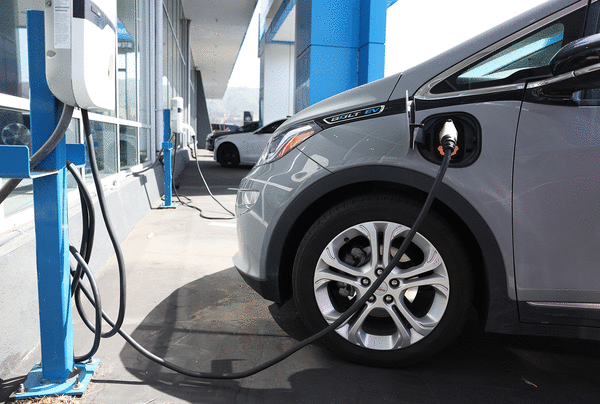
WASHINGTON — The U.S. House has proposed an annual, nationwide registration fee of $130 for electric vehicles to help address weakening reserves for federal road maintenance.
The fee would eventually rise by $5 every two years beginning in 2029, with a maximum fee of $150. The proposal also calls for a $35 fee on plug-in hybrid models, to be eventually capped at $50.
"(T)he BUILD America 250 Act ensures that electric vehicle owners begin paying their fair share for the use of our roads," said U.S. Rep. Sam Graves, R-Missouri, who chairs the House Committee on Transportation and Infrastructure.
The upcharge had previously been floated on Capitol Hill as lawmakers raised concerns that EV drivers — who do not pay for gas, and therefore do not pay federal gas taxes that finance roadwork — were benefitting from American roads without sufficiently contributing to their upkeep.
Most states already impose similar fees on EVs to address the issue below the federal level.
Michigan, notably, has the highest EV charges in the country after lawmakers hiked fees in 2025 as part of a road funding plan. The fees in 2026 are $267 (up from $160) for EVs and $113 (up from $60) for plug-in hybrids that travel short distances on electricity before switching to gas.
The House proposal for an additional federal EV charge on top of state charges was part of a bipartisan compromise on a sweeping surface transportation reauthorization bill. The U.S. Senate has not yet put together a proposal.
Congress typically passes a reauthorization bill once every five or six years to set funding levels for federal highway, transit and safety programs. The last one to pass was the Infrastructure Investment and Jobs Act, also known as the Bipartisan Infrastructure Law, in 2021.
The Zero Emission Transportation Association, a pro-EV lobbying group in Washington with prominent members like automaker Tesla Inc,, battery giant LG Corp. and utility operator Duke Energy, slammed the proposal in a Monday statement.
"While ZETA understands the need to maintain the solvency of the Highway Trust Fund, the proposed EV fee in the surface transportation reauthorization bill — starting at $130 and increasing to $150 by FY36 — is simply a punitive tax that would disproportionately impact adopters of electric vehicles, with no meaningful impact on maintaining the (fund)," ZETA Executive Director Albert Gore said.
He continued: "Drivers of gas-powered vehicles pay approximately $73 to $89 in federal gas tax each year. The proposed fee would charge an unfair premium on EV drivers, at a time when all Americans are looking for ways to save money.
"This is particularly concerning as the EV fee will increase to $150 by 2035 — nearly double what gas car drivers would pay in a year. This fee lands on top of the road use taxes that many EV drivers already pay at the state level."
The nonpartisan Congressional Research Service wrote in a report last year that while annual revenue flowing to the federal Highway Trust Fund has increased in nominal terms since its creation in 1983, collections have not kept pace with inflation.
"The purchasing power of revenue in (fiscal year) 2023 was the lowest since FY1984," the report noted. It also described an imbalanced budget that could jeopardize infrastructure projects by the end of the decade.
"Since FY2001, expenditures from the highway account have exceeded revenue. The persistent gap between the highway account's revenue and expenditures has raised questions about its long-term sustainability," report author Ali Lohman wrote.
She added: "Based on current trends, the Congressional Budget Office (CBO) projects that in FY2028, the highway account may not have sufficient funds to fulfill federal obligations to states and local governments for transportation projects."
Despite the persistent budgetary gap and inflation eating into the real-world purchasing power of tax dollars, Congress has not raised fuel taxes since 1993.
©2026 www.detroitnews.com. Visit at detroitnews.com. Distributed by Tribune Content Agency, LLC.










Comments