A shot to fix Chicago's parking meter deal? Aldermen test chances amid sale
Published in Business News
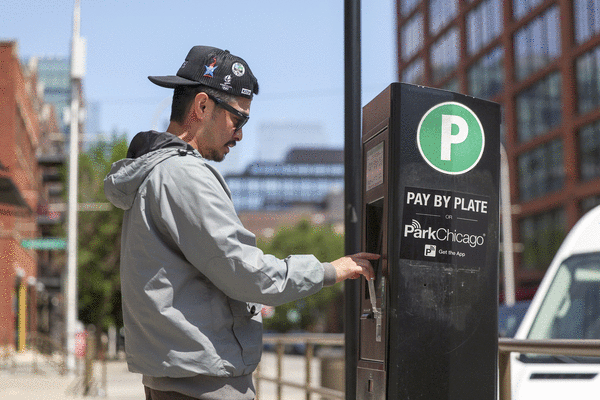
As aldermen weigh a long-shot chance of reworking Chicago’s infamous parking meter deal, some are citing one firm point.
“The worst-case scenario is the status quo,” Ald. Walter “Red” Burnett, 27th Ward, said.
But they are hoping to do better than that.
Several council members are attempting to find ways to force Stonepeak Partners, a New York investment firm aiming to buy the much-loathed lease from Chicago Parking Meters LLC, to at least tweak the terms. Chicago drivers who are looking at decades of ever-increasing parking rates — with the money continuing to go into the pockets of a private company rather than the city’s coffers — would cheer any change in their favor.
Among the possible leverage points some are considering is a clause in the meter deal that allows the council to consider “the background and reputation” of the proposed operator. Stonepeak, aldermen have noted, owns an air freight company with a subsidiary that carries out deportation flights for U.S. Immigration and Customs Enforcement. That background puts the company starkly at odds, they argue, with policies and values in Chicago that seek to oppose ICE activities.
Aldermen are planning to consider their options in a public hearing and are in the process of retaining legal and financial advisers to determine what, if anything, they could score.
The notorious 2008 privatization scheme, masterminded by then-Mayor Richard M. Daley and rushed through the City Council in three days, sold a 75-year lease for a $1.15 billion cash payout. Aldermen at the time voted 40-5 to approve the deal.
That lump sum pales in comparison with what the lease has already made for the parking system’s private owners, led by Morgan Stanley, alongside Deeside Investments, a firm reportedly nearly half owned by the Abu Dhabi Investment Authority. According to an audit published in April, it earned a record $189 million in revenue last year alone — meaning it has now made over $2 billion since the doomed sale.
But the pending transaction announced three weeks ago must be approved by aldermen. That requirement could give them power to better the city’s rotten hand, even if only in a small way, some aldermen believe.
“I think it’s important for us to do a thorough investigation and also make sure that we get proper legal and financial advice on this,” said downtown Ald. Bill Conway, 34th Ward, vice chair of the City Council Finance Committee that is now considering the transfer.
Even the most optimistic admit they cannot score a wholesale change to the legally sturdy lease, but they nonetheless point to the documents governing the parking system to argue that they have the power to say “no,” while adding they have little to lose.
Conway nods to sweeping language included in the original contract that says any sale must be approved by aldermen, “notwithstanding” any other rules.
“City Council is not some ministerial rubber stamp in this process,” he said.
It’s a view backed by Renee Hatcher, a University of Illinois Chicago School of Law professor who shared with aldermen a memo detailing the argument that they have wide latitude to approve or reject the transaction.
In her view, while Mayor Brandon Johnson may be tied up by requirements in the city’s original lease contract that he advance a sale, aldermen “are not subject to any type of standard or not inhibited to vote any particular way, given the deal.”
“It’s a leverage point,” said Hatcher, who directs the law school’s Community Enterprise and Solidarity Economy Clinic. “They can certainly choose not to sell … and so I think aldermen have a responsibility to do their due diligence and to not pass the buck.”
The current lease imposes extensive burdens on Chicago that discourage the city from closing streets for festivals or removing parking spots to add bike lanes, especially without adding new metered parking spots elsewhere. The payments the city must make to the parking meters’ owner when it closes spots, called “true-ups,” totaled nearly $12 million last year.
Such rules governing how the city must treat the system have proved inescapable.
When Lori Lightfoot was mayor, she tried to sweeten the deal by carrying out an arbitrage scheme to take advantage of fluctuating meter values and suspending meter enforcement at the start of the COVID-19 pandemic. The city settled a legal challenge over Lightfoot’s efforts by paying the system’s owners $15.5 million and agreeing to allow “enhanced enforcement.”
With paid parking and eager ticketing agents all over, many people are priced out of visiting different neighborhoods and closer to being unable to afford living in the city, Hatcher said.
“If the City Council isn’t willing to look out for the interest of residents, then whose responsibility is that?” she asked.
The original contract bars the city from “unreasonably or arbitrarily” withholding approval of a sale and provides only narrow grounds for disapproval tied to a new buyer’s fitness to operate a parking system.
Johnson appeared to point to those rules last week, citing his Law Department to suggest the same rules that restrict him also restrict aldermen. The scope of review available to aldermen “is quite minuscule,” he said.
“There’s a reason why it was described as the worst ever deal in the history of not just municipal government but government, period: because it gave all of the control essentially to the vendor and took the control and the accountability away from the government body,” he said.
Asked about the City Council’s role in the sale, Stonepeak Senior Managing Director James Wyper did not address the possibility that aldermen could reject the deal and said the company looks forward to working with them.
“Stonepeak is excited about the opportunity to expand its investments in the city of Chicago, sees on-street parking as a critical component of the city’s evolving transportation network, and believes it will remain an essential part of its infrastructure for decades to come,” Wyper said.
But Burnett, a first-year alderman Johnson appointed in September to succeed Burnett’s father, struck a more confident tone. He conceded that the mayor is contractually obligated to “push things along,” but argued that the council gets to approve the transaction — “point blank, period, full stop” — without facing the same restrictions.
“At the minimum, we have a right to do our diligence on the buyer and the transaction,” Burnett said. “This is coming up to a council vote. It’s not just a rubber-stamp vote.”
Aldermen could push for a transfer fee for the sale or try to lessen the cost of true-up payments, he said.
They could also take issue with Stonepeak’s connections to the federal government’s immigration enforcement efforts, he added, nodding to a part of the city’s contract that allows the approval process to consider “the background and reputation” of the proposed operator.
Last year, Stonepeak purchased Air Transport Services Group, a $3.1 billion air freight company that owns charter flight airline Omni Air International. The subsidiary company’s work includes deportation flights for U.S. Immigration and Customs Enforcement.
The flights that carry out ICE deportations could conflict with the goals Johnson and many aldermen have shared since immigration agents flooded the city last fall, said Matt Parr, spokesperson for the Chicago-based Private Equity Stakeholder Project, a nonprofit watchdog organization that has researched Stonepeak’s holdings.
“There have been reports and allegations of migrants about prolonged shackling and inadequate food and water and medical issues on these deportation flights,” Parr said.
Persuading enough aldermen that they can and should seek bargaining power to improve the parking meter deal would be a daunting challenge in a deeply divided City Council where little has gotten done in recent months.
Some aldermen already believe there is no shot at better terms.
“This is an ironclad agreement,” said Ald. Scott Waguespack, 32nd Ward, one of only five aldermen to vote against the original 2008 deal, and the only one still in the City Council. “It always was.”
Waguespack said the message from Johnson’s administration has been simple: The City Council votes on this, and the mayor is out of the picture.
That’s in part because Johnson signed a confidentiality agreement when the city engaged in talks to buy the parking meter system itself in January, Waguespack said. Shortly after reports of the talks surfaced, Johnson abandoned the pursuit and said the purchase would be too expensive.
Waguespack does not believe aldermen can consider Stonepeak’s connection to ICE. And in his view, aldermen must vet the company only for its ability to operate a parking system.
“Most of the attorneys we’ve talked to have said that you can’t just go and break open the contract,” he said. “It’s not like you can just pick one article and say, ‘We’re going to blow this thing wide open.’ Otherwise we would have done this 15 years ago.”
He criticized the administration for being too slow to inform aldermen of the deal and delaying their analysis. Johnson spokesperson Allison Novelo said the administration informed aldermen “at the earliest practicable opportunity.”
“The Council is an independent body with the ability to advance expectations for its review,” Novelo wrote in a statement Friday.
Ald. Pat Dowell, 3rd Ward, chair of the Finance Committee, canceled a meeting planned for last Wednesday to publicly examine the sale and possibilities to allow for more time to answer questions about the City Council’s limitations.
Aldermen are securing legal and financial advisers and submitting questions about the sale, she said. The meeting has been rescheduled for June 15.
©2026 Chicago Tribune. Visit at chicagotribune.com. Distributed by Tribune Content Agency, LLC.









Comments